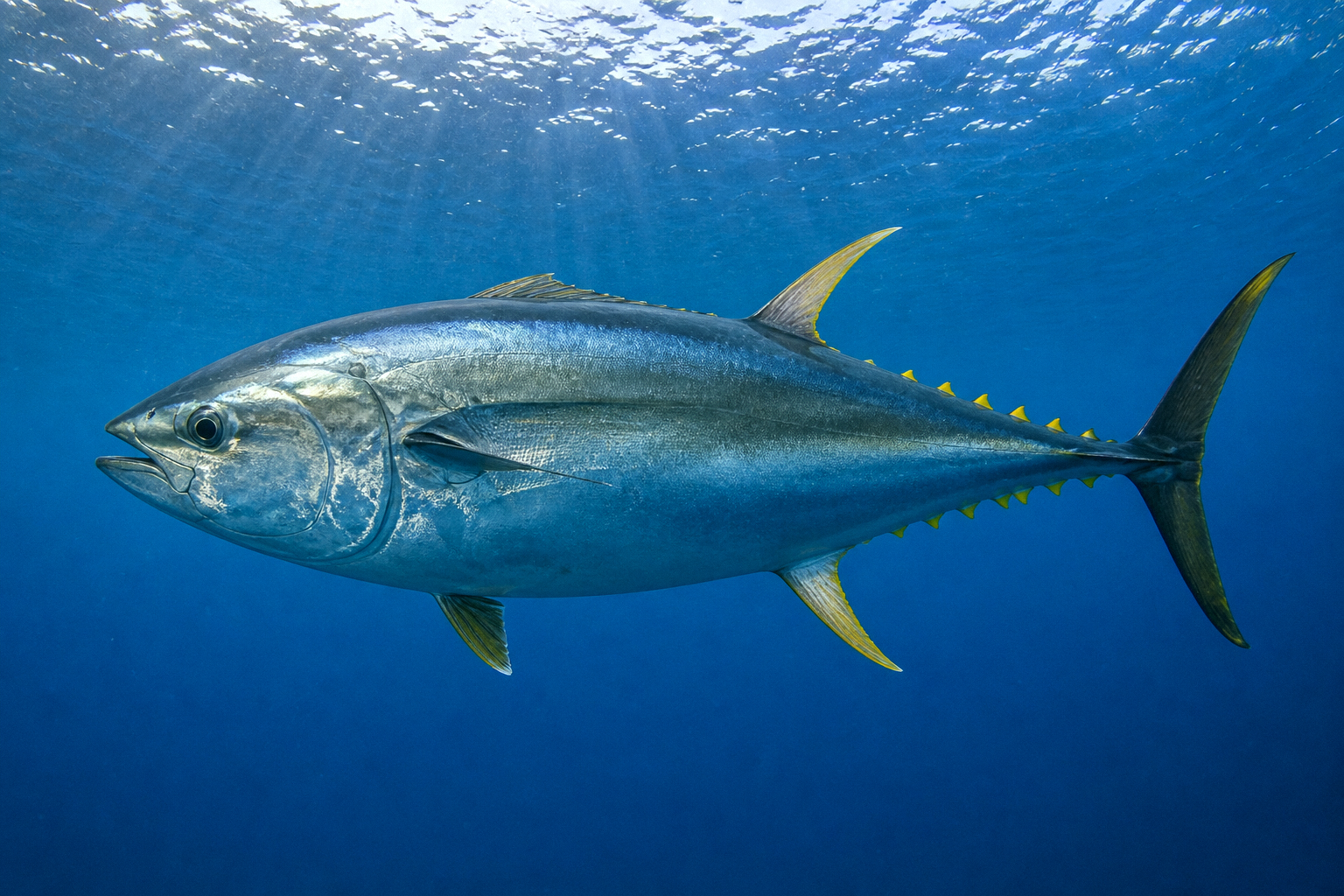
Yellowfin Tuna (Thunnus albacares)
Yellowfin tuna are the crown jewel of the Virginia offshore fishery. Every summer, the Gulf Stream waters off the Virginia Beach coast host some of the finest yellowfin fishing on the East Coast. These powerful, blazing-fast fish are the primary target of the charter fleet running out of Rudee Inlet and the Virginia Beach oceanfront. A single yellowfin can test an angler’s endurance to the breaking point, and a boat limit is a day etched in memory.
Identification
Yellowfin tuna are sleek, hydrodynamic torpedoes. The back is dark metallic blue, transitioning to silver on the sides and white on the belly. The namesake feature is the brilliant golden-yellow stripe running along each flank, matched by long, bright yellow dorsal and anal fins. The finlets are yellow with black edges. Virginia fish typically range from 30 to 80 pounds, with triple-digit fish caught every season. The pectoral fin extends further back than a bluefin’s — a key field mark for telling the two apart when size alone isn’t conclusive.
Habitat and Behavior
Yellowfin are pure pelagics, following warm Gulf Stream water along the edge of the continental shelf. Off Virginia, the Stream runs roughly 30 to 40 miles offshore from the Virginia Beach oceanfront, making this one of the closest Gulf Stream access points on the entire East Coast. Yellowfin track temperature breaks, weed lines, and bait concentrations along the western edge of the current. They school and feed aggressively on squid, flying fish, small tunas, and baitfish. Surface feeding is visible as breaking fish and diving birds — one of the most exciting sights in offshore fishing. Activity peaks at dawn and dusk, with a strong afternoon bite common as well.
Fishing Techniques
Trolling: The standard Virginia offshore approach is trolling rigged ballyhoo behind a spread of lures. Run six to eight lines at 6.5 to 7.5 knots. A mix of skirted ballyhoo, cedar plugs, and small artificials like the Joe Shure or Green Machine covers the water column. The key is locating temperature breaks and color changes where yellowfin are actively feeding.
Chunking: When yellowfin are found feeding on the surface, the boat stops and butterfish chunks go over the side to hold the school. Anglers then drop chunks on a hook or jig directly into the feeding frenzy. This is as visceral as fishing gets — watching yellowfin eat chunks next to the boat before the line comes tight.
Baits and Lures
Ballyhoo rigged on a circle hook with a skirt is the universal yellowfin trolling bait. Secure with a rubber band or rigging floss and troll at 6.5 to 7.5 knots. Skirt colors in dolphin/yellow-and-green, blue/white, and pink/white are Virginia standards.
Cedar plugs trolled in the spread are yellowfin killers. Run them naked or with a small skirt in the shotgun or long rigger position. They produce when nothing else will.
Butterfish chunks are the key to chunking. Cut into bite-sized pieces and deploy on a 6/0 to 8/0 circle hook on 80- to 100-pound fluorocarbon leader. Let the chunk drift naturally in the current among the feeding fish.
Tackle Recommendations
- Rod: 6.5-foot, 50- to 80-pound class trolling rods for trolling; 6-foot, 50-pound class rod for chunking
- Reel: Conventional reels like Shimano Tiagra 50W or 30W with 50- to 80-pound braid or mono
- Leader: 80- to 100-pound fluorocarbon for chunking; 150- to 200-pound mono for trolling
- Hook: 6/0 to 8/0 circle hooks for chunking; rigged hooks for ballyhoo
Best Times and Locations on the Chesapeake Bay
Yellowfin season runs June through October, with peak action in July and August. Key departure points and locations:
- Rudee Inlet — closest Virginia access to the Gulf Stream
- Virginia Beach oceanfront marinas — primary fleet for yellowfin trips
- Norfolk Canyon — deep-water structure that stacks yellowfin
- Washington Canyon — productive ledge system to the northeast
- 100-fathom curve along the western edge of the Gulf Stream
- Temperature breaks and color changes — the most reliable indicators of yellowfin presence
Regulations
Yellowfin tuna are managed under the federal Atlantic Highly Migratory Species program administered by NOAA. The recreational bag limit is 3 per vessel per day with a minimum size of 27 inches curved fork length. An HMS permit is required for the vessel, and anglers must carry a recreational HMS angling permit. Regulations can change seasonally — always verify current NOAA HMS rules before your trip. Yellowfin are also subject to international management through ICCAT. Carry a copy of your HMS permit and be prepared for a NOAA enforcement boarding.