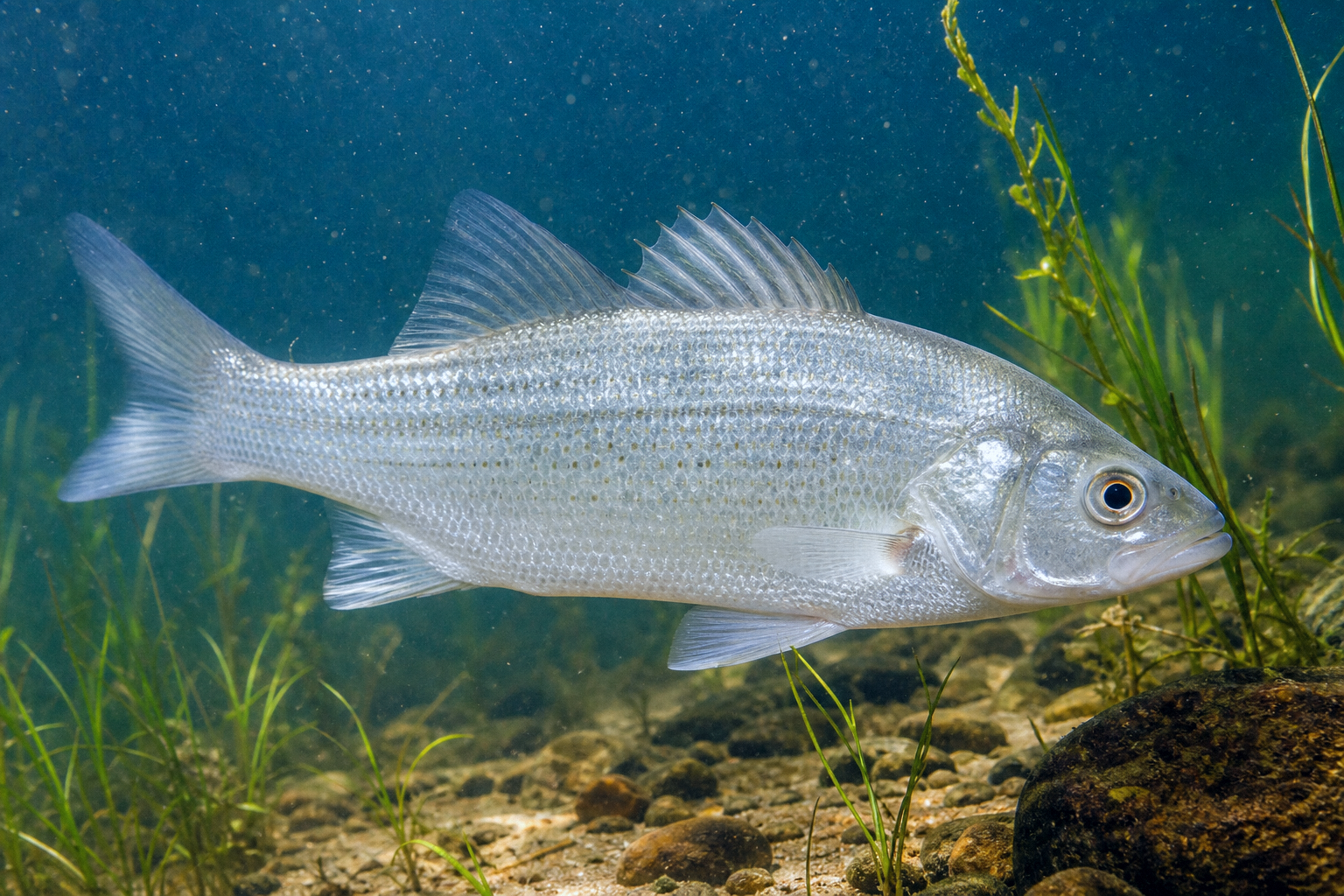
White Perch
Identification
White perch are the Chesapeake’s everyman fish — a small member of the temperate bass family, cousins to striped bass but without the stripes or the size. The body is silvery-green to olive-gray with a lighter belly, gently compressed, with a moderately forked tail. The two dorsal fins — spiny first, soft-rayed second — connect at the base, and the first dorsal carries 8 to 10 spines. Most Virginia white perch run 8 to 12 inches and weigh a half-pound to a pound and a half, though fish pushing 2 pounds come from the James and York river systems. They’re not true perch despite the name; they’re Moronidae, related to stripers and white bass.
Habitat and Behavior
White perch are one of the most abundant and underappreciated gamefish in Virginia waters. They’re semi-anadromous, living primarily in the brackish Chesapeake Bay and its tributaries and pushing into fresher water to spawn each spring. Their salinity tolerance is remarkable — they thrive from nearly fresh to moderately brackish. White perch school aggressively in large numbers and orient to structure: bridge pilings, creek mouths, channel drop-offs, submerged timber, dock posts, and riprap. They feed on small fish, shrimp, crabs, and aquatic insects. In the Bay and its rivers, white perch are a staple for local anglers, providing steady action when other species aren’t cooperating and filling stringers for the fryer.
Fishing Techniques
White perch are eager biters that will hit almost any small offering. Bottom fishing with pea-sized pieces of shrimp or bloodworm on a two-hook chicken rig is the most common method — drop near structure and wait for the tap-tap bite. Small jigs of 1/16 to 1/8 ounce in chartreuse, white, or pink, tipped with shrimp or bloodworm, are deadly when cast around bridge pilings and creek mouths. Sabiki rigs tipped with shrimp catch perch when they’re schooled up. A slip bobber suspended 3 to 5 feet deep works well in calm water around docks. Ultralight spinning gear transforms white perch fishing — even a 10-inch fish puts up a respectable fight on 4-pound line.
Baits and Lures
Fresh shrimp cut into pea-sized pieces is the universal Virginia white perch bait — cheap, available, and effective. Bloodworms and sandworms are excellent but pricier. Grass shrimp, when available, are a top natural bait that perch devour. Small tube jigs and curly-tail grubs in 1- to 1.5-inch sizes, in white, chartreuse, and pink, work well for active fish. Tiny spinners like a Rooster Tail in size 0 or 1 can be effective in creeks. Cut herring or menhaden in small pieces catches perch when they’re feeding on baitfish. For fly anglers, small white or chartreuse Clousers and woolly buggers on a slow retrieve produce around Bay structure.
Best Times and Locations on the Chesapeake Bay
White perch are catchable year-round but peak from March through June during the spawning run and again in October and November as water cools. The Chesapeake Bay is the heart of Virginia white perch fishing. The bridge pilings at the James River Bridge, the York River crossings, and the Nansemond River are reliable producers — fish around the pilings with shrimp on a bottom rig. The creeks feeding the lower Bay — particularly around Hampton, Newport News, and the Middle Peninsula — hold good populations. Back Bay and the canals of the Northwest River area offer accessible bank-fishing for perch. The Eastern Shore creeks behind Kiptopeke and around Cape Charles produce as well. Spring is the peak: perch move shallow to spawn and feed aggressively.
Regulations
White perch carry no minimum size limit and no daily creel limit in most Virginia inland and joint waters, making them an ideal species for keeping a mess of fish for a fry. Some water bodies may have specific regulations, so always verify current Virginia DWR and VMRC rules. White perch are managed jointly between DWR (inland) and VMRC (coastal/joint waters). A valid Virginia fishing license — inland, coastal, or unified — is required depending on the water body. White perch are excellent eating: firm, mild white meat that’s delicious fried, baked, or in chowder.