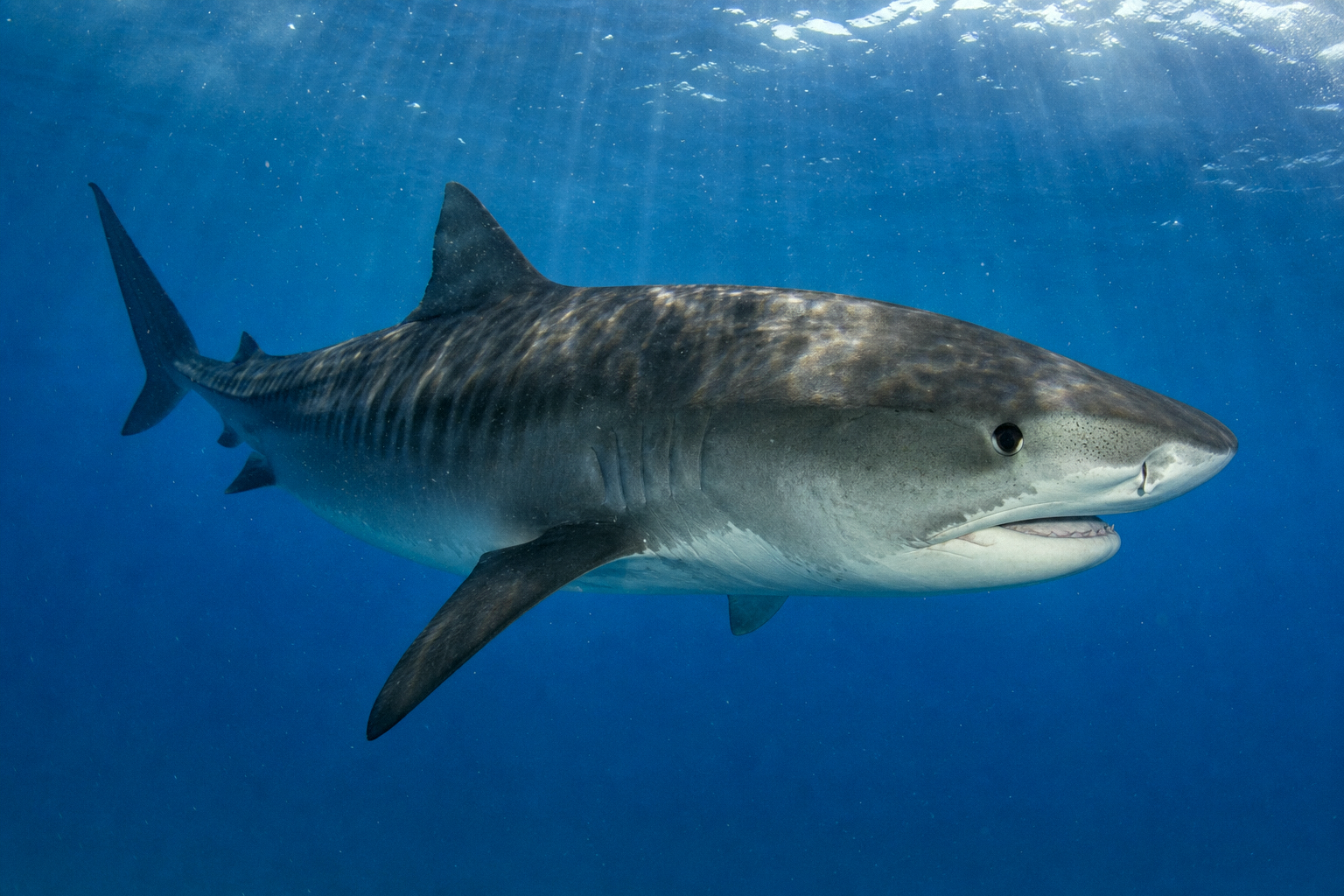
Tiger Shark
Identification
The tiger shark is the heavyweight of Virginia’s coastal shark lineup — capable of reaching 12 to 14 feet and exceeding 800 pounds. The body is thick and blunt, with a squared-off snout and a broad, almost rectangular head. The signature feature is the pattern of dark vertical bars and stripes across the back and flanks, sharp and vivid in younger animals, fading to ghostly outlines in the largest specimens. The dorsal fin is tall and distinctly sickle-shaped. The tail is long and powerful with an elongated upper lobe. When a tiger shark materializes behind a bait in the Virginia Beach surf, there’s no mistaking it — the sheer mass and those stripes set it apart from every other shark in the water.
Habitat and Behavior
Tiger sharks are nomadic apex predators that move into Virginia waters as the Atlantic warms in early summer, staying through fall. They favor deeper nearshore zones, inlet mouths, and the outer sandbars where baitfish, rays, and smaller sharks concentrate. Their diet is famously indiscriminate — fish, sea turtles, rays, seabirds, other sharks, and virtually anything else they encounter. They hunt primarily at night, becoming most active from dusk through dawn. Tigers are curious and will investigate almost anything in their path. In Virginia, the most consistent encounters come from Sandbridge and the outer bars off the Eastern Shore, where deep water swings close to the beach.
Fishing Techniques
Targeting tiger sharks from the Virginia Beach surf is land-based shark fishing at its most demanding. The gear requirements are extreme: a 13-foot or longer surf rod, a large conventional reel like a Penn Senator 6/0 or equivalent heavy spinning setup, 50- to 80-pound braid main line, and a wire cable leader of at least 150-pound test. A fish-finder rig with 8 to 12 ounces of lead holds bottom in the strong currents off Sandbridge. The standard method is kayak deployment — one person paddles a large bait beyond the outer bar into deep water while the angler manages the line from shore. This is a team operation. Night fishing is essential for consistent results. For boat anglers, drifting or anchoring with large baits in deep water near the beach or in the CBBT channels produces encounters.
Baits and Lures
Tiger sharks demand large, fresh baits. A whole fresh menhaden, a live bluefish, or a large mullet is the standard offering. Bigger is better — tigers are drawn to substantial meals. Fresh tuna or bonito chunks from charter boat discards are excellent. The scent trail from a large, bloody bait is what pulls a tiger from a distance. Baits should be fished on the bottom or suspended just above it. Use 10/0 to 12/0 circle hooks on heavy cable leaders. Frozen or stale bait won’t cut it — freshness is critical for attracting these wary giants.
Best Times and Locations on the Chesapeake Bay
Tiger sharks are summer and fall visitors, most commonly encountered from June through October. Sandbridge is the premier land-based tiger shark location in Virginia — the deep-water proximity that makes it unique on the mid-Atlantic coast is exactly what tigers need. The beaches from False Cape south toward the North Carolina line also produce. Rudee Inlet and the deeper channels around the CBBT hold tigers during peak summer. The Eastern Shore side, particularly the outer bars off Kiptopeke and Fisherman’s Island, can produce encounters. Fish from late evening through the night, especially around the new moon when darkness is greatest. Tide changes during the night hours are the most productive windows.
Regulations
Tiger sharks are prohibited from recreational harvest in Virginia state waters — catch and release only. They’re managed as a prohibited species under the federal shark management plan. If you hook a tiger, handle the situation with extreme care. Keep the shark in the water at all times — never drag a large tiger onto the beach. Use a dehooker or cut the leader as close to the hook as possible. Support the shark’s body in the water, allow it to recover, and let it swim away under its own power. Large tigers can take 15 minutes or more to revive properly. Report tag data to NOAA if the shark carries one.