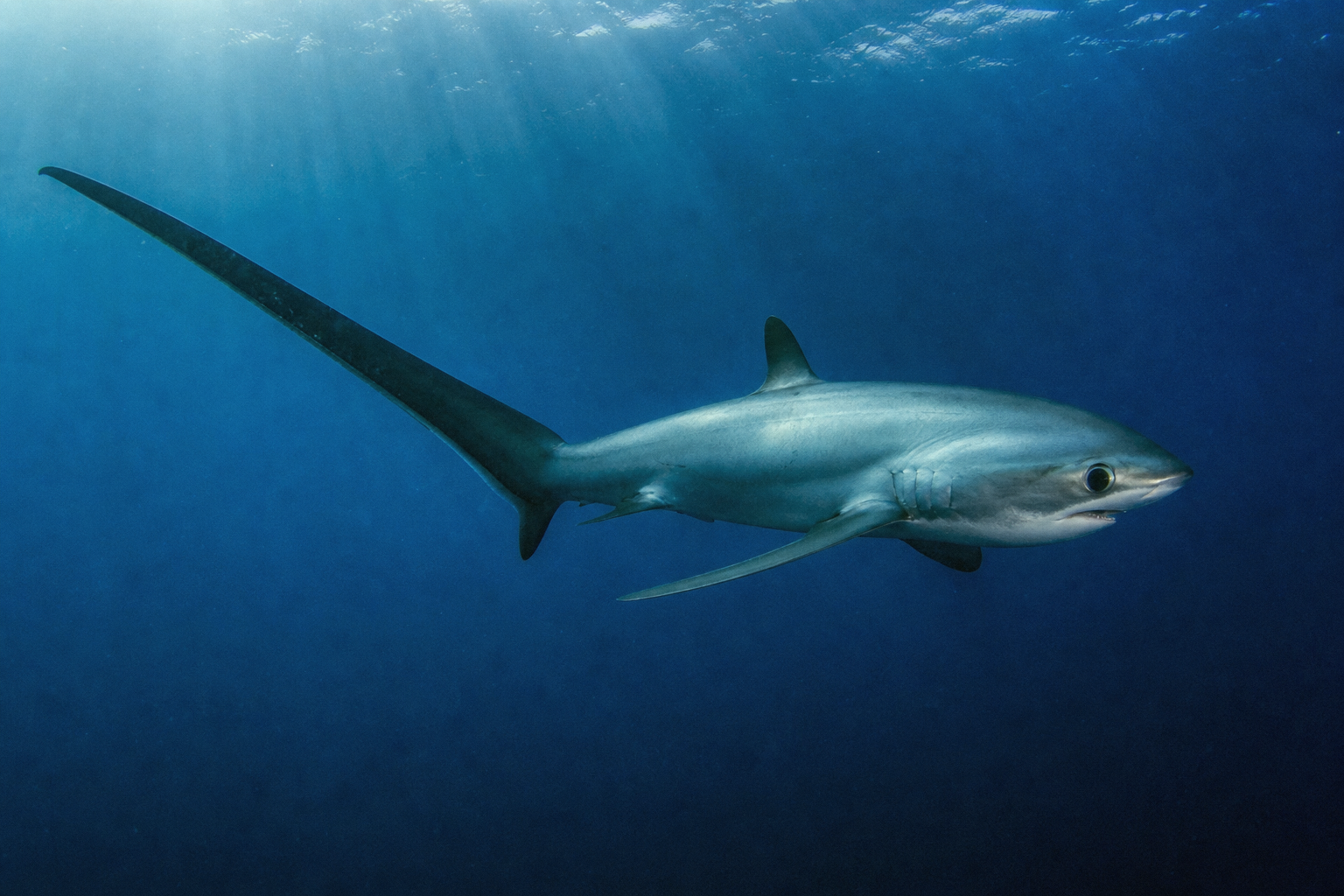
Thresher Shark
Identification
The thresher shark is impossible to mistake. Its upper tail lobe stretches as long as the body itself — a 10-foot thresher is half tail. The body is sleek and muscular, colored dark metallic blue-gray to purplish above and pale below. The dorsal fin is modest and set far back, the pectoral fins are long and swept, and the snout is short and conical. Threshers typically reach 10 to 15 feet overall, and they’re among the fastest sharks in the ocean. When one launches clear of the water — and they do, frequently — the tail whips through the air like a scythe.
Habitat and Behavior
Threshers patrol the nearshore and offshore waters off Virginia Beach, favoring the Gulf Stream edge, artificial reef sites, wrecks, and hard-bottom ledges. They’re less common in the surf than other local shark species, but Sandbridge’s unique geography — deep water close to the beach — makes land-based encounters possible. The thresher’s tail does real work: they use it to herd and stun schooling fish, lashing through balls of menhaden or bluefish with a single whip that cripples multiple prey at once. They feed primarily on schooling baitfish, squid, and pelagic forage. Activity peaks at dawn and dusk, though they hunt throughout the day.
Fishing Techniques
Thresher sharks are primarily a boat-fishing target in Virginia waters. Drifting live baits near wrecks, reefs, and temperature breaks along the Gulf Stream edge is the most productive approach. Heavy conventional gear is required — a 50- to 80-pound class trolling outfit with at least 80-pound wire leader. Threshers are spectacular fighters: blistering runs, acrobatic jumps, and tail-thrashing at the surface. The fight demands a smooth drag and steady pressure. For surf anglers, threshers are occasionally hooked at Sandbridge during summer nights when large baits are kayaked into deep water beyond the outer bar. This is a rare and demanding pursuit requiring the heaviest surf gear available — 13-foot rods, large conventional reels, and 80-pound braid minimum.
Baits and Lures
Live bait is the top producer. A live bluefish or menhaden drifted near structure is the gold standard. Threshers hunt by sight and speed, so a lively bait that creates vibration and flash is ideal. Fresh mackerel strips and whole mullet work when live bait isn’t available. For trolling, rigged ballyhoo or mullet strips pulled at moderate speed near temperature breaks can draw strikes. Threshers have relatively small mouths for their body size — a 6- to 8-inch live bait or comparable strip is the sweet spot. Use 8/0 to 10/0 circle hooks.
Best Times and Locations on the Chesapeake Bay
Threshers are present in Virginia waters from May through November, with the best window June to October. The nearshore waters off the Virginia Beach coast and the Gulf Stream edge are the primary boat-fishing zones. Sandbridge is the only surf location where threshers are a realistic possibility, and even there it’s uncommon. The wrecks and artificial reefs off the CBBT and Rudee Inlet hold threshers during summer. The deeper sloughs and channels off False Cape and Back Bay can produce. Dawn and dusk are peak feeding periods. For boat anglers, temperature breaks and color changes along the Gulf Stream’s western edge are the most reliable indicators of thresher presence.
Regulations
Thresher sharks fall under the large coastal shark management group in Virginia. The minimum size is 54 inches fork length. The recreational bag limit is 1 shark per person per day, with a vessel limit of 1 shark per day combined across large coastal shark species. All sharks must be landed with head, tail, and fins naturally intact — no finning, no dismemberment. There is no closed season in state waters. Threshers are powerful but can exhaust themselves quickly; use appropriate heavy tackle to minimize fight time. Keep the shark in the water during release, support the body, and allow full recovery before letting it swim. Never lift a thresher by its tail — the elongated upper lobe is vulnerable to injury.