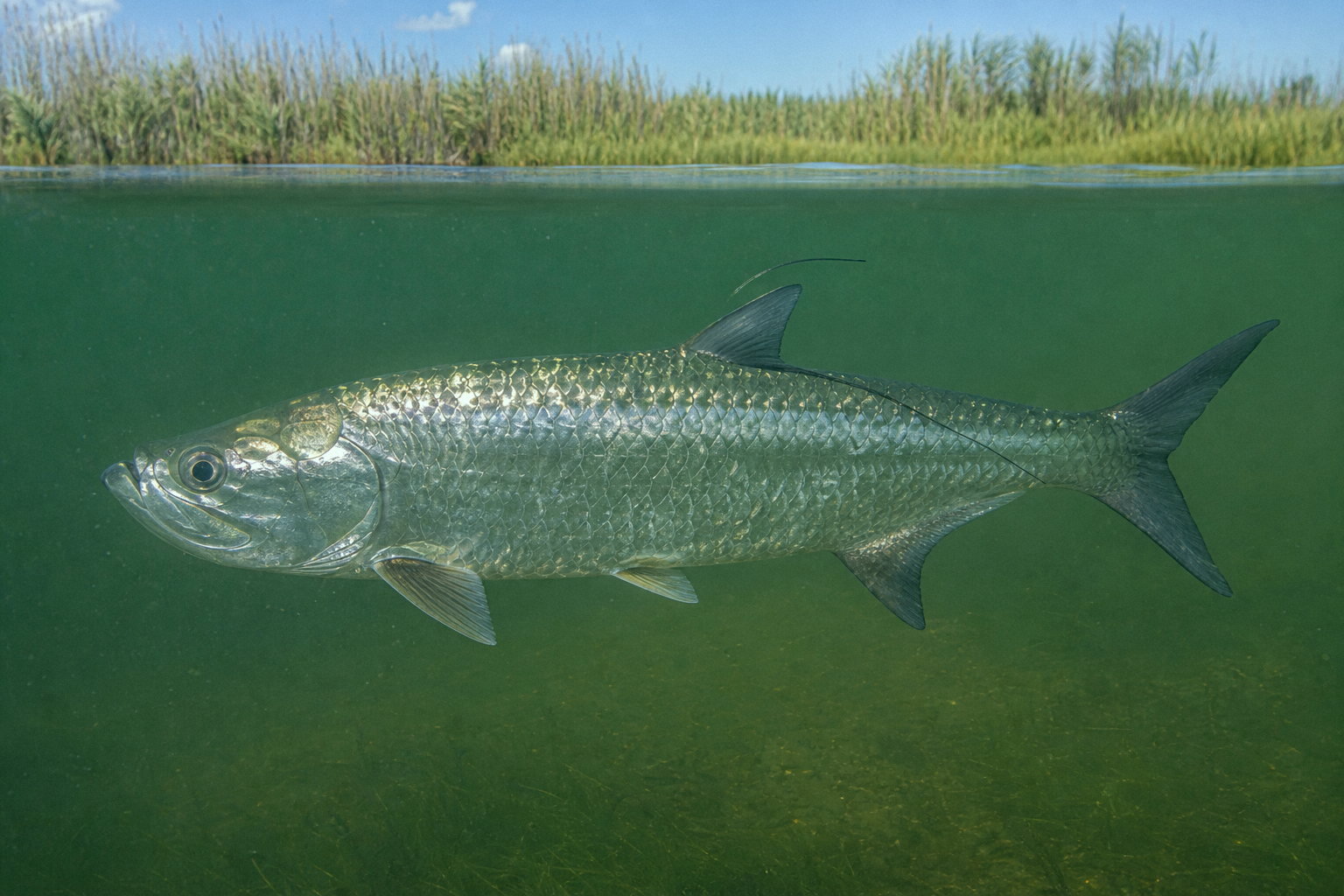
Tarpon
Identification
Few fish command the kind of reverence that tarpon do. These silver giants are built like armored plates — deep, slab-sided bodies covered in enormous mirror-like scales, a wide scoop of a mouth turned upward, and a dorsal fin whose last ray trails into a long filament. The back is dark blue-green to near-black, the flanks blazing silver, the belly white. Virginia tarpon commonly run 40 to over 150 pounds. The eyes are large and prehistoric-looking. And then there’s the jump: when hooked, a tarpon doesn’t just break the surface — it detonates through it, clearing the water by several feet in a shower of spray, gills rattling. It’s the reason anglers spend entire summers chasing them in the lower Bay.
Habitat and Behavior
Tarpon ride the Gulf Stream north as summer warms the Atlantic, reaching Virginia waters by June and lingering into early October. July and August are peak. They favor warm, brackish to fully saline environments and concentrate in the deeper channels of the lower Chesapeake Bay, particularly around the CBBT complex and the mouth of Rudee Inlet. Tarpon are obligate air-breathers — their modified swim bladder lets them gulp atmospheric oxygen, which means they thrive in low-oxygen backwaters where other large predators can’t follow. This behavior also makes them easy to locate: on calm mornings, look for fish rolling at the surface, exposing their broad backs and dorsal fins as they take a breath.
Fishing Techniques
Live bait is the Virginia tarpon game. Anchor or slow-drift near inlet mouths, channel edges, and the deep holes that dot the lower Bay, presenting bait on or just above the bottom. Circle hooks are essential — tarpon mouths are hard and bony, and a traditional swing-and-miss hookset rarely connects. Heavy tackle is non-negotiable: a 7- to 9-foot heavy-action rod, a large spinning or conventional reel loaded with 50- to 80-pound braid, and a long 80- to 100-pound fluorocarbon leader. Sight-casting to rolling fish is electric when conditions allow. Patience is the real currency — tarpon can be maddeningly finicky, and hours of waiting may precede a single explosive strike.
Baits and Lures
Live mullet in the 6- to 10-inch range are the top offering, followed by live menhaden and small bluefish. Live blue crabs, fished on the bottom, are surprisingly effective. Pinfish and croaker work as well. A sliding sinker or fish-finder rig with enough lead to hold bottom against the strong tidal currents of the CBBT and inlet mouths is the standard presentation. Artificial lures see less use in the Bay, but large swimbaits and heavy jigging spoons can draw strikes from actively feeding fish.
Best Times and Locations on the Chesapeake Bay
The Virginia tarpon fishery centers on the lower Chesapeake Bay. The CBBT complex — the bridge pilings, the rock islands, and the deep channels between them — is the epicenter. Rudee Inlet and the deeper holes just outside its mouth hold fish. The Eastern Shore side, particularly the channels and sloughs behind Kiptopeke and around Fisherman’s Island, is prime territory. The best window is July through September, when Bay water temperatures reach the mid-70s to low 80s. Early morning and late afternoon around tide changes are the most productive periods. Calm days make spotting rolling fish far easier. The deep water on the back side of the CBBT’s high-rise section is a well-known tarpon gathering point.
Regulations
Tarpon are not classified as a game fish in Virginia, so there is no closed season, size limit, or bag limit in state waters. Despite this, catch and release is the universal practice among Virginia anglers and charter captains — tarpon grow slowly and the population is fragile. Any harvest must be reported. Use circle hooks to minimize deep-hooking, keep the fish in the water during release, and revive it thoroughly before letting it swim off. Federal waters may carry additional restrictions. Always verify current VMRC regulations before heading out.