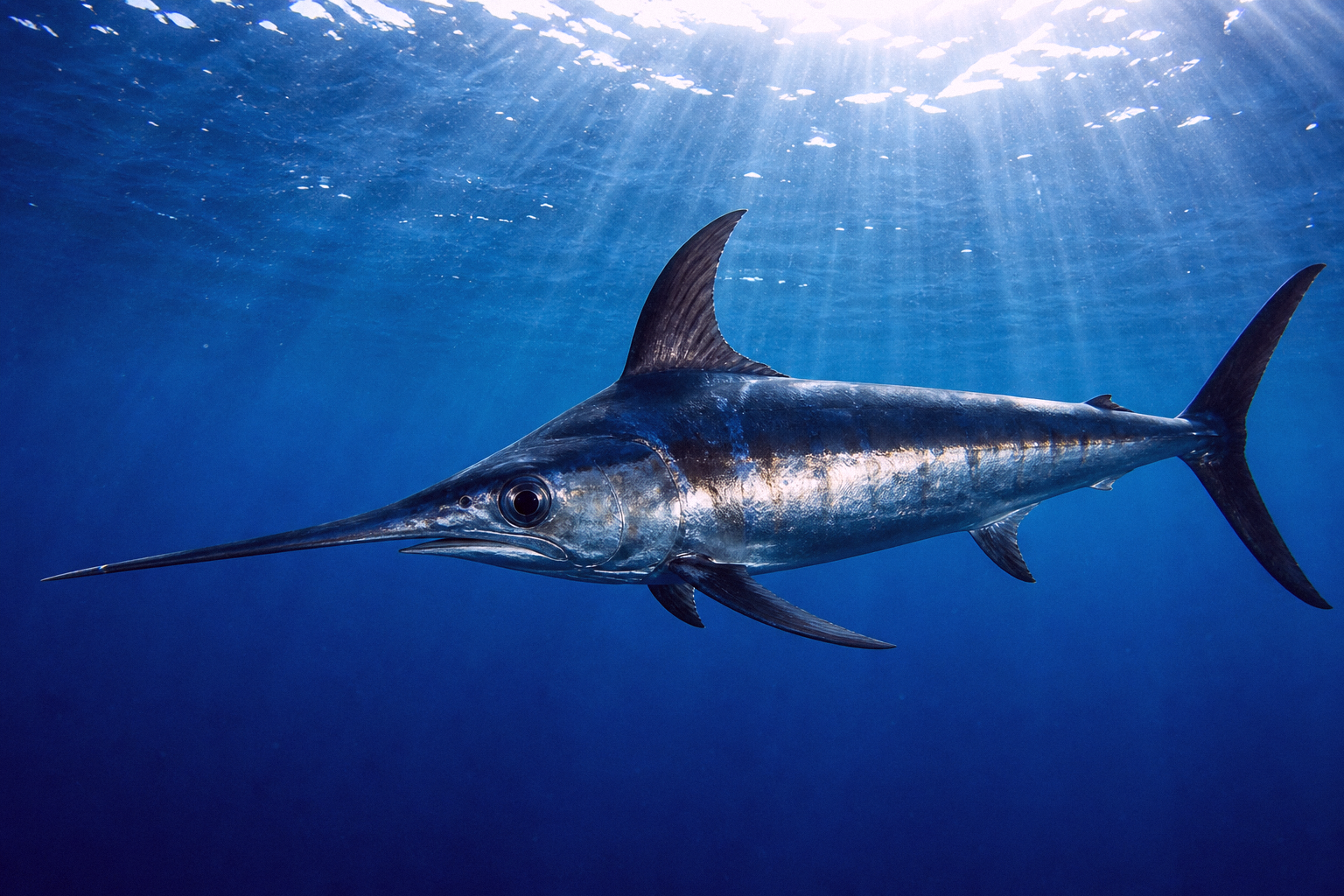
Swordfish
Identification
The swordfish is unmistakable — a broad, flattened bill that’s a true sword, not the rounded spike of a marlin. The body is thick and powerful, dark brown to near-black across the back, fading to lighter brown on the sides. There are no pelvic fins, and adult fish lose their scales entirely. The eyes are enormous, adapted for hunting in the near-total darkness of the deep scattering layer. Off Virginia, swordfish typically run 50 to 200 pounds, with fish over 300 showing up each season. The deep-drop fishery out of Rudee Inlet and the CBBT has revealed a year-round population that previous generations of anglers never knew existed.
Habitat and Behavior
Swordfish live in two worlds. By day they ride the deep scattering layer at 1,000 to 3,000 feet, following the vertical migration of squid and lanternfish. At night they rise toward the surface, often into water as shallow as 100 feet, to feed under cover of darkness. They tolerate a remarkable temperature range — 60 to 75°F at the surface, near-freezing at depth. Off the Virginia coast, swordfish associate with the continental shelf edge and the submarine canyons that cut into it. They hunt alone, slashing through schools of squid with the bill to stun prey before circling back to consume it. Multiple fish may work the same area, but they don’t school.
Fishing Techniques
Daytime deep-dropping has transformed Virginia swordfishing. Using electric reels or heavy manual gear, anglers send baited rigs to 600 to 2,000 feet during daylight. A typical deep-drop rig carries 5 to 15 pounds of lead at the terminal end, with one or two hook leaders above. A battery-powered light stick or LED is attached near the bait — at 1,500 feet, it’s pitch black, and the glow is what draws the strike. Nighttime drifting is the traditional approach: squid baits suspended near the surface while the boat drifts over the shelf edge. Buoy gear — a weighted line attached to a floating buoy — lets a single boat fish multiple locations simultaneously.
Baits and Lures
Whole large squid are the universal swordfish bait, effective day and night. Rigged on heavy circle hooks, squid is the natural prey and produces consistent results. Large bonito strips, mahi-mahi belly strips, and mackerel also work. For deep-dropping, the bait must be fresh and rigged to survive the long descent without spinning or washing out. Glow beads, light sticks, and luminescent skirts are standard additions to the rig for visibility in the abyss.
Best Times and Locations on the Chesapeake Bay
Daytime swordfish are available year-round in deep water, but the most consistent weather window for the long offshore run is May through October. Nighttime swordfishing peaks in summer. Target water 30 to 50 miles offshore from Rudee Inlet and the Virginia Beach coast, along the shelf edge in 100-plus fathoms. The Norfolk Canyon and the Washington Canyon to the northeast are primary destinations. Look for steep bottom contours, temperature breaks, and areas where the shelf drops sharply — these concentrate the squid and baitfish that swordfish follow.
Regulations
Swordfish require an Atlantic HMS recreational permit. The bag limit is 1 per person per day, maximum 3 per vessel, with a 47-inch lower jaw fork length minimum. Circle hooks are mandatory with natural bait. The commercial fishery is quota-managed under longline permits. All recreational landings must be reported through the HMS reporting system.