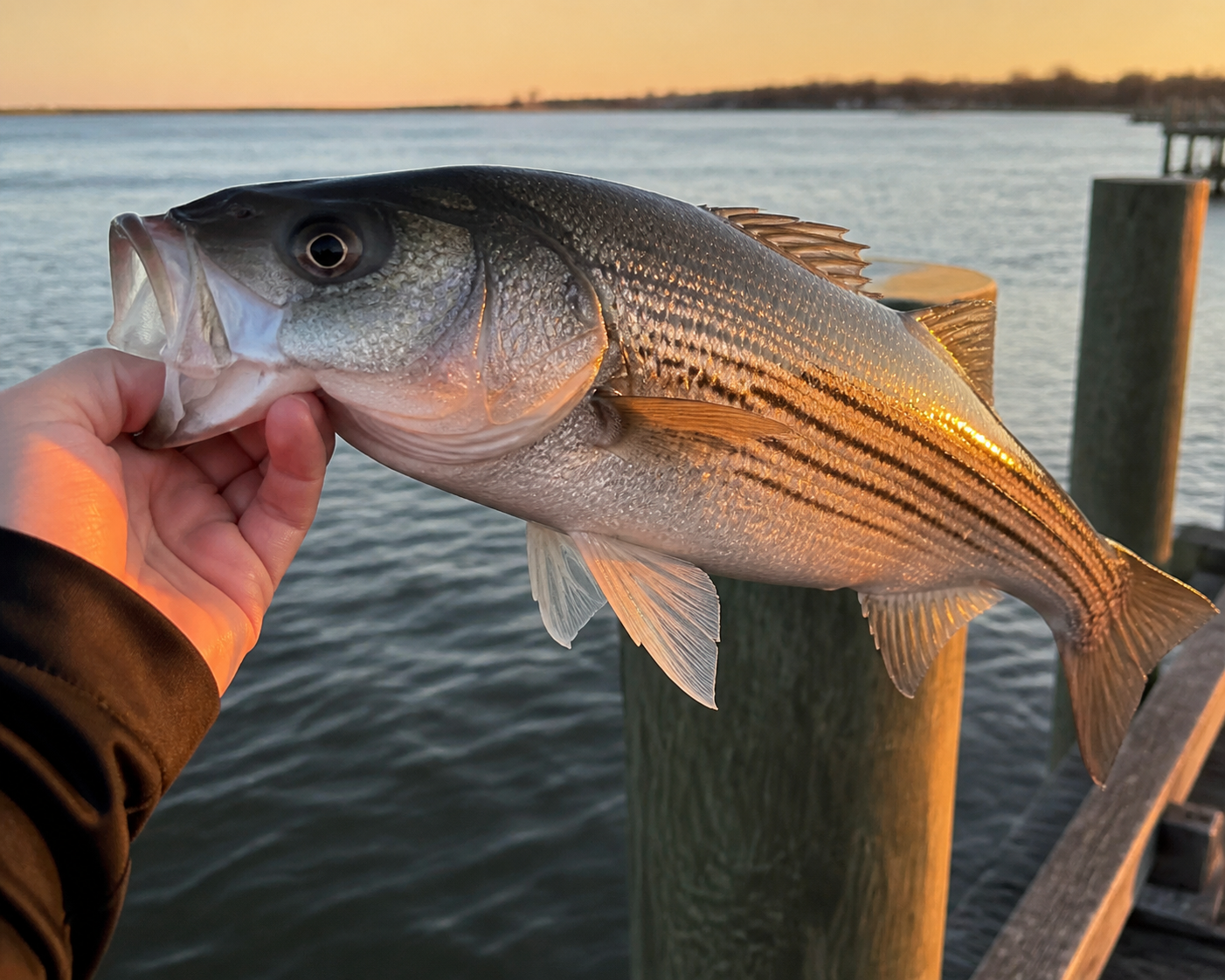
Striped Bass (Morone saxatilis)
Striped bass — “rockfish” in every Virginia bait shop and boat ramp — anchor the winter fishery across the lower Chesapeake. While summer belongs to flounder and cobia, the cold months deliver the largest striped bass on the Atlantic seaboard, and the waters around the Chesapeake Bay Bridge-Tunnel are the epicenter. Anglers from across the country make the pilgrimage to Virginia Beach each winter for a shot at a 50-pound class fish in sight of the bridge pilings.
Identification
The striped bass body is long and powerful, silvery-green above with a white belly and the signature dark horizontal stripes — typically seven or eight — running from gill plate to tail. Two separate dorsal fins sit on the back: a spiny first and a soft-rayed second. The tail is broad and deeply forked. Virginia fish commonly run 10 to 40 pounds, but every winter produces fish over 50, and the state record came from the CBBT. The mouth is large and the lower jaw projects slightly, built for engulfing menhaden and spot in open water.
Habitat and Behavior
Striped bass are anadromous — they spend adulthood in saltwater and push into rivers to spawn. The Chesapeake Bay is the single most important striped bass nursery on the East Coast, and the winter fishery off Virginia Beach draws fish from both the Chesapeake and Hudson River stocks. These migrants stack up around the CBBT, the deeper channels off Cape Henry, and along the Virginia Beach oceanfront, gorging on menhaden, spot, and mullet. They favor water between 42°F and 55°F and feed most aggressively during tide changes, overcast skies, and the low-light windows of dawn and dusk. Striped bass are pure structure-oriented ambush predators — they hold in current seams behind bridge pilings, along channel edges, in the wash zone of the surf, and behind sandbars.
Fishing Techniques
Casting: Working swim shads, bucktails, and metal-lip swimmers from the surf near the CBBT and along Sandbridge is a top winter approach. A 5- to 6-inch paddletail in white or chartreuse, retrieved slowly through the current, draws crushing strikes. The last two hours of a falling tide are prime.
Trolling: The boat standard is trolling mojos, umbrella rigs, and deep-diving plugs along the CBBT channel edges and around the bridge islands. Vary depth and speed until you find the pattern. This method accounts for the largest fish of the season.
Live Eel Fishing: Drifting a live eel through the CBBT on a moving tide is the trophy hunter’s play. Rig a single 8/0 circle hook through the eel’s lip on a fish-finder rig with enough lead to keep it near the bottom. When nothing else gets bit, the eel will.
Baits and Lures
Live eels are the premier winter bait. Virginia Beach and Hampton tackle shops stock them during the season. Rig on a fish-finder with a 6/0 to 8/0 circle hook and fish inlet current seams.
Cut bait — fresh menhaden, spot, or mullet chunks — fished on the bottom in the surf near the CBBT and along the Fort Story beaches produces, especially on falling tides.
Swim shads in the 5- to 7-inch range are the go-to surf lure. Tsunami and Bass Assassin paddletails in white, chartreuse, or pearl on a 1- to 2-ounce jig head, worked slow and low in the current, are consistent producers.
Tackle Recommendations
- Rod: 9- to 11-foot heavy surf rod for the beach; 7-foot medium-heavy boat rod for trolling and eeling
- Reel: 5000 to 8000 size spinning reel with 30 to 50 pound braid for surf; conventional reel with 40 to 65 pound braid for boat
- Leader: 50 to 80 pound fluorocarbon or mono
- Hook: 6/0 to 8/0 circle hook for live eels; 1- to 2-ounce jig heads for swim shads
Best Times and Locations on the Chesapeake Bay
The Virginia striped bass season runs November through March, with December and January delivering peak action. Key locations:
- Chesapeake Bay Bridge-Tunnel (CBBT) — the center of the winter rockfish universe
- CBBT bridge pilings and rock islands — trolling and live eeling around the structure
- Sandbridge and False Cape surf — accessible beach fishing with deep-water proximity
- Rudee Inlet — secondary winter holding area
- Ocean View and Buckroe — nearshore trolling during mild winter days
- Kiptopeke and the Eastern Shore — productive when fish push up the Bay
Regulations
Virginia striped bass regulations are layered and can differ between Chesapeake Bay and coastal waters. The current recreational limit is 1 fish per person per day, minimum 28 inches total length. Management areas may carry different seasons — always verify current VMRC rules before fishing. Striped bass are managed under the Atlantic States Marine Fisheries Commission, and regulations can shift mid-season based on quota. Handle every fish with care: support the body, minimize air exposure, and revive the fish in moving water before release.