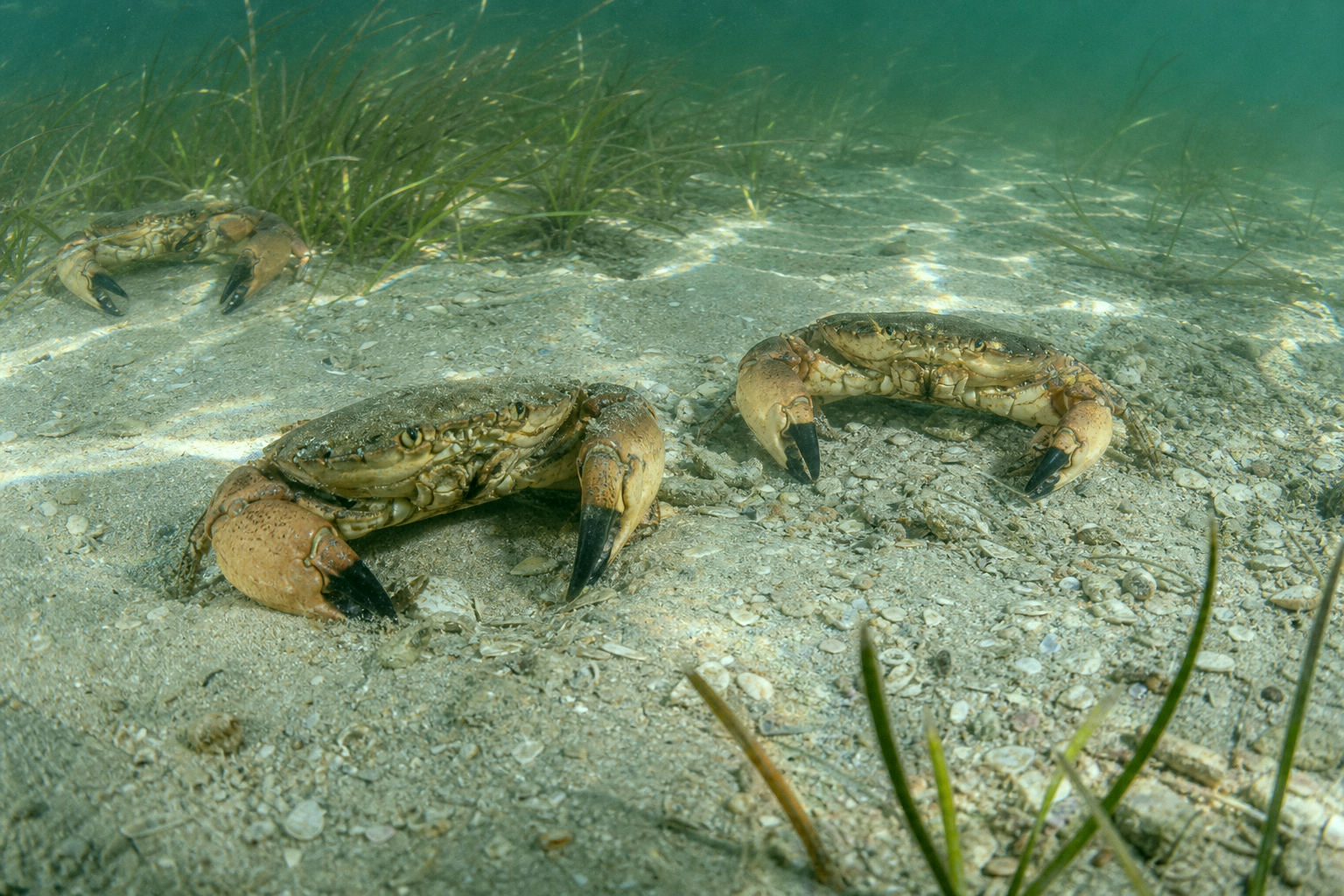
Stone Crab
Identification
The stone crab is a heavy, thick-shelled bruiser built for crushing. Its signature feature is the pair of massively asymmetrical claws — one a blunt crusher, the other a smaller, sharper pincer — both tipped in jet black. The carapace runs brownish-red to deep purple with tan mottling, and adults span 5 to 6 inches across. The claws are the entire point: the meat inside is sweet, dense, and rivals blue crab in quality. Unlike blue crabs, stone crabs can’t swim. They’re pure bottom-walkers, clinging to hard structure with powerful legs and retreating into crevices at the first sign of danger.
Habitat and Behavior
Stone crabs demand hard substrate — rock jetties, oyster bars, seawalls, bridge footings, anything solid they can wedge into. In the lower Chesapeake and Virginia Beach, the best habitat is man-made: the granite boulders of the CBBT islands, the jetty rocks at Rudee Inlet, the riprap along the Hampton Roads shoreline, and the bulkheads lining marinas in Little Creek and Lynnhaven. They’re strictly nocturnal, emerging from crevices after dark to crush oysters, small crabs, and slow-moving fish. By day they vanish deep into the rocks. Stone crabs handle cold water far better than blue crabs, remaining active and harvestable through the winter months when blue crabs have buried themselves in mud or moved offshore.
Harvesting Techniques
Crab pots set tight against hard structure are the most productive method in Virginia waters. Standard wire pots baited with fish heads or mullet chunks work, though stone crabs enter pots more reluctantly than blue crabs — overnight soaks improve results dramatically. Position pots directly against jetty rocks or along bulkheaded shorelines in 3 to 10 feet of water. Drop nets and hand-collection by turning rocks at low tide are alternatives, but stone crabs pinch with crushing force, so heavy gloves are mandatory. The Florida-style sustainable practice — twisting off a single legal claw and returning the crab alive to regenerate — is gaining traction among Virginia recreational harvesters and is strongly recommended for maintaining local populations.
Best Times and Locations on the Chesapeake Bay
The stone crab season runs October through April, when cooling water pushes them shallower and more accessible. The CBBT rock islands are the premier location — the massive granite boulders that anchor the bridge-tunnel complex hold dense populations. Rudee Inlet’s jetties, the riprap along Ocean View, and the rock groins at Fort Monroe and Buckroe all produce. Around Kiptopeke on the Eastern Shore, the ferry terminal pilings and inlet rock walls are reliable spots. The bulkheaded marinas of Lynnhaven and Little Creek hold crabs tucked under docks and along seawalls. Calm weather windows make trap-checking safer near inlet rocks, and the best results come from overnight soaks during periods of moderate current.
Regulations
Stone crabs fall under VMRC crab regulations. Recreational crab pots are limited to two per person without a license; a Recreational Commercial Gear License allows up to five. Virginia doesn’t maintain a separate stone crab size or bag limit distinct from general crab rules, but harvesters should verify current VADEQ regulations. Never take egg-bearing females. The claw-only harvest approach — removing one claw and releasing the crab — is recommended for sustainability even though Virginia doesn’t mandate it the way Florida does.