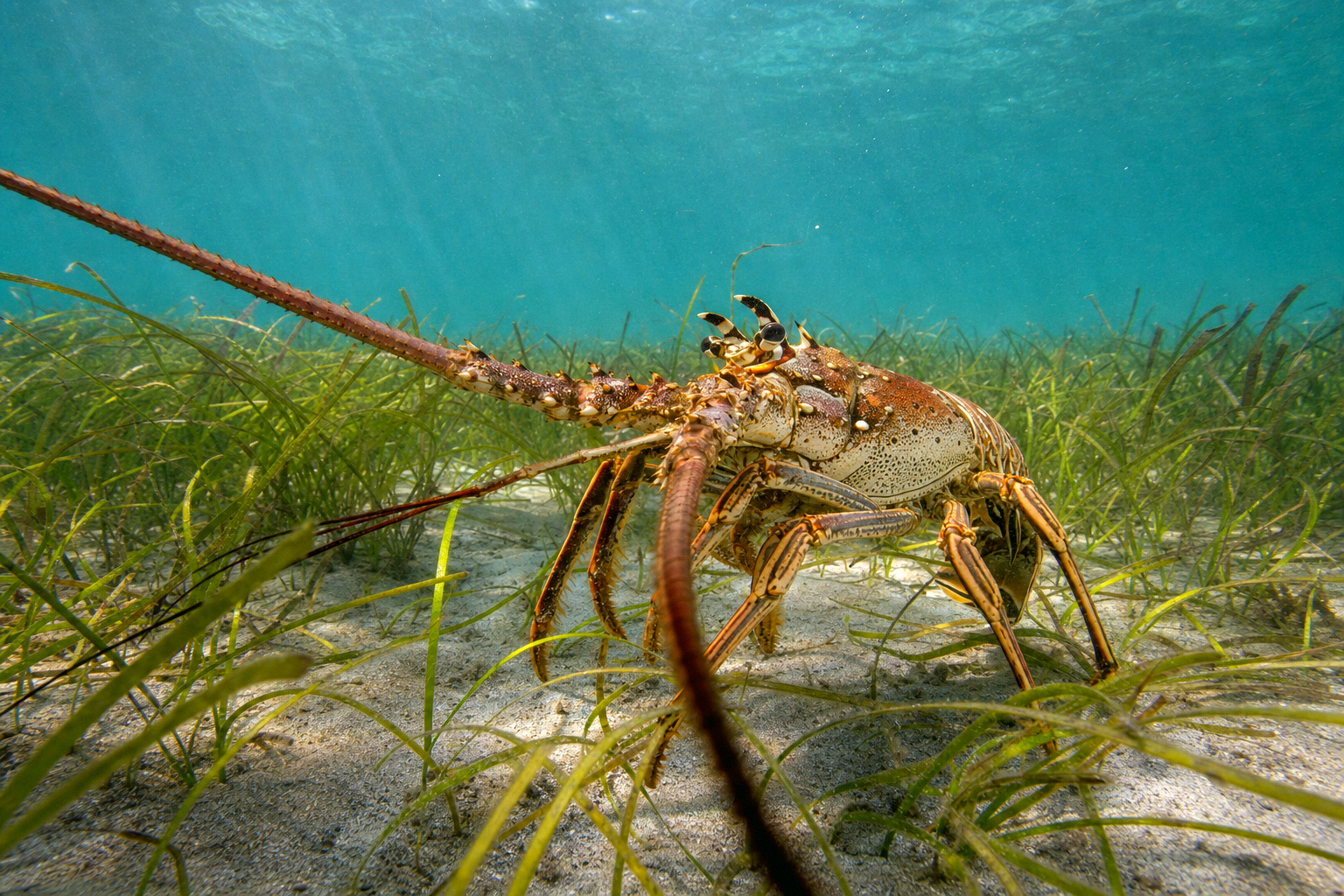
Caribbean Spiny Lobster
What You’re Looking At
The Caribbean spiny lobster is a clawless crustacean wrapped in a fortress of spines. The carapace runs olive-green to reddish-brown, dotted with pale yellow spots across the tail segments. Two massive forward-pointing antennae covered in sharp spines serve as its primary defense — there are no claws whatsoever, unlike the familiar Maine lobster. A mature specimen stretches 15 to 20 inches and weighs several pounds. The tail holds all the meat: firm, sweet, and slightly leaner than cold-water lobster. In Virginia waters, this animal sits at the absolute northern fringe of its range, making every encounter a genuine rarity worth celebrating.
Where They Live
Spiny lobsters are creatures of the tropics and subtropics, abundant from the Caribbean up through Florida. They reach Virginia only as Gulf Stream strays, carried north by warm eddies that peel off the main current. Hard structure is everything — coral heads, rocky ledges, shipwrecks, and artificial reef modules where they can wedge into crevices by day and emerge after dark to hunt snails, crabs, and urchins. The temperature floor is roughly 68°F; prolonged cold kills them, which explains their complete winter absence and their scarcity even in summer. They’re nocturnal and highly gregarious, often piling into the same crevice in groups. Any spiny lobster found off Virginia will almost certainly be on deep offshore hard bottom in the Gulf Stream’s warm-water influence zone, 15 to 40 miles out.
How to Harvest Them
Harvesting spiny lobster in Virginia is a diving-only proposition. The animals hold on deep offshore structure reachable only by boat and scuba gear. The standard tool is a lobster snare — a pole with a wire noose that slips over the tail while the lobster is backed into a hole, then cinches tight. A tickle stick helps coax the animal forward out of the crevice before the snare is deployed. Bully netting, the Florida Keys method of scooping lobsters from shallow reefs at night with a long-handled hoop net, doesn’t translate to Virginia’s deep, murky offshore waters. Hand-grabbing is possible but demands skill — spiny lobsters fire their muscular tail to rocket backward into cover the instant they sense danger. Commercial-style traps aren’t a practical recreational method here.
When and Where in the Chesapeake Region
Encounters are unpredictable and rare, concentrated in late summer and early fall — August through October — when Gulf Stream eddies push the warmest water over the shelf. The offshore wrecks and artificial reef sites east of the Virginia Beach coast and Kiptopeke are the most plausible locations. The deeper ledge systems along the 30-fathom curve, the various artificial reef deployments in 60 to 120 feet, and any hard-bottom structure within the warm-water tongue can hold an occasional individual. Divers spearing or exploring these sites for grouper and snapper sometimes spot a spiny lobster as a complete surprise. Targeting them specifically isn’t practical — this is purely a catch of opportunity, and one worth documenting when it happens.
The Rules
Virginia has no established recreational season, size limit, or bag limit for spiny lobster, reflecting how rarely the species appears. General Virginia fishing regulations and potentially federal rules under the South Atlantic Fishery Management Council may apply to offshore harvest. Anyone considering retaining a spiny lobster should verify current regulations with VADEQ and SAFMC beforehand. Given the species’ extreme rarity at this latitude, catch-and-release — or simply photographing and leaving the animal — is the most appropriate choice for a range-edge encounter.