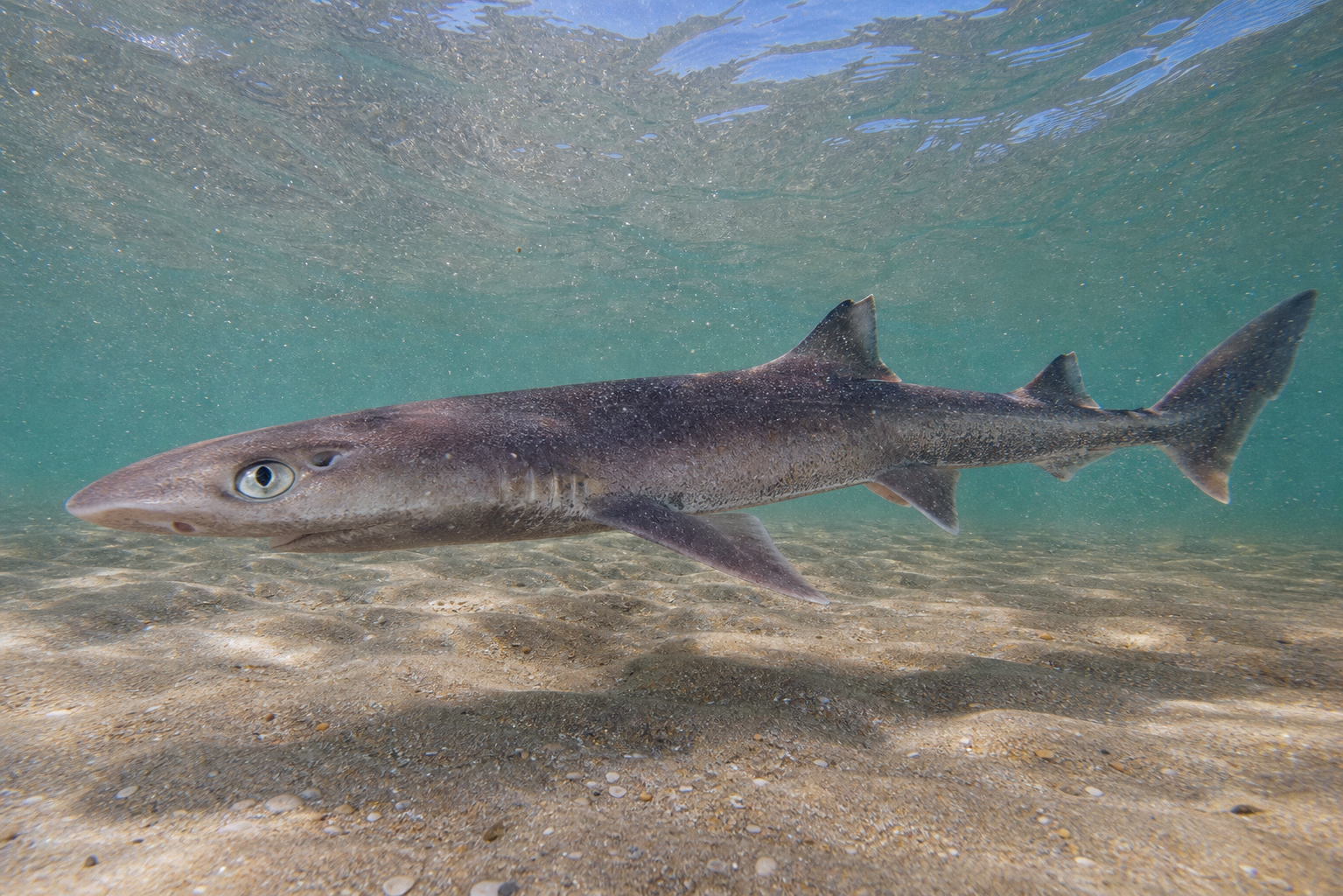
Spiny Dogfish
Identification
A small shark built like a torpedo, the spiny dogfish runs 2 to 4 feet long and rarely tops 15 pounds in Virginia waters. The back is slate-gray to brownish, the belly a clean off-white. What sets it apart from every other shark you’ll encounter is the pair of sharp, mildly venomous spines — one in front of each dorsal fin. The first dorsal is noticeably larger than the second, and there’s no anal fin at all. The snout is long and pointed, the teeth are small and uniform in both jaws, designed for gripping rather than shearing. Younger fish sometimes carry a dusting of white spots along the flanks. Dogfish travel in enormous single-sex schools, and when a pack moves through, anglers pulling up doubles and triples is the norm, not the exception.
Habitat and Behavior
Spiny dogfish hold the title of most abundant shark on the planet, ranging from Arctic waters down through temperate zones. In the lower Chesapeake and along Virginia Beach, they’re strictly a cold-water visitor — showing up once surface temperatures dip below 60°F, typically November, and sticking around through April. The migration pattern is textbook: south in winter, north in summer. They move in packs that can number in the thousands, hunting small fish, squid, and crustaceans. For surf and pier anglers working the Virginia Beach oceanfront, dogfish are the classic winter nuisance — once a school settles in around Buckroe Pier or the Ocean View surf, keeping a bait on the bottom for anything else becomes a genuine challenge. They find food almost entirely by scent, which is why fresh, oily cut bait draws them from surprising distances.
Fishing Techniques
Nobody really targets spiny dogfish in Tidewater — they’re the bycatch that shows up when you’re bottom fishing for something better. A standard fish-finder rig with 3 to 6 ounces of lead and a 4/0 to 6/0 circle hook will get bit almost immediately when dogfish are around. Heavier leader is non-negotiable: 40 to 60 pound test keeps their sandpaper skin and small teeth from fraying through. When the dogfish are thick — and they get thick at Sandbridge and along the CBBT during January and February — fishing the bottom becomes an exercise in feeding sharks. The workaround is switching to a float rig or fishing higher in the water column to get above the dogfish layer. Some anglers simply embrace it and fill a cooler; dogfish make excellent fish and chips when bled and iced immediately.
Baits and Lures
Cut bait rules for spiny dogfish. Strips of fresh menhaden, mullet, or mackerel fished on the bottom are the ticket. Squid works nearly as well and is often what’s on the hook when dogfish crash a party meant for croaker or spot. Shrimp will catch them too, though it’s less durable. The formula is simple: fresh, oily, smelly bait on the bottom. Bigger chunks help select for larger fish and discourage the smallest individuals from stealing bait. Artificial lures are essentially useless — dogfish hunt by nose, not by sight.
Best Times and Locations on the Chesapeake Bay
The dogfish window in Virginia opens in late fall and closes in early spring, with December through February being peak abundance. Ocean View Fishing Pier and Virginia Beach Fishing Pier are the most reliable winter pier options, since many smaller piers close for the season. The surf from Ocean View down through Sandbridge produces, especially during winter nor’easter swells that stir up the bottom. The CBBT complex and Rudee Inlet concentrate dogfish as they ride tidal currents in and out. Little Creek Inlet and the deeper channels off the Eastern Shore can also hold schools. Daytime fishing is more productive than night, and the bite intensifies on a moving tide.
Regulations
Spiny dogfish fall under joint management by the Atlantic States Marine Fisheries Commission and the Virginia Marine Resources Commission. There’s no closed season, no minimum size, and no recreational bag limit in Virginia state waters. The real regulation is self-imposed: those dorsal spines deliver a painful poke, so handle every dogfish with a rag or gripper and keep clear of the spines. Always verify current VMRC rules before heading out, since commercial quota adjustments can ripple into recreational management.