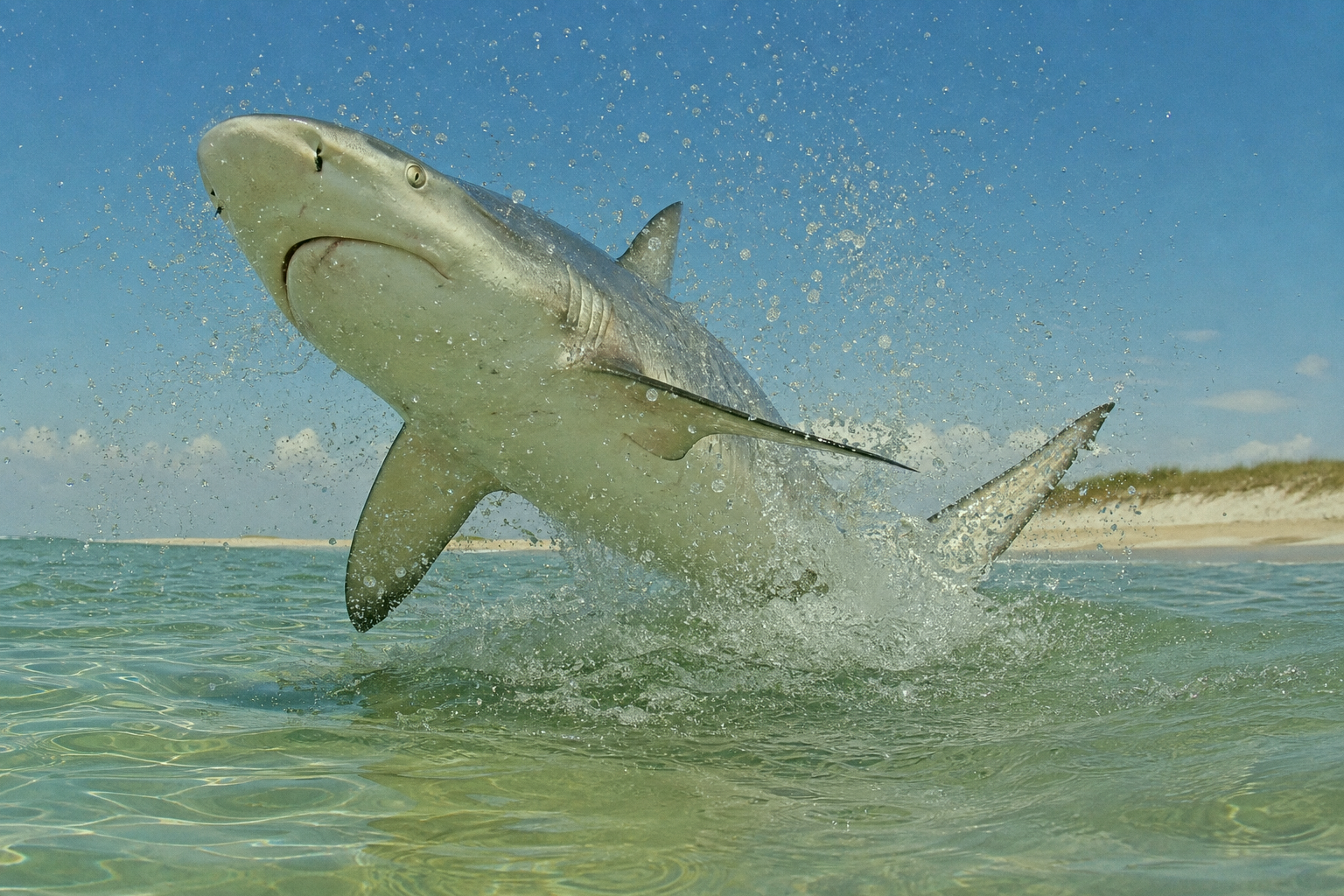
Spinner Shark
Telling Them Apart
The spinner shark and the blacktip are nearly identical at a glance — same sleek profile, same bronze-gray back and pale underside, same faint white stripe tracing the flank. The definitive field mark lives on the anal fin: spinners carry a black tip there, blacktips do not. That single detail is the separator. These are fast, muscular requiem sharks, most Virginia specimens spanning 5 to 7 feet. The real show, though, is behavioral. Spinners earned their name by launching through bait schools and corkscrewing through the air — sometimes three or four full rotations — before crashing back into the water. Watching a spinner shark helicopter through a menhaden school at first light off Sandbridge is one of the signature experiences of Virginia surf fishing.
Where They Cruise
Spinner sharks patrol Virginia’s warm nearshore corridor from late spring through early autumn. They favor open beachfront with well-defined sandbar systems and moving water, working the same sloughs and troughs that blacktips hunt. These sharks are highly migratory, shadowing menhaden and mullet schools along the coast. Their feeding strategy relies on raw speed — they slash through bait balls at full throttle, and the spinning leaps that follow are more frequent and dramatic than anything blacktips produce. In the field, if you see a shark launching and rotating repeatedly, you’re watching spinners.
The Surf Setup
The surf setup for spinners mirrors the blacktip program. A heavy 11- to 13-foot rod paired with a 6000- to 8000-size spinning reel, 30- to 50-pound braid, and a wire leader of at least 80-pound test is the baseline. A fishfinder rig with 6 to 8 ounces of lead, adjusted for current, keeps the bait in the strike zone. Live baits deployed in the slough beyond the outer bar are the most productive presentation. Kayak deployment of baits is essential at Sandbridge and other high-current stretches where long casts alone won’t reach the feeding lane. For charter anglers, drifting live menhaden along the beachfront or near inlet mouths produces consistent action. Watch for spinning leaps and position baits in the path of surface activity.
What They’ll Hit
Live bait is the gold standard. Live mullet, menhaden, and spot fished on circle hooks generate the most strikes — the vibration of a struggling baitfish is irresistible to a hunting spinner. When live bait is unavailable, fresh-cut bluefish, mackerel strips, or large mullet fillets work well. Freshness is the critical variable; spinners key in on the scent and oil signature of fresh, bloody baits. A 4- to 6-inch live mullet or a comparable chunk of cut bait is the ideal size. For charter trolling, mullet strips or rigged ballyhoo can draw strikes when spinners are actively feeding on the surface.
Prime Season and Spots in Tidewater
Spinner sharks appear in Virginia waters from May through October, with peak activity concentrated in June through September. Sandbridge is the premier location, especially during summer when warm Gulf Stream water pushes bait close to the beach. Rudee Inlet, the waters around Kiptopeke, and the Sandbridge beach area are also excellent. On the northern beaches, the sandbars off the Eastern Shore can hold spinners during calm summer conditions. Fish the incoming tide and the first two hours of the outgoing tide. Late afternoon into evening is prime time, as spinners become more active as the light fades.
The Rules
Spinner sharks are managed under the large coastal shark group in Virginia. The minimum size is 54 inches fork length. The recreational bag limit is 1 shark per person per day with a vessel limit of 1 shark per vessel per day, combined with other large coastal shark species. All sharks must be landed with head, tail, and fins naturally intact. There is no closed season in state waters. Use circle hooks for catch and release fishing. Keep the shark in the water as much as possible during handling, support the body properly, and allow the shark to swim away under its own power after revival.