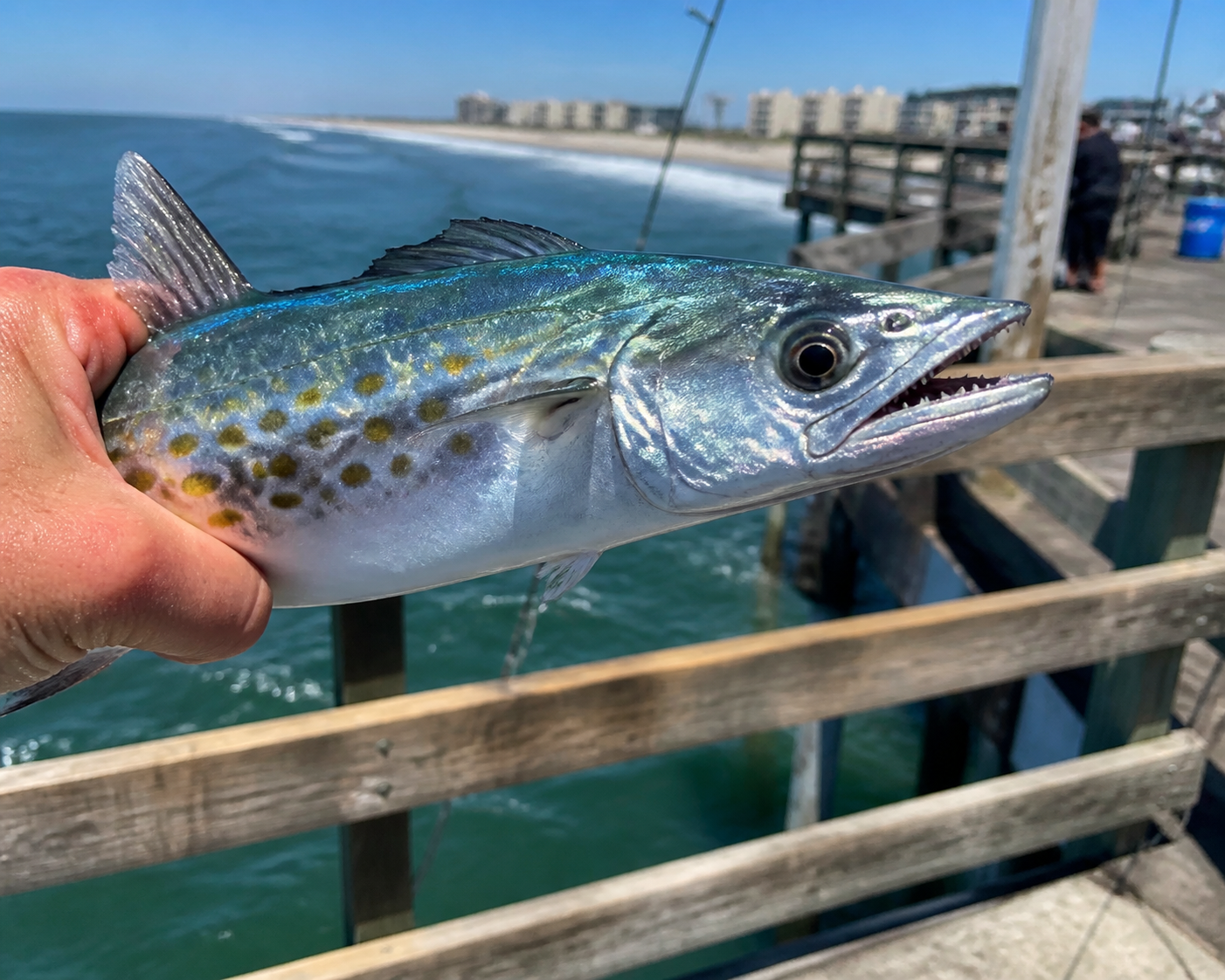
Spanish Mackerel (Scomberomorus maculatus)
Spanish mackerel are the people’s game fish of the Virginia coast — fast, aggressive, accessible, and delicious. They arrive in nearshore waters by May and provide nonstop action through October. Whether you’re casting a Gotcha plug from the Ocean View pier, trolling a spoon along the beach at Sandbridge, or working a metal jig from the CBBT rocks, Spanish mackerel deliver. They are also one of the best entry-level saltwater species for new anglers.
Identification
Spanish mackerel are built like torpedoes — long, slender, and designed for speed. The back is bronze-green, the flanks are silver, and the body is covered in distinct oval-shaped yellow spots. The key field mark that separates them from king mackerel is the anterior portion of the first dorsal fin: it is spotted in Spanish mackerel, solid black in kings. Spanish mackerel spots also continue all the way down past the lateral line, while king mackerel spots fade. Adults in Virginia waters typically run 1 to 3 pounds and 12 to 20 inches, though fish pushing 5 pounds show up late in the season.
Habitat and Behavior
Spanish mackerel are pelagic schoolers that push into Virginia’s nearshore waters when temperatures climb above 68°F in May. They follow schools of bay anchovies and menhaden along the beach and into inlets. Spanish mackerel are surface-oriented feeders that drive baitfish upward — the action is visible as breaking fish and diving birds — making them easy to locate. They frequent the first trough off the beach, the wash zone off piers, and inlet current seams. Their teeth are razor-sharp, and wire leaders or heavy fluorocarbon are essential to avoid cut-offs.
Fishing Techniques
Casting Spoons: The most popular method from Virginia piers. A 1/2- to 1-ounce Clark spoon or Kastmaster, cast as far as possible and retrieved at a fast, steady pace, produces strikes. The flash mimics a fleeing baitfish.
Trolling: Slow-trolling spoons behind planers or trolling weights at 5 to 7 knots is the standard small-boat technique. Run Clark spoons at different depths using #1 or #2 planers to cover the water column. This method is extremely productive along the beach from Ocean View to Sandbridge.
Gotcha Plugs: The classic Virginia pier technique. A 1.5- to 2-ounce Gotcha plug — a hard plastic lure with a weighted head and feathered treble — is cast out and worked with sharp jerks and pauses. The erratic darting action drives Spanish mackerel crazy.
Baits and Lures
Spoons in silver or silver-and-chartreuse are the universal Spanish mackerel killer. Clark spoons, Kastmasters, and Diamond jigs all work. Gotcha plugs in red-and-white, pink, or chartreuse are the Virginia pier standard and account for hundreds of Spanish mackerel landed every season at the Ocean View, Buckroe, and Virginia Beach Fishing Piers. Live mullet fished on a short wire leader and slow-trolled or drifted near breaking fish will produce when artificials fail. Finger mullet are the go-to bait — they can be caught with a cast net in the shallows or purchased at local tackle shops.
Tackle Recommendations
- Rod: 6.5- to 7-foot medium spinning rod for casting; 7-foot medium rod for trolling
- Reel: 3000- to 4000-size spinning reel with 15- to 20-pound braid
- Leader: 30-pound wire or 40- to 50-pound fluorocarbon to prevent cut-offs
- Hardware: Barrel swivels and snap swivels to prevent line twist from spoons
Best Times and Locations on the Tidewater region
Spanish mackerel season runs May through October, with peaks in June and September. The best locations include the Ocean View Fishing Pier and Buckroe Pier — top pier destinations for Spanish — the CBBT area where breaking fish appear on tide changes, Rudee Inlet where schools push through on falling tides, and the beaches from Ocean View to Sandbridge where trolling the first trough in 15 to 25 feet of water is consistently productive.
Regulations
The Virginia recreational bag limit for Spanish mackerel is 15 per person per day with a minimum size of 14 inches fork length. The fishery is jointly managed by the Atlantic States Marine Fisheries Commission and the South Atlantic Fishery Management Council, and regulations can change. Always verify current rules with the Virginia Marine Resources Commission. Spanish mackerel are excellent eating when bled immediately and iced — their flesh is white, flaky, and mild when fresh.