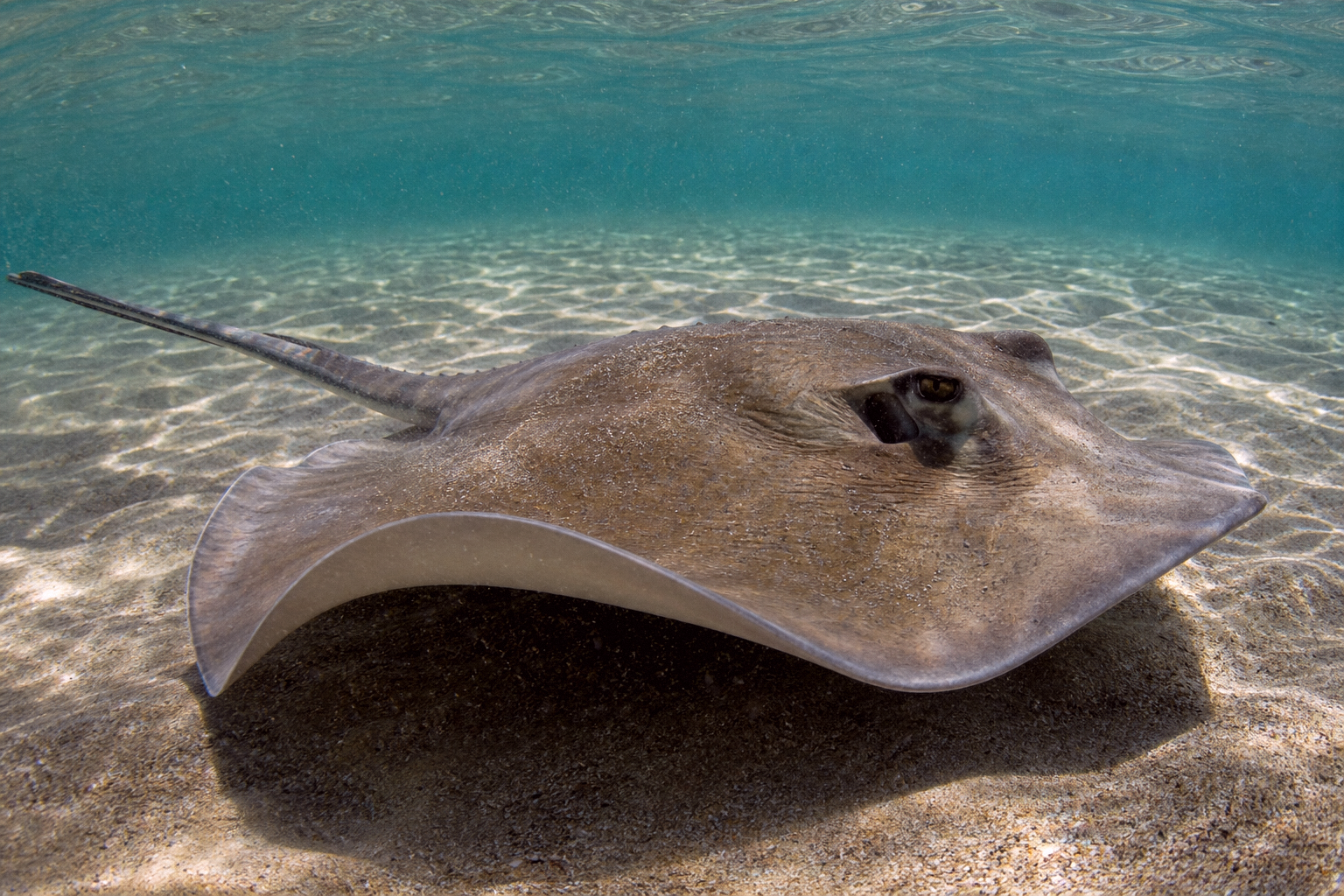
Clearnose Skate
Identification
Clearnose skates belong to the family Rajidae — cartilaginous fish related to sharks and rays. The body is a flat, diamond-shaped disc that spans 18 to 30 inches across in Virginia waters. The upper surface is brown to grayish-brown with darker mottling and scattered spots. The namesake feature is a pair of translucent patches on either side of the snout — “clear” windows in the cartilage that give the species its common name. The underside is white to pale yellow. A long, thorny tail extends behind the disc, carrying one or two small dorsal fins near the tip. Unlike stingrays, skates lack a venomous spine. Male skates show prominent claspers along the pelvic fins. The clearnose is the skate most often encountered by Virginia anglers.
Habitat and Behavior
Clearnose skates range from Massachusetts to Florida and throughout the Gulf of Mexico. They are bottom-dwellers that favor sandy or muddy substrate in shallow coastal water, typically less than 100 feet deep. In Virginia, they are found in the surf zone, around pier structure, in inlet channels, and on the sandy bottoms of the lower Chesapeake Bay. Skates are sedentary animals, spending much of their time partially buried in the sand, waiting to ambush passing prey. Their diet is broad — crabs, shrimp, small fish, clams, and worms. Clearnose skates are egg-layers, producing distinctive rectangular egg cases often called “mermaid’s purses” that wash up on Virginia beaches, each containing a single developing embryo.
Fishing Techniques
Skates are almost always an incidental catch in Virginia — rarely a targeted species. They take standard bottom rigs fished for other fish. A fishfinder or two-hook bottom rig with 2 to 4 ounces of lead and hooks in the 2/0 to 4/0 range will catch skates. Use 20- to 30-pound leader material, as their rough skin can chafe lighter line. The bite is a slow, heavy pull — the rod tip bends over gradually and stays down. Skates put up a stubborn but unspectacular fight, using their flat body to create drag against the current. Landing a large skate from the surf can be a workout, particularly in a strong current. Most Virginia anglers release skates, though the wings are edible and sometimes prepared like scallops.
Baits and Lures
Squid is the most common bait that produces skates — it’s what most anglers are using when they catch skates incidentally. Cut bait — strips of mullet, menhaden, or other fish — fished on the bottom will also readily take skates. Shrimp and clam are effective as well. Skates are not picky eaters; they will take almost any natural bait fished on the bottom. To avoid skates, fish baits higher in the water column using float rigs, or move to a different spot when skates become too numerous. For those actually targeting skates, fresh squid or cut bait on a bottom rig in the surf or from a pier is the simplest approach.
Best Times and Locations on the Tidewater region
Clearnose skates are present in Virginia waters from spring through fall, with the highest abundance from May through October. They are common in the surf throughout the region — from Sandbridge to the Eastern Shore — and can be caught from all Virginia piers. Skates are particularly common in the surf near inlets, where moving tide concentrates them along with their prey. They are most active during the warmer months and tend to move offshore or south in winter. Skates are more likely to be caught during the day, as they are visual ambush predators. They are often found in the same areas as other bottom fish — sloughs, holes, and the bottom of the surf zone near sandbars. Anglers targeting sea mullet, spot, and croaker in the surf will frequently hook skates, particularly when using squid or cut bait.
Regulations
Clearnose skates are managed by the Virginia Marine Resources Commission. There is no closed season, no minimum size limit, and no recreational bag limit in Virginia state waters. Skates are not subject to specific recreational regulations, as they are not a commonly targeted species. Always check current VMRC regulations for any updates. Handle skates carefully — while they lack the venomous spine of stingrays, they have rough skin and a thorny tail that can cause minor cuts. Always release skates carefully, as they are an important part of the Virginia marine ecosystem.