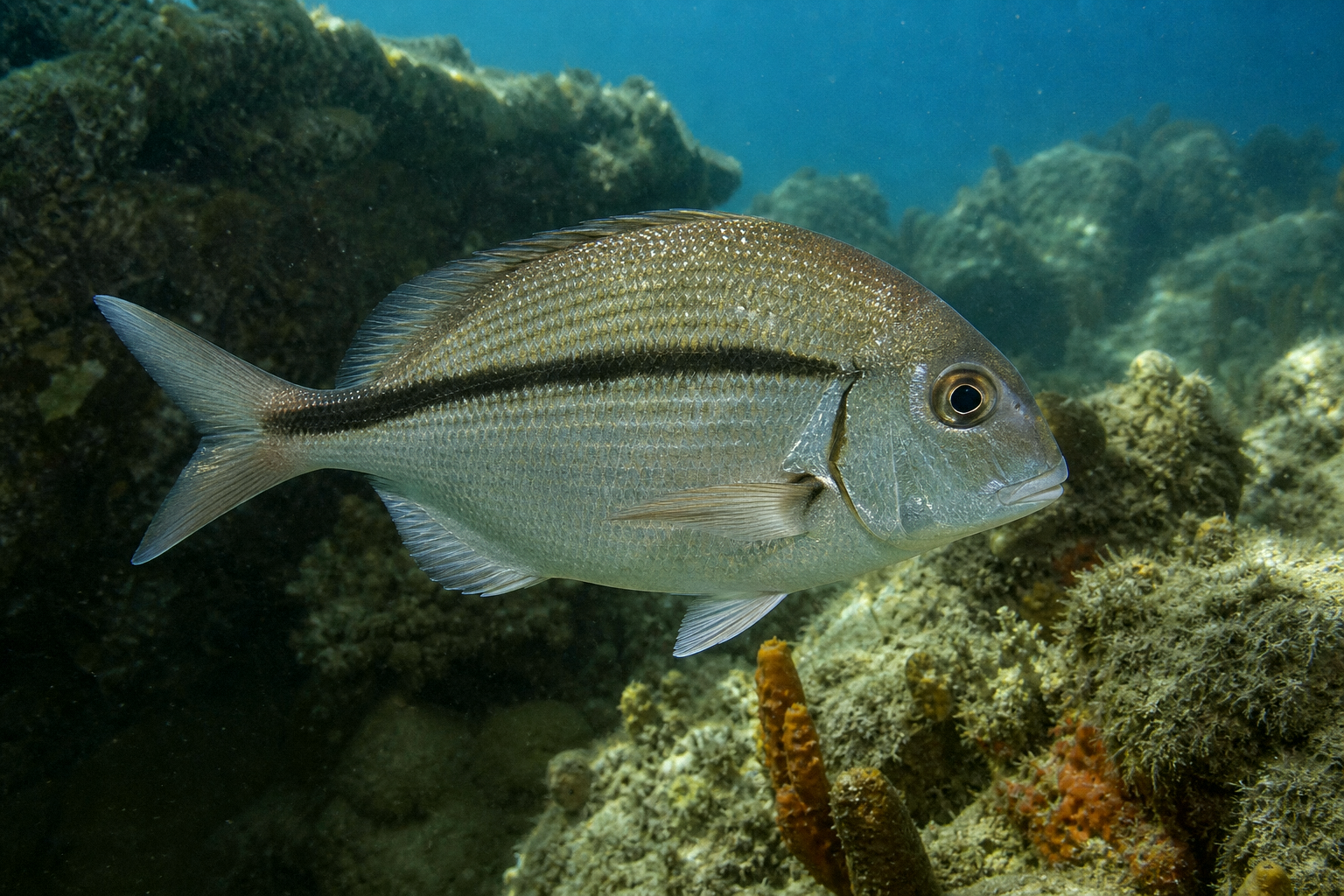
Scup
What They Look Like
Scup — the northern porgy to anglers above the Mason-Dixon line — is a compact, disc-shaped fish that rarely exceeds 16 inches or 2 pounds in Virginia waters. The body is a uniform bronzy-silver, deeper through the midsection than it is long, with subtle dark mottling or faint vertical bars along the sides. The head is blunt and the mouth surprisingly small for a fish that feeds so aggressively. The eyes are proportionally large, adapted for picking out prey on the seafloor in low light. Scup lack the pinkish wash of red porgy and the pronounced cranial knobs of the Calamus species — they’re the understated, workmanlike member of the porgy tribe. In Virginia, they appear less frequently than red porgy but still show up reliably on hard-bottom drops off the Virginia Beach coast.
Daily Life
Scup associate with hard substrate — rocky reefs, wreckage, artificial reef modules, and transitional zones where sand and mud meet structure. Off Virginia, they occupy mid-shelf reefs in 50 to 120 feet, often intermingled with other porgy species. They’re dedicated bottom foragers, working through crustaceans, polychaete worms, small mollusks, and the occasional tiny fish. Scup are schooling fish and can appear in substantial numbers when conditions align. They feed most actively during daylight, with a pronounced morning and late-afternoon bite window.
The Setup
A high-low rig — two dropper loops above a bank sinker of 3 to 5 ounces — is the standard approach. Because scup have small mouths, hook selection matters: sizes 4 through 1 produce far more hookups than larger hooks. Fish the rig vertically with the weight resting on the substrate. Drifting over hard-bottom structure lets you cover ground and locate schools; once you find them, repeated drops in the same zone can yield fish after fish. Light spinning or conventional tackle in the 20- to 30-pound class makes the fight more enjoyable and improves your ability to detect the subtle taps that signal a scup bite.
Bait Choices
Squid strips are the top producer, as they are for most porgy species. Clam strips are equally effective and sometimes outperform squid, particularly when scup are feeding on bivalves. Shrimp, bloodworms, and sandworms are excellent alternatives, especially during finicky bites. The critical technique point: keep bait pieces small and thread them securely up the hook shank. Scup are notorious bait thieves — a tiny mouth and a knack for picking baits clean without touching the hook point. A small strip of squid threaded tightly rather than a large flapping piece will dramatically improve your hookup ratio.
When and Where in Tidewater
Scup are a summer and early-fall species in Virginia, showing up from June through October. They’re most commonly encountered on the hard-bottom reefs off the Virginia Beach coast in 60 to 100 feet. They tend to concentrate more heavily on the northern Virginia reef complexes than on those further south. Party boats running half-day and full-day bottom trips out of Rudee Inlet and Little Creek regularly pick up scup as part of the mixed reef catch. Morning trips often produce the best scup action before the fish settle into a midday lull.
Regulations
Scup are included in the Virginia aggregate porgy regulation, which typically allows 10 fish per person per day with a 10-inch minimum size. As with all reef fish regulations, rules can change. Verify current limits and any seasonal closures with the Virginia Marine Resources Commission and the South Atlantic Fishery Management Council before your trip.