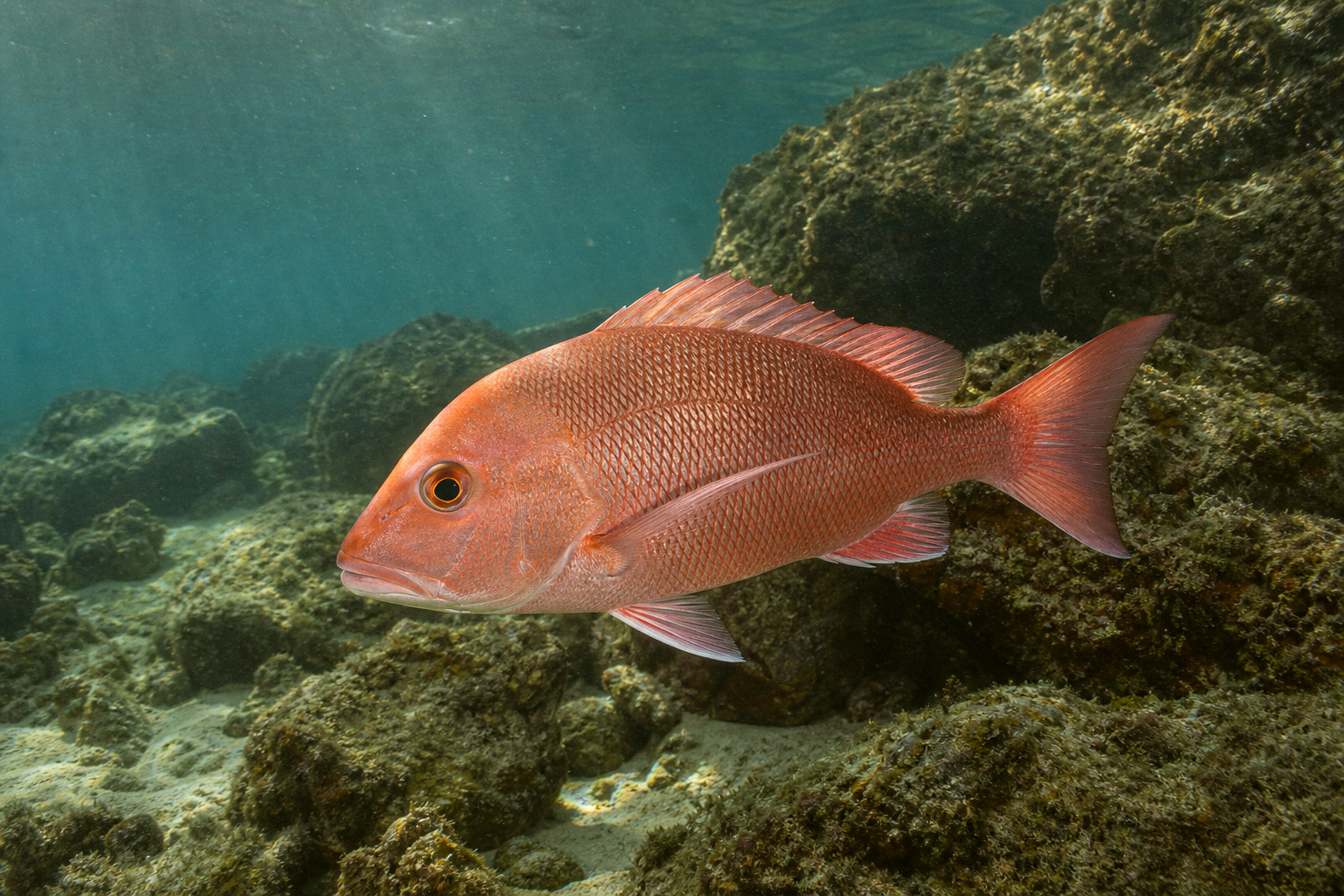
Red Porgy
What They Look Like
Red porgy are among the most handsome fish on the reef — a silvery-pink to rose-red body that seems to glow against the blue-green water of the mid-shelf. Younger fish often display subtle blue spots scattered across the upper sides. The body is deep and laterally compressed, with a blunt head and large, dark eyes adapted for scanning the seafloor. Adults typically run 14 to 20 inches and 1 to 3 pounds, though fish pushing 5 pounds come off the deeper Virginia reefs. The dorsal fin is continuous and spiny, and the tail is gently forked. The uniform pinkish-red wash and relatively large mouth distinguish red porgy from other porgy species in the catch.
Where They Live
Red porgy are structure-oriented fish that thrive on hard-bottom habitat — natural limestone ledges, rocky outcroppings, live-bottom patches, wrecks, and artificial reef sites. Off the Virginia coast, they are commonly found in 60 to 180 feet over hard bottom southeast of the Chesapeake Bay entrance and around the reef complexes off Rudee Inlet. They are bottom feeders, using molar-like teeth to crush crustaceans, mollusks, sea urchins, and small fish. Red porgy are schooling fish — find one and you’ve found a group — which makes them a reliable target for reef fishermen. They hold tight to the substrate and rarely venture more than a few feet above it.
How to Catch Them
The standard approach is a two-hook bottom rig — often called a chicken rig — fished straight down with enough lead to hold bottom, typically 3 to 6 ounces depending on depth and current. Circle hooks in size 2/0 to 4/0 work well and reduce deep-hooking. Drift fishing over hard bottom is productive; let the rig bounce along the structure as the boat moves. Vertical jigging with small jigs tipped with squid can entice larger porgy, especially when the school is finicky. Keep the rig on or very near the bottom — red porgy almost never feed more than a few feet above the structure.
What They’ll Eat
Fresh squid strips are the number-one bait — they stay on the hook well and red porgy love them. Cut bait from mullet or menhaden also works. Shrimp and bloodworms are excellent when the fish are picky or when targeting smaller porgy. Tipping jigs with squid combines the best of both approaches. A light chum line of crushed clam or ground fish can help draw the school closer to the boat.
When and Where in Tidewater
Red porgy fishing peaks from late spring through early fall, when water temperatures on the mid-shelf reefs climb into the 60s and 70s. Key areas include the hard-bottom zones off the Virginia Beach coast in 80 to 120 feet, the reef complexes southeast of Rudee Inlet, and the artificial reef sites off the central Virginia coast. Party boats running out of Rudee Inlet and Little Creek regularly target red porgy as part of mixed bottom-fishing trips. Calm days with minimal current produce the best fishing — strong current makes it difficult to keep baits on the small, specific pieces of hard bottom where porgy congregate.
The Rules
Red porgy fall under the Virginia recreational snapper-grouper complex. The current aggregate bag limit for porgy species is typically 10 fish per person per day with a 10-inch minimum size, but regulations change frequently. Always check the latest Virginia Marine Resources Commission and South Atlantic Fishery Management Council rules before heading out. Seasonal closures have occurred in the past, particularly in deeper water, so verify the current status.