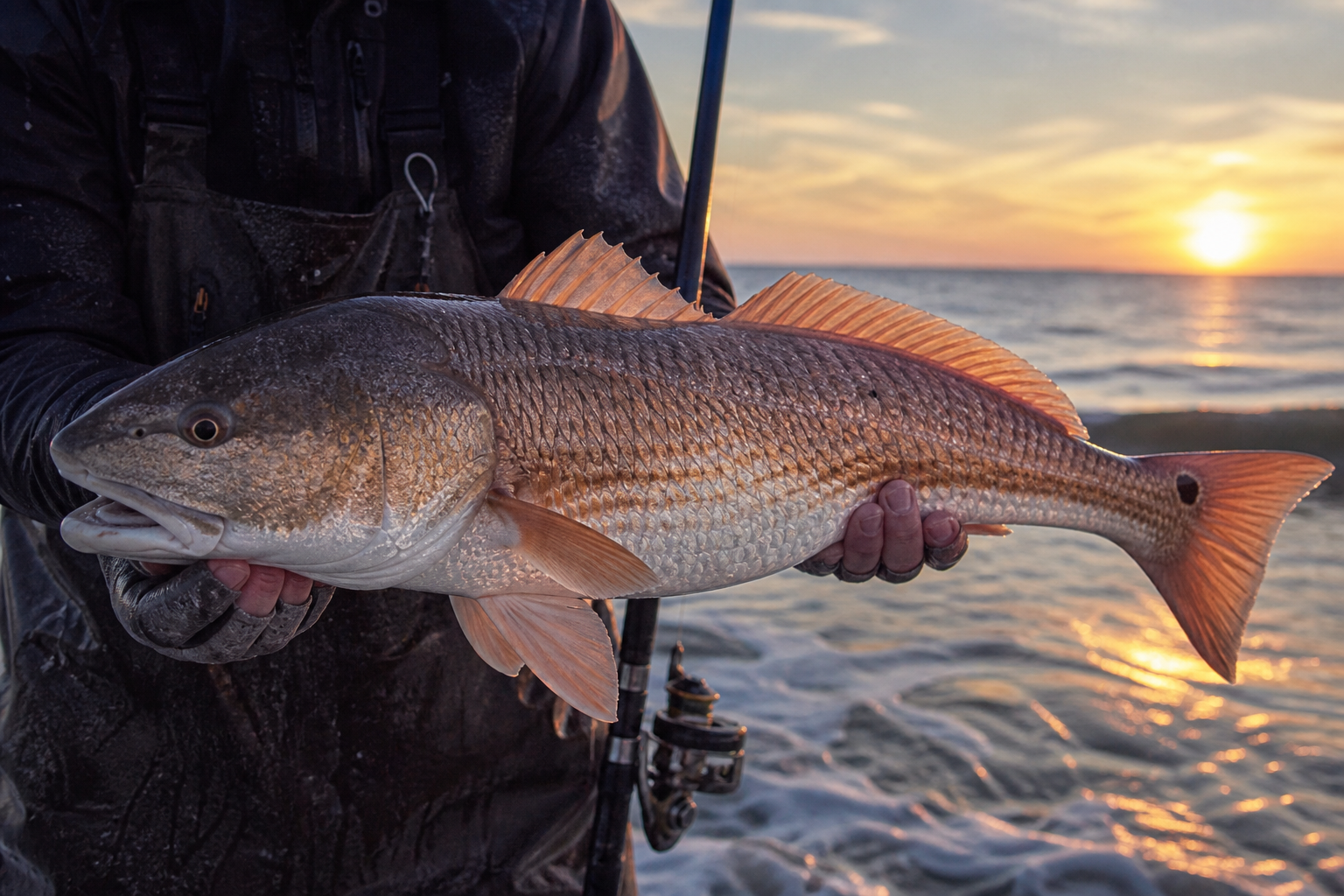
Red Drum (Sciaenops ocellatus)
Red drum — called channel bass, redfish, or spottail throughout the Tidewater — hold a special place in Virginia’s angling culture as the official state saltwater fish. The fall migration of bull drum along the Eastern Shore and through the mouth of the Chesapeake Bay is one of the great spectacles in East Coast surf fishing. These fish are prized for their raw power, their willingness to take a bait in the wash, and the electric thrill of spotting a tailing fish in skinny water.
Identification
A red drum is unmistakable: copper-bronze body, sloping forehead, and at least one jet-black ocellated spot at the base of the tail. Most fish carry one spot, but two, three, or even more are not unusual. Juvenile fish — “puppy drum” — run 14 to 27 inches and often show a more heavily spotted pattern. Adult “bull drum” can exceed 50 inches and 50 pounds, with coloration that deepens to a dark copper as they age. The species name ocellatus refers to that eye-like tail spot, thought to confuse predators into striking the tail rather than the head. Red drum belong to the family Sciaenidae, alongside speckled trout, black drum, and croaker.
Habitat and Behavior
Red drum are remarkably adaptable, occupying surf zones, inlet passes, grass flats, marsh creeks, and deep channels throughout the lower Chesapeake. Puppy drum stay in the estuaries year-round, patrolling the grass beds of the Lynnhaven River, the marsh edges of Back Bay, and the shallows behind the CBBT. Bull drum migrate along the ocean beaches in the fall, following schools of menhaden and mullet. They are bottom feeders, using chin barbels and sensory pores to locate crabs, shrimp, and baitfish in sand and mud. In shallow water, feeding drum reveal themselves by “tailing” — tipping up to root in the bottom, their tails breaking the surface — or by pushing visible wakes across a flat.
Fishing Techniques
Surf Fishing: The classic approach for bull drum during the fall run. A fishfinder rig with a 6/0 to 8/0 circle hook, baited with a fresh mullet chunk the size of a silver dollar, cast into the slough beyond the first bar. Dawn, dusk, and nighttime produce the best results. The beaches of the Eastern Shore near Kiptopeke and the surf along Sandbridge are prime fall-drum territory.
Sight Casting: Puppy drum in the shallows of the Lynnhaven River and Back Bay are ideal targets for sight fishing from a kayak or skiff. Look for tails, wakes, or mud boils in water less than two feet deep. A soft plastic paddletail in chartreuse or new penny, cast ahead of the moving fish and retrieved with short hops, is the standard presentation. Stealth is everything — drum in shallow water spook at the slightest disturbance.
Pier Fishing: The Virginia Beach Fishing Pier, Ocean View Pier, and Buckroe Pier all produce drum during the fall run. Fish a fishfinder rig with cut bait at night for the best results.
Baits and Lures
Fresh mullet chunks are the number-one surf bait. Cut menhaden is equally effective, especially for larger fish. Live mud minnows excel for puppy drum in the shallows, fished on a jig head or under a float. Blue crabs, halved or quartered, are a natural drum food and can be deadly in the surf and sound. Soft plastics — Gulp! swimming mullet in chartreuse or new penny, Z-Man paddletails — are the top artificials for sight casting. Gold and silver spoons work well for both sight casting and trolling.
Tackle Recommendations
Surf Fishing for Bull Drum: 11- to 13-foot heavy surf rod, conventional or spinning reel with 20- to 30-pound braid, 50- to 80-pound fluorocarbon shock leader, 4- to 8-ounce pyramid sinker, 6/0 to 8/0 circle hook.
Sound Fishing for Puppy Drum: 7- to 8-foot medium spinning rod, 3000- to 4000-size reel with 10- to 15-pound braid, 20- to 30-pound fluorocarbon leader, 1/4- to 1/2-ounce jig head with soft plastic.
Best Times and Locations on the Tidewater region
Red drum are caught year-round in Virginia waters, but the peak season runs September through November during the fall migration. Key locations include the Eastern Shore surf near Kiptopeke, the beaches of Sandbridge and False Cape, the CBBT rock islands and bridge structure, Rudee Inlet, the Lynnhaven River grass flats, Back Bay shallows, and all regional piers during the fall run.
Regulations
Virginia manages red drum under a slot limit: only fish between 18 and 26 inches total length may be kept. The daily bag limit is 3 fish per person. Possession of red drum over 26 inches is prohibited — these large breeding fish must be released immediately. This regulation protects the spawning stock and has been instrumental in rebuilding the fishery. Always check current VMRC regulations before fishing, as rules may change.
Red drum fishing in Virginia is a bucket-list experience. Whether you’re casting to tailing fish in a quiet marsh creek or fighting a 45-inch bull in the October surf, red drum deliver some of the finest fishing the Tidewater has to offer.