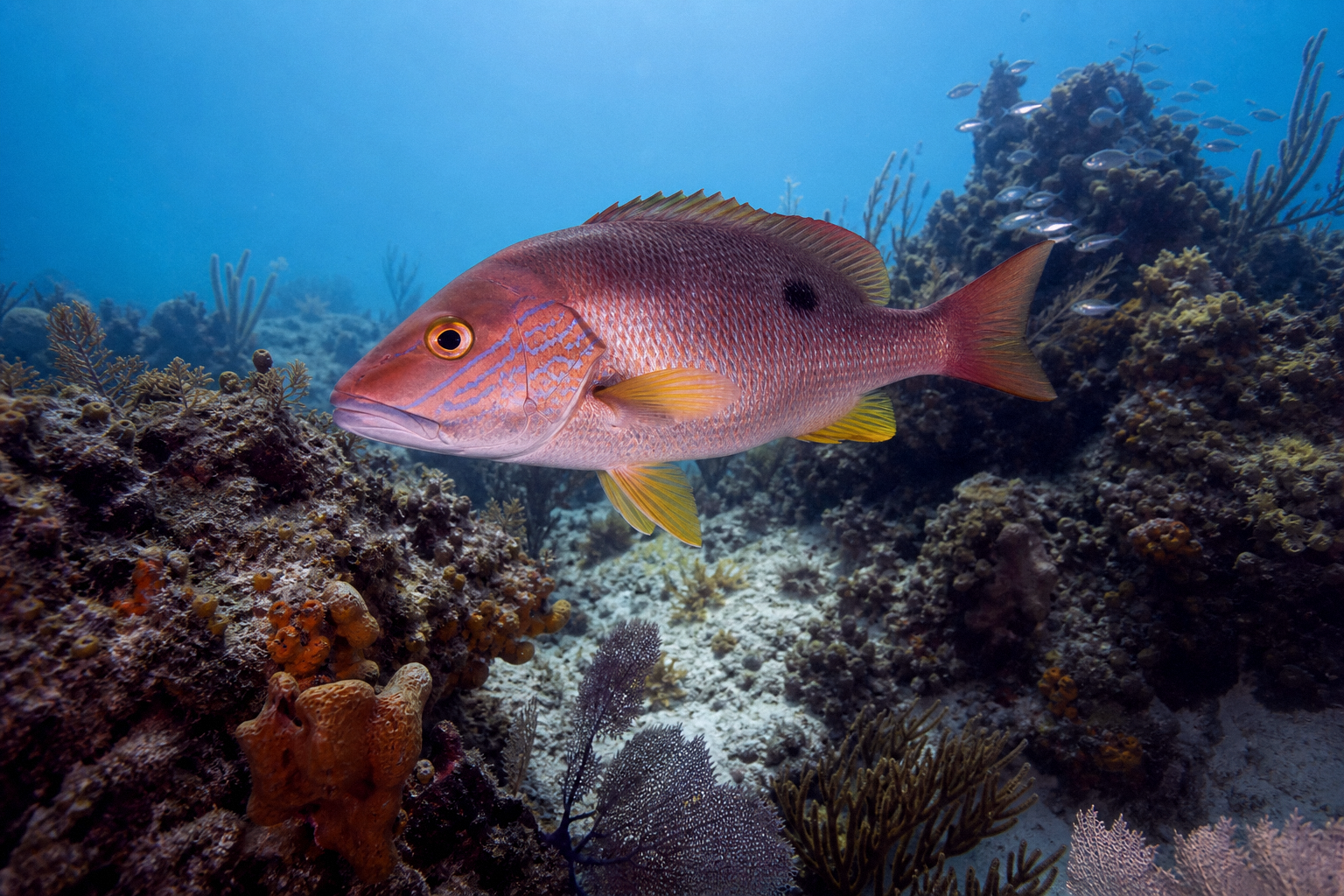
Mutton Snapper
What They Look Like
A mature mutton snapper carries itself with a profile that’s more streamlined than the typical reef snapper — olive across the back, shifting to a warm reddish hue along the flanks, with a pale belly. The telltale mark is a vivid blue stripe tracing from beneath the eye forward toward the snout. A prominent black spot sits high on the flank just below the dorsal fin, larger and more defined than the similar marking on a lane snapper. The tail fin often shows a reddish edge, especially on larger fish. In Virginia offshore waters, mutton snapper typically run 5 to 15 pounds, though specimens topping 20 pounds turn up on deeper structure. The fillets are dense, white, and exceptionally sweet — widely regarded as the finest-eating member of the snapper tribe.
Where They Live
Mutton snapper gravitate toward high-relief bottom — shipwrecks, ledge systems, and live-bottom patches in 80 to 300 feet. Unlike the gregarious vermilion snapper, muttons tend toward solitary behavior, hugging tight to the structure much like a grouper. They are deliberate feeders, often circling a bait several times before committing, which makes fooling one a satisfying challenge. Their diet consists of small reef fish, squid, shrimp, and crabs taken near the substrate. Though more abundant in Florida and the Caribbean, mutton snapper appear with regularity on the deeper wrecks and hard-bottom ledges accessible from Rudee Inlet and Little Creek, particularly along the 30- to 50-fathom curve southeast of the Chesapeake Bay entrance.
How to Catch Them
A Carolina rig with a 6- to 12-ounce egg sinker, 50- to 80-pound fluorocarbon leader, and a 5/0 to 7/0 circle hook is the standard delivery system. Live menhaden or pinfish hooked through the nose and lowered to the bottom near wreckage is the most reliable presentation. Because muttons are leader-wary, stepping down to 40-pound fluoro and lengthening the leader to 6 or 8 feet can make the difference on a slow day. A steady chum line of ground menhaden draws fish up from the structure and puts them in a competitive mood. Deep jigging with butterfly jigs in the 150- to 300-gram class, worked with sharp lifts and controlled drops, triggers reaction strikes from fish holding tight to the wreck.
What They’ll Eat
Live menhaden are the premier offering for mutton snapper off the Virginia coast. Live pinfish and small croaker are equally effective. Cut squid and sardine chunks will catch fish, but live bait consistently outperforms dead offerings for this wary species. Butterfly jigs in blue-and-silver or pink patterns in the 150- to 300-gram range produce when fish are actively feeding. Bucktail jigs tipped with a strip of squid or belly meat also draw strikes. The common thread is a natural drift — mutton snapper inspect every offering carefully and will refuse anything that looks or moves unnaturally.
When and Where in Tidewater
Mutton snapper are present year-round on Virginia’s offshore structure, with the most consistent action from May through October when sea conditions allow regular trips. Productive water lies in 80 to 300 feet — deep wrecks, hard-bottom ledges, and artificial reef sites along the shelf edge. The deeper wrecks southeast of Rudee Inlet and the hard-bottom zones along the 30- to 50-fathom curve hold fish. Most mutton snapper come as a welcome bonus on mixed bottom-fishing trips targeting grouper and red snapper out of Rudee Inlet and Little Creek. They are not a high-volume catch in Virginia waters, but their quality makes every one memorable.
The Rules
Mutton snapper fall under the South Atlantic Fishery Management Council’s snapper-grouper complex. The minimum size is 16 inches total length. The recreational bag limit is part of the snapper aggregate, typically 10 snapper total per person per day across all species. The season remains open year-round. Commercial harvest operates under quota management. Always confirm current rules with the Virginia Marine Resources Commission and SAFMC before heading offshore.