Mussels
What You’re Harvesting
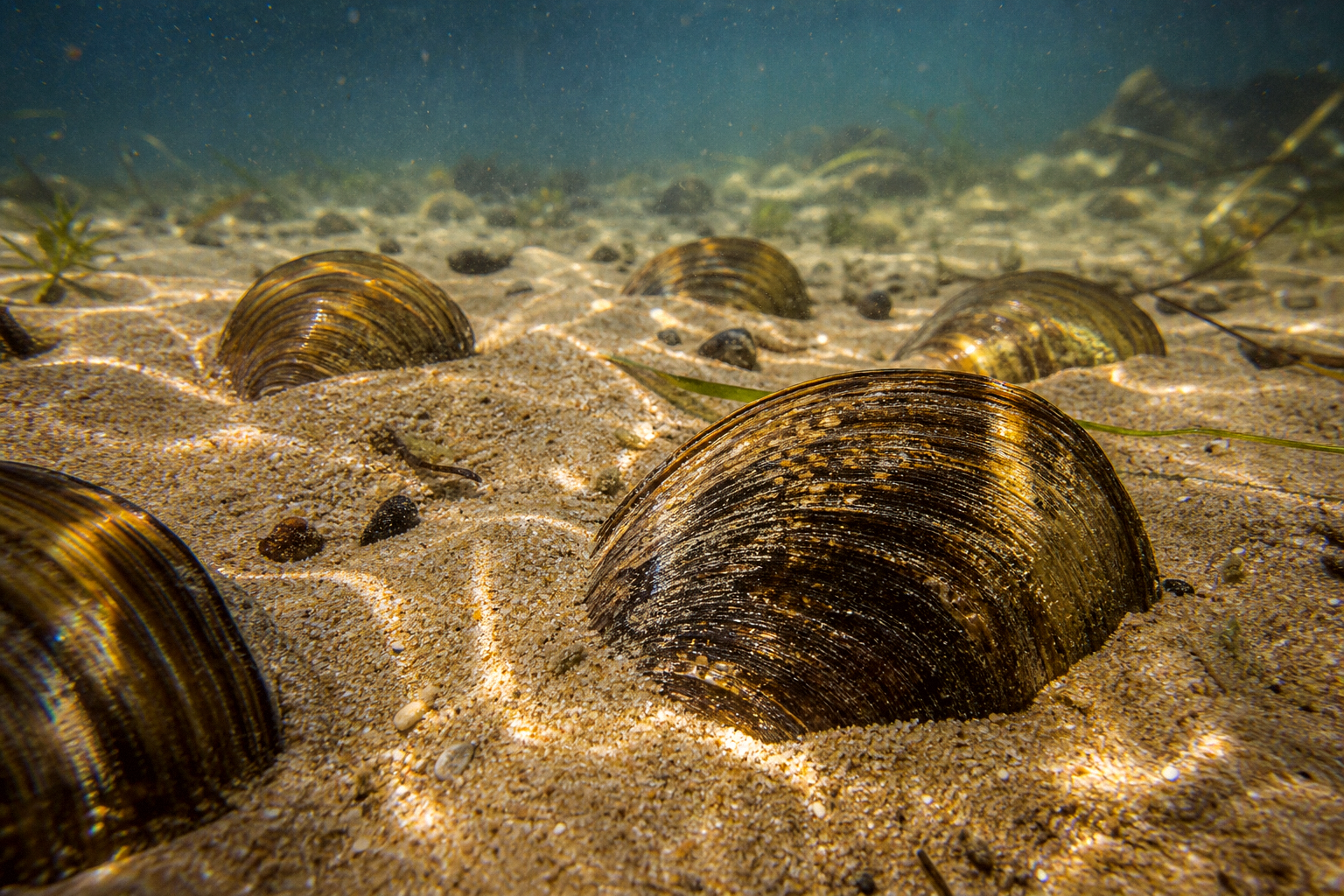
The ribbed mussel is the workhorse bivalve of Virginia’s salt marshes — not as celebrated as the oyster, but vastly more abundant and just as accessible to anyone willing to wade out at low tide. The shell is elongated, dark brown to nearly black, and marked with distinct radiating ridges that run from the hinge line to the outer edge. Mature specimens reach 2 to 4 inches. Unlike the blue mussel of New England waters, ribbed mussels have a firmer, more assertive flavor — they’re not a raw-bar centerpiece, but they shine in chowders, stews, and stuffings, and they make excellent bait. Blue mussels occasionally turn up around Virginia inlets during cold winters but are uncommon. If you’re foraging in a Chesapeake Bay salt marsh, you’re harvesting ribbed mussels.
Where They Live
Ribbed mussels are intertidal specialists, anchoring themselves with tough byssal threads to the base of cordgrass stalks — specifically Spartina alterniflora, the dominant plant of Virginia’s tidal marshes. They also cluster thickly on oyster reef edges, dock pilings, bridge abutments, and any hard surface in the estuarine shallows. The marsh systems of the lower Chesapeake Bay support enormous populations, with dense clusters lining creek banks and marsh edges for miles. As filter feeders, they draw water through their siphons, extracting plankton and suspended organic particles. They handle wide salinity swings and can survive hours of low-tide exposure by sealing their shells tight. Their dense aggregations in the marsh roots actually reinforce the bank against erosion — they’re ecologically important as well as edible. Feeding activity peaks during high tide; at low tide they clamp shut and wait.
How to Gather Them
Mussel gathering is the simplest form of shellfish foraging in Virginia — hands and a bucket are all you need. Walk the marsh edge at low tide and twist mussels free from grass stalks and exposed oyster reef. They detach with a firm rotation. A short-handled rake helps scrape clusters from marsh banks or pilings. Wear sturdy gloves — the shells are sharp and often encrusted with barnacles. The real skill is selection, not collection: choose larger mussels, 3-plus inches, that are tightly closed. Discard any with gaping or cracked shells. After harvesting, scrub the shells clean and remove the byssal threads — the “beard” — before cooking. A 30-minute soak in cold saltwater helps them purge any sand. Tap any mussel that’s open; if it doesn’t close, throw it out.
When and Where to Go
Mussels are available year-round but are best harvested from September through April — the classic “R-month” rule that also governs oyster harvest. Summer’s warm water can elevate bacterial loads and make mussels riskier to consume. The marshes behind the lower Chesapeake and the Eastern Shore hold staggering ribbed mussel populations. The creeks around the CBBT, the Lynnhaven River marshes, and the back-country marsh complexes of Back Bay National Wildlife Refuge are all highly productive. Kayak or skiff access to the marsh edges is ideal — look for the dark clusters visible on grass stalks at the waterline during low tide. The marshes along the James, York, and Nansemond rivers also support dense beds. Calm, mild days with a good low tide are perfect foraging conditions. The Pagan River and the feeder creeks of the lower James are underrated mussel grounds worth exploring.
Regulations
Ribbed mussels are not as tightly regulated as oysters and clams in Virginia, but shellfish sanitation rules apply equally. There is no specific recreational bag limit for ribbed mussels in Virginia state waters, but harvesting from waters closed by VADEQ shellfish sanitation is prohibited. Always check the VADEQ shellfish sanitation closure map before harvesting — areas can be temporarily closed after rainfall due to bacterial runoff. No license is required for hand harvesting from public grounds. Mussels should only be harvested from approved waters and consumed during cooler months when water temperatures are below 70°F. Commercial sale of mussels requires a Shellfish Harvester License and harvesting from certified waters only.