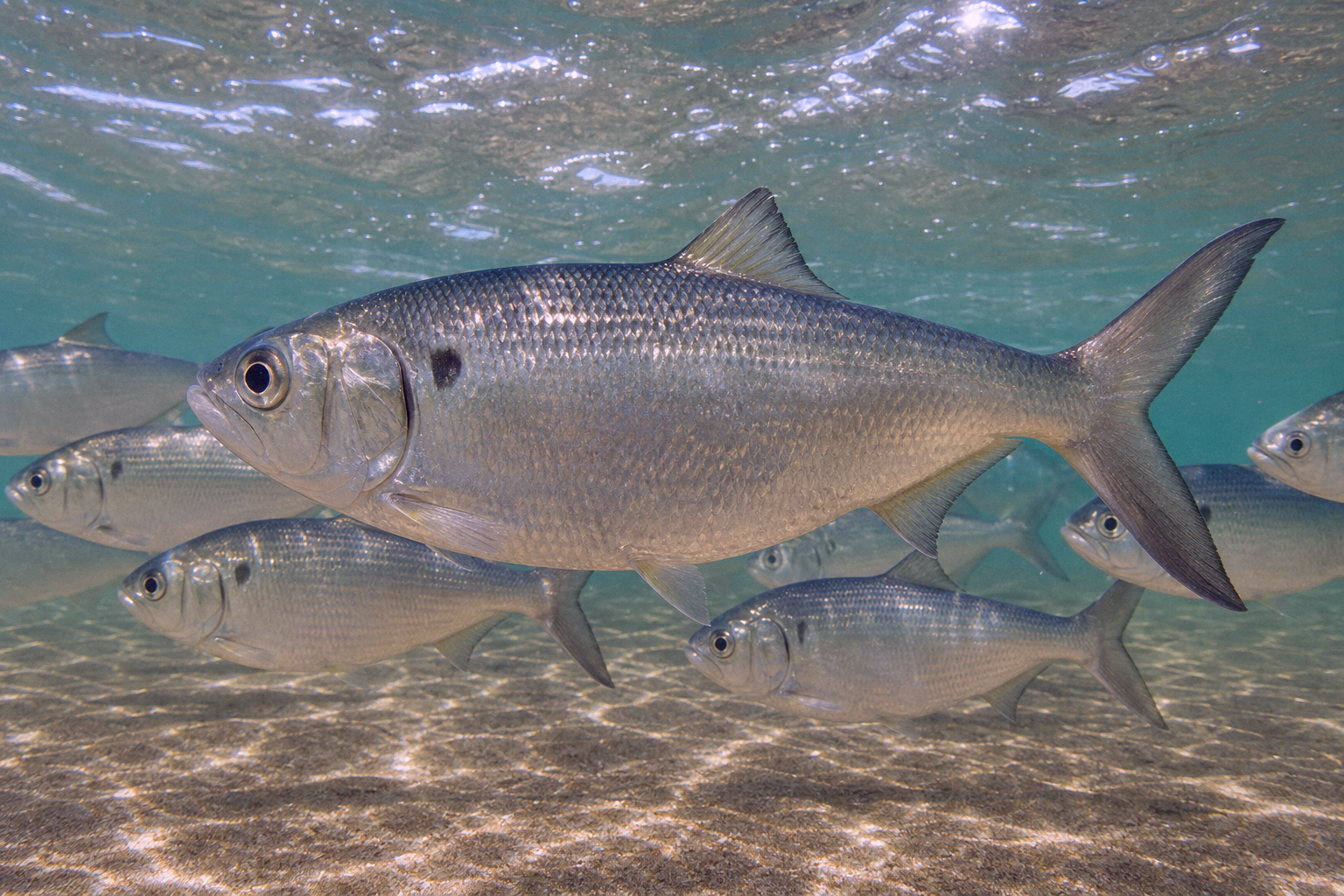
Menhaden (Pogy/Bunker)
Identification
Menhaden — bunker, pogy, fatback, the most important fish in the Atlantic that nobody eats — are members of the herring family (Clupeidae). They’re deep-bodied and silver-sided, with a dark bluish-green back and a prominent black shoulder spot behind the gill plate that is the quickest field mark. They typically run 6 to 15 inches, though larger adults can reach 18. The body is covered in fine, easily-shed cycloid scales, and the tail is deeply forked. The head is disproportionately large with a mouth designed for filter-feeding — menhaden strain plankton from the water rather than chasing prey. They’re not glamorous, but they are the foundation of the entire Virginia sport fishery. Everything eats menhaden.
Habitat and Behavior
Menhaden are the most abundant forage species in Virginia waters, and their presence — or absence — dictates where the gamefish will be. They travel in massive schools, often numbering in the thousands, and are frequently seen dimpling or flipping at the surface as they filter-feed on plankton. In the lower Chesapeake Bay, menhaden move through the CBBT area, Rudee Inlet, and the river mouths in large pulses during spring and fall migrations. Summer brings consistent pods throughout the Bay, particularly around creek mouths and along the Eastern Shore. The fall migration south is one of the most important events in Virginia fishing — vast schools of menhaden pour out of the Bay and down the coast, and every predator in the ocean follows them. Red drum, striped bass, bluefish, cobia, king mackerel, Spanish mackerel, sharks — they all key on menhaden. If you want to know where the fish are, find the bunker.
Fishing Techniques
Anglers don’t target menhaden for the table — they’re oily, bony, and strongly flavored — but catch them specifically for live or cut bait. Cast netting is the most common method: find a school dimpling at the surface in a creek, inlet, or the Bay, and throw a 3/8-inch mesh net over the pod. The lower Chesapeake, Lynnhaven River, and the creeks feeding into the James and York rivers are reliable cast-netting grounds. Snagging is another popular technique: use a heavy sabiki rig or a weighted treble hook (snag hook) and cast into a marked school, jerking the rod to hook fish. Some anglers troll small spoons through schools to hook them incidentally. In the surf, menhaden can sometimes be snagged when schools push close to the beach at Sandbridge or along the Virginia Beach oceanfront.
Baits and Lures
Menhaden are filter-feeders and rarely respond to traditional bait or lures — they’re caught with nets or snag hooks. However, as bait, menhaden are unmatched in Virginia waters. Live menhaden fished on a fish-finder rig or under a balloon is top-tier bait for cobia, king mackerel, and large red drum. Cut menhaden — chunks or fillets — is the standard surf bait for red drum, black drum, and bluefish. The oily flesh releases a strong scent trail that draws predators from long distances. Many Virginia surf anglers freeze menhaden chunks in salt for sessions when fresh bait is unavailable. A well-presented menhaden bait is as close to a guarantee as surf fishing gets.
Best Times and Locations
Menhaden are present year-round but are most accessible from spring through late fall. In April and May, large schools move through the lower Chesapeake and Rudee Inlet as water temperatures rise. Summer brings consistent pods in the Bay, particularly around the mouths of creeks and behind the Eastern Shore. Fall runs bring another wave as menhaden migrate south — this is prime time for surf anglers at Sandbridge, where drum and bluefish crush menhaden schools in the wash. Cast netting in the Lynnhaven River, Little Creek, and the creeks around Hampton and Newport News can yield fresh bunker throughout the summer. For live-lining, the waters around the CBBT and the Bay’s river mouths are reliable producers.
Regulations
Recreational harvest of menhaden for personal bait use generally has no bag limit, though cast net regulations (mesh size, radius) vary by water body. Commercial harvest of menhaden is managed by the Virginia Marine Resources Commission under a quota system. Always check current VMRC regulations before harvesting large quantities. In some Bay waters, netting restrictions may apply in designated nursery areas.