Margate
Spotting One
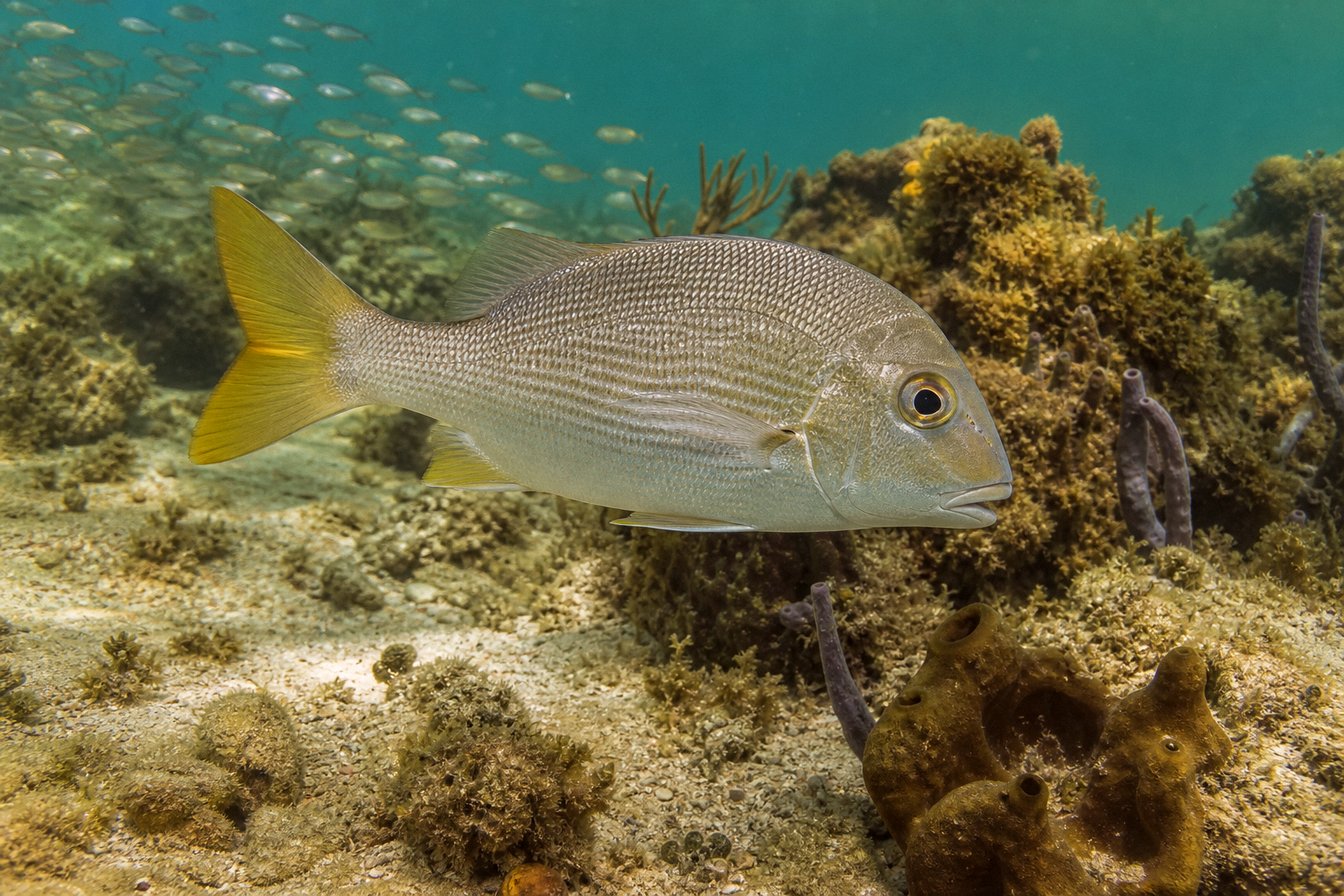
The margate stands apart from every other grunt on the reef — it’s the heavyweight of the Haemulon clan, built like a linebacker among slot receivers. A thick, slab-sided body in pale silver-white, sometimes carrying a faint wash of yellow across the upper back and fins, gives it a clean, unmarked appearance. There are no stripes, no spots, no bars — just a broad, powerful frame that looks like it could pull drag on tackle meant for fish twice its size. The mouth is notably large for a grunt, and the interior is tinged reddish. Virginia specimens commonly span 15 to 22 inches and run 2 to 5 pounds, with the occasional fish pushing past 8. If you pull up something that looks like a grunt that’s been hitting the gym and skipped the stripes, you’ve got a margate.
Life on the Deep Reef
Margate favor the deeper end of the reef spectrum — 80 to 180 feet over hard substrate, shipwrecks, and rocky ledge systems well offshore. They’re a warm-water species whose core abundance lies in the Caribbean and southern Atlantic; Virginia represents the northernmost reach of their regular range, which makes every one a noteworthy catch. Unlike the thick schools of white grunt that blanket shallower structure, margate tend toward solitary habits or small loose groups. Their diet skews toward larger prey — crabs, small fish, and mollusks — and their size lets them bully smaller reef residents away from prime feeding lanes. When one grabs your bait, there’s no mistaking it: the pull is steady, heavy, and determined, far more authoritative than any other grunt.
Getting One to Bite
A standard two-hook bottom rig with 4 to 8 ounces of lead, adjusted for current and depth, is the workhorse setup. Scale up your terminal tackle — 2/0 to 4/0 hooks and 40- to 50-pound fluorocarbon leaders — because margate have the mouth and the muscle to punish light gear. Circle hooks in the 3/0 to 5/0 range work well and simplify release if needed. Drifting over deep hard-bottom patches lets you cover water and locate fish. Once a margate is hooked, the fight is a grinding, head-down pull toward the structure; keep steady pressure and don’t give an inch, because they’ll take every inch you offer.
Bait Selection
Squid strips catch margate, but these fish respond to bigger meals. Cut baits — strips of fresh mullet, menhaden, or bonito — are more effective for drawing strikes from larger specimens. Shrimp and crab pieces produce well, especially when margate are keyed in on crustaceans. Because their mouths are substantially larger than those of other grunts and porgies sharing the same structure, don’t hesitate to fish a bigger bait profile. A whole small crab or a thick strip of fresh cut bait on a 3/0 hook is a solid margate rig.
Prime Season and Spots
Margate show up in Virginia from May through October, with the warmest months delivering the best odds. The deeper reef drops off the Virginia coast in 100 to 180 feet are the primary zone — full-day charter trips running to the far reef complexes out of Rudee Inlet and Little Creek offer the most realistic shot. They’re not a fish you fill the box with; encountering one is a pleasant surprise on a deep bottom trip. The late-summer period, when water temperatures peak on the mid-shelf, provides the best window. Party boats working deep-water drops occasionally pick one up in the mixed bag.
Legal Stuff
Margate fall under Virginia’s unclassified reef fish category, with no dedicated federal bag limit in the South Atlantic region. State-level rules may apply, and the broader reef fish regulatory framework is subject to periodic revision. Always verify current VMRC regulations for any applicable size or bag restrictions before heading out.