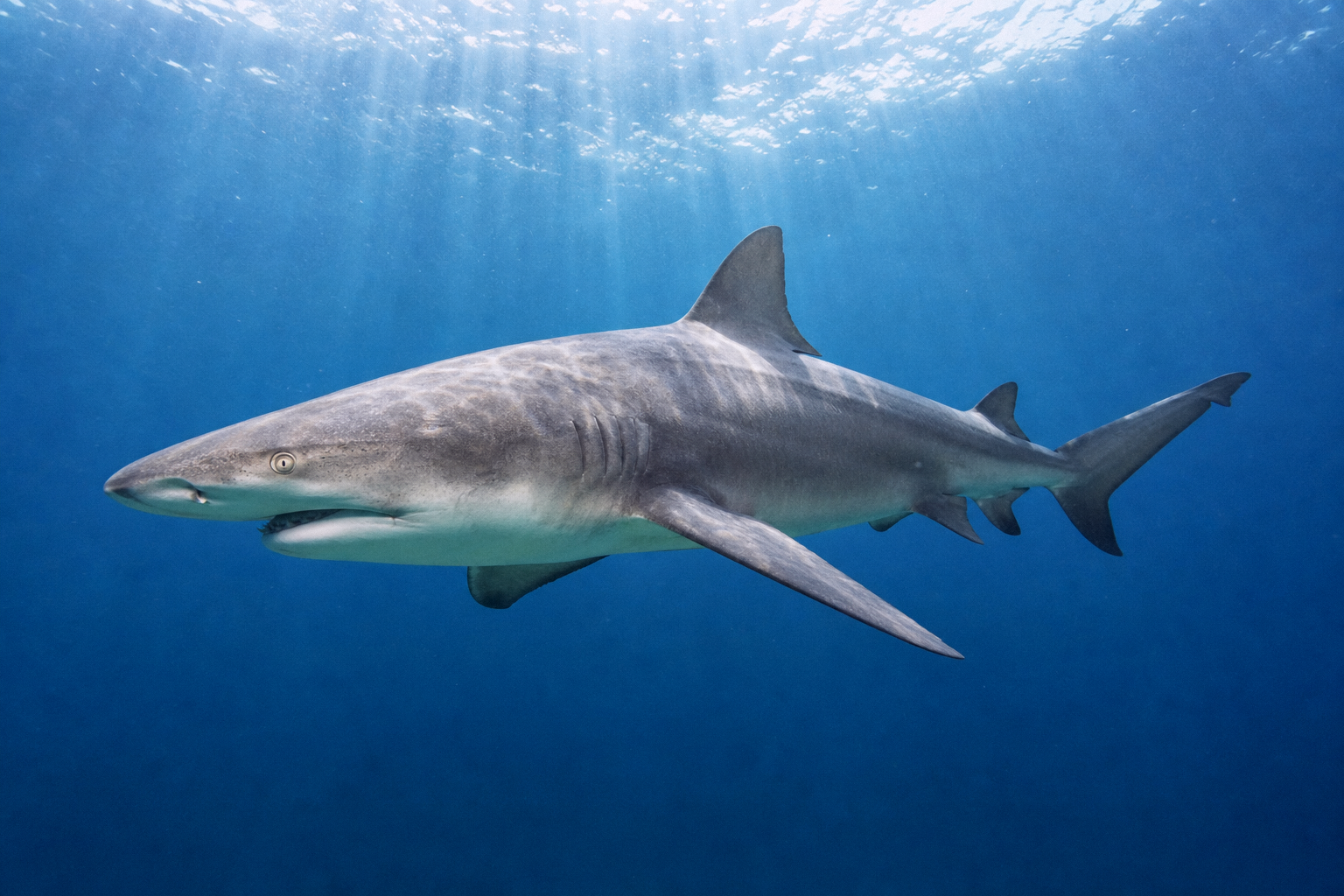
Lemon Shark
Identification
The lemon shark is one of the most distinctive requiem sharks in Virginia waters, named for its unique yellowish-brown to olive coloration — a hue that sets it apart from every other shark species in the region. These are stocky, powerful fish that typically reach 8 to 10 feet in length. The body is robust with a broad, flat snout, and the two dorsal fins are nearly equal in size — the second dorsal is almost as large as the first, which is a key identifying feature. The underside is pale yellowish-white, and the overall coloration is uniform without distinctive markings. They can be confused with bull or sandbar sharks at a distance, but the yellow tint and the equal-sized dorsals are reliable field marks. Get close enough and there’s no mistaking a lemon.
Habitat and Behavior
Lemon sharks favor shallow coastal waters, estuaries, and the lower reaches of tidal rivers. In Virginia, they’re found in the lower Chesapeake Bay, around the CBBT, and in the shallow surf zone during summer months. They are bottom-oriented predators that prefer flat, shallow habitat with muddy or sandy bottom. Their diet includes fish, rays, crabs, and squid. Lemons are relatively sluggish compared to blacktips or spinners, but they’re powerful fighters that use their bulk to wear you down. They’re most active at night and during tide changes, when they move into shallow water to hunt. Lemon sharks tolerate lower salinity than most shark species, which is why they’re found well up into the Bay’s tributaries and river mouths — the James, York, and Nansemond all see lemons during summer.
Fishing Techniques
Lemon sharks are caught both from the surf and from boats in Virginia. For surf fishing, use a heavy rod (11-13 feet) with a 6000-8000 size reel, 30-50 pound braid, and an 80-pound minimum wire leader. Fish a bottom rig with 6-10 ounces of lead in the slough beyond the sandbar. Live baits fished on the bottom are the most productive approach. For Bay fishing from a boat, anchor or drift near flat edges and channel drop-offs in the lower Chesapeake. Bottom fishing with live or cut baits produces lemon sharks throughout the summer. Fish at night for the best action, especially during the incoming tide when lemons move shallow to feed.
Baits and Lures
Live baits are the top choice for lemon sharks. Live mullet and live spot fished on the bottom are consistently productive. The vibration of a live baitfish on the bottom draws lemon sharks, which rely heavily on scent and electroreception to locate prey. When live bait is unavailable, fresh cut mullet chunks, bluefish strips, and menhaden produce well. Lemon sharks are scent-driven feeders, so fresh, oily baits are essential. Use larger baits than you would for sharpnose — a whole mullet or a 4-inch chunk of fresh cut bait is appropriate. An 8/0 to 10/0 circle hook on a wire leader is the standard rig.
Best Times and Locations
Lemon sharks are summer visitors to Virginia, present from June through October with peak activity in July and August. The lower Chesapeake Bay and its river mouths are the primary habitat, particularly the shallow flats and channel edges near the CBBT and the Eastern Shore. Rudee Inlet and the nearshore ocean off Virginia Beach are productive for both surf and boat fishing. Sandbridge and the Back Bay area can produce lemon sharks in the surf during summer nights. The waters around Kiptopeke and the lower Eastern Shore are also worth exploring. Fish at night during tide changes, especially the incoming tide, for the best results.
Regulations
Lemon sharks are prohibited from recreational harvest in Virginia state waters — catch and release only. They are managed under the prohibited species category by the Atlantic States Marine Fisheries Commission. If you catch a lemon shark, handle it carefully and keep it in the water at all times. Use a dehooker or cut the leader close to the hook if the hook cannot be safely removed. Lemon sharks are slow-growing and have low reproductive rates, making them vulnerable to overfishing. Support the body during release, allow the shark to recover in moving water, and let it swim away under its own power. Report any tagged lemon sharks to the appropriate research program.