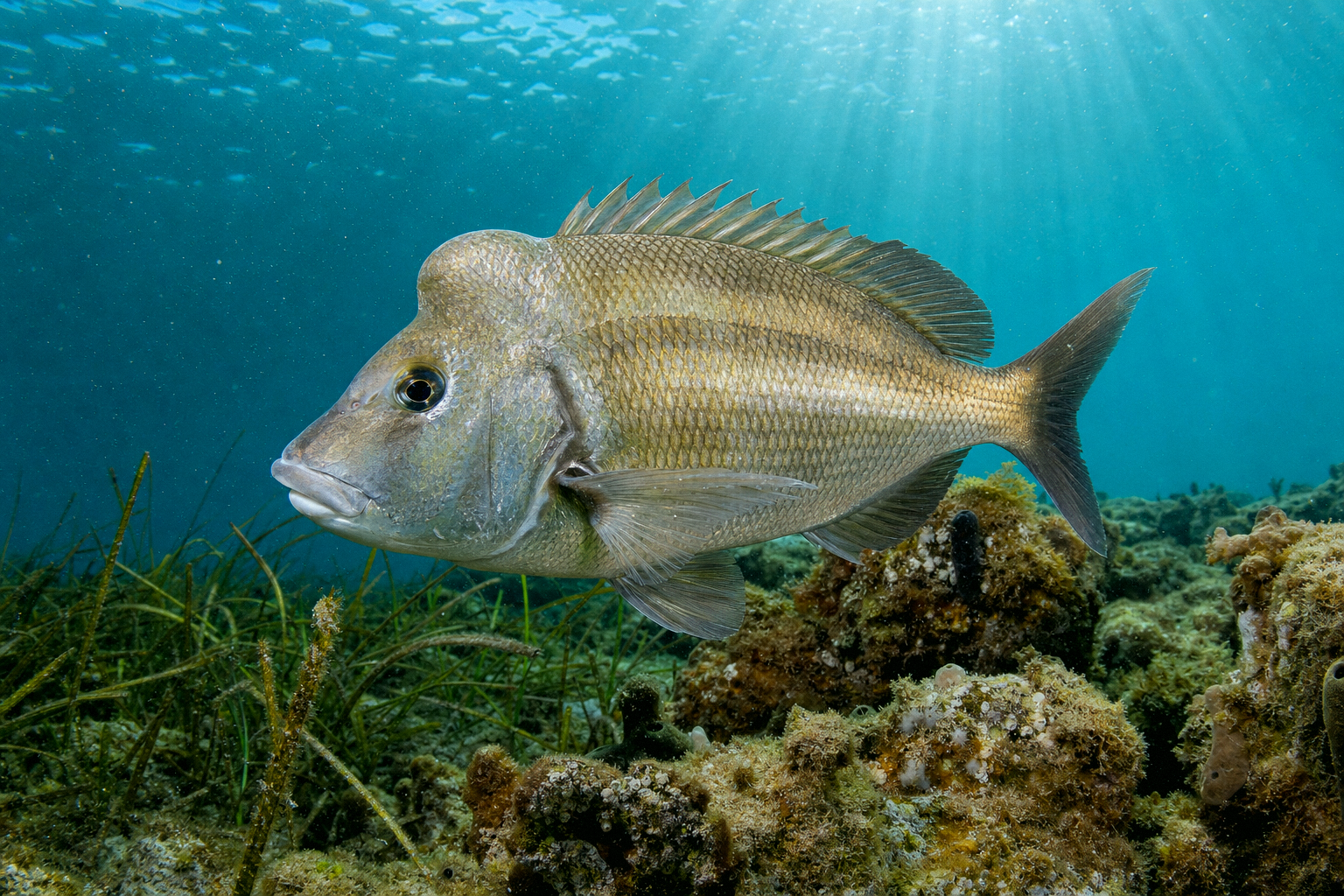
Knobbed Porgy
How to Recognize One
The name tells the story: a bony bump sits on the forehead right above the eyes, and it gets more pronounced as the fish ages. That single feature separates knobbed porgy from every other Calamus species on the reef at a glance. The body is deep and slab-sided, silver with a warm golden or brassy sheen, and faint vertical bars often ghost across the flanks. Like all members of its genus, it packs a set of heavy molar-like teeth in the throat designed for one purpose: crushing shells. Most Virginia specimens measure 14 to 18 inches and weigh 1 to 3 pounds. On a mixed reef drop, the head knob is the quickest way to sort knobbed from whitebone and jolthead porgies in the box.
Where They Hang Out
Knobbed porgy gravitate toward hard-bottom terrain with genuine vertical relief — limestone ledges, large wrecks, and rocky outcroppings in 60 to 160 feet off the Virginia coast. Flat hard bottom holds fewer of them; they want structure they can work against. Their entire feeding strategy revolves around shellfish: crabs, shrimp, sea urchins, snails, and small bivalves all get crushed by those molar plates. They school alongside other porgy species and are routinely caught in the same drops that produce red porgy, triggerfish, and black sea bass on Virginia’s mid-shelf reefs. When the bottom bite is steady, knobbed porgy are reliably part of the mix.
Rigging Up
The two-hook bottom rig with 3 to 6 ounces of lead is the standard delivery system. Hooks in the 1/0 to 2/0 range match the knobbed porgy’s medium-sized mouth. Circle hooks are the smart choice — the fish hooks itself, and deep-hooking is rare. Drifting over hard-bottom patches lets you locate concentrations; once a school is found, holding position over the spot can produce fish after fish. In clear water, stepping down to 25- to 35-pound fluorocarbon leaders can coax bites from finicky fish that are inspecting baits carefully.
What They’ll Eat
Squid strips are the universal porgy bait and work perfectly well. But given the knobbed porgy’s shellfish-heavy diet, shrimp and small crab pieces are especially effective — they’re eating what you’re offering. Cut strips of mullet or menhaden also produce. The critical detail is hook security: porgies are masters at stripping a bait without touching steel. Thread the bait firmly up the shank. Small jigs tipped with a squid strip, worked vertically near the substrate, can draw strikes from larger, more aggressive individuals.
Timing and Territory
Knobbed porgy are caught from May through October, with the peak window running July through September when water temperatures climb on the mid-shelf reefs. Productive zones include the hard-bottom patches off the Virginia Beach coast in 80 to 140 feet, the ledge and wreck systems off the Eastern Shore, and the artificial reef network deployed along the central Virginia shelf. Full-day charter and party boat trips that push out to the deeper reef complexes are the most reliable way to find knobbed porgy in numbers worth targeting.
Keeping It Legal
Knobbed porgy are covered under Virginia’s aggregate porgy regulation — typically 10 fish per person per day with a 10-inch minimum size. The snapper-grouper complex rules are updated periodically. Always confirm current limits with VMRC and the South Atlantic Fishery Management Council before your trip.