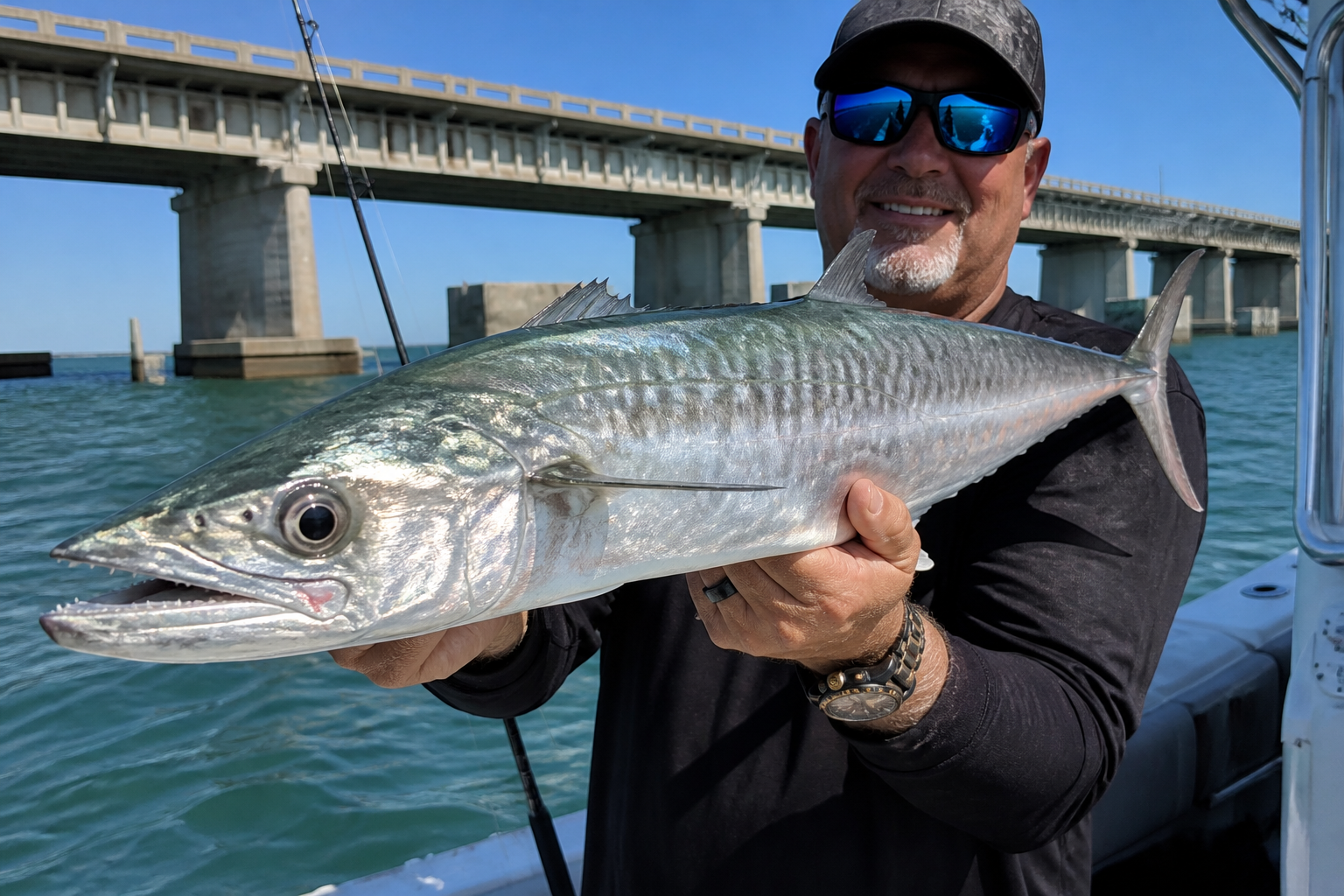
King Mackerel
Identification
King mackerel — “kingfish” to every angler from Hampton Roads to the Eastern Shore — are the streamlined apex predators of Virginia’s nearshore waters. These fish run 5 to 30 pounds commonly, with trophy “smoker” kings pushing 40 to 50-plus pounds. The body is pure pelagic engineering: iridescent silver sides, a blue-green back, a sharply pointed snout, and a mouth full of razor-sharp triangular teeth. The lateral line drops sharply below the second dorsal fin — a key field mark. Unlike Spanish mackerel, which have bronze spots, kings have a clean, unspotted body. If you’re not using wire leader, you’re not fishing for kings — those teeth will slice through mono or fluoro like it isn’t there.
Habitat and Behavior
King mackerel migrate along the Virginia coast from spring through fall, tracking warm water and bait concentrations. They stage over nearshore reefs, wrecks, live bottom, and hard-bottom ledges in 30 to 80 feet of water. They also patrol inlet mouths and the beachfront, especially during the fall mullet run when bait pours out of the Chesapeake. Kings are ambush predators that use structure and current to their advantage, typically holding on the up-current side of wrecks and reefs where baitfish are swept past. Their diet is dominated by menhaden, cigar minnows, bluefish, and other baitfish. Smoker kings often travel in pairs or small groups, while smaller “snake” kings school more loosely.
Fishing Techniques
Slow trolling live bait is the premier technique for Virginia king mackerel. Live menhaden trolled at 1-2 knots over reefs and wrecks is the gold standard. The rig is a two-hook stinger setup with #4 or #6 treble hooks on 30-40 pound wire — the stinger trails back into the bait’s tail to catch short-striking fish. Live cigar minnows and rigged ballyhoo also produce. When trolling dead bait, skirted ballyhoo or ribbonfish work well at slightly higher speeds. Downriggers or planers get baits deeper when fish are holding below the surface. Drifting live bait over wrecks while anchored, or slow-trolling in a current seam, is another effective approach. The strike is unmistakable — a screaming run that peels line at a rate that makes your reel sing.
Baits and Lures
Live menhaden are the undisputed champion — cast-net them in the lower Chesapeake or buy them at the bait dock and keep them lively in a round livewell. Live cigar minnows are the next best option and are often available around nearshore reefs. Rigged ballyhoo on a kingfish rig with a skirted head is the standard dead-bait trolling offering. Ribbonfish trolled on wire rigs are deadly for bigger kings, especially at dawn and dusk. Bluefish strips and squid strips on a slow-trolled rig can also produce. For hardware, Drone spoons and Clark spoons trolled behind planers catch kings when fish are keying on small bait.
Best Times and Locations
King mackerel fishing in Virginia runs from April through November, with the best action in May-June and again September-October. Spring brings the first wave of fish to nearshore reefs off the Virginia Beach coast and the CBBT. Fall produces the biggest fish as smoker kings follow the mullet migration south. Prime locations include the waters off Rudee Inlet, the CBBT reef complex, the Tower off Virginia Beach, and the live bottom south of the inlet. The wrecks and artificial reefs accessible from the lower Chesapeake and the Eastern Shore are productive. Early morning and the hour around tide changes are prime feeding times.
Regulations
King mackerel are managed jointly by the South Atlantic Fishery Management Council and the Atlantic States Marine Fisheries Commission. The recreational bag limit is 2 per person per day with a minimum fork length of 24 inches. The season is open year-round in both state and federal waters. Virginia state waters extend to 3 miles; federal waters extend from 3 to 200 miles. A NOAA Fisheries permit is not required for recreational anglers in private vessels. Check VMRC and SAFMC for the latest regulations and any seasonal adjustments.