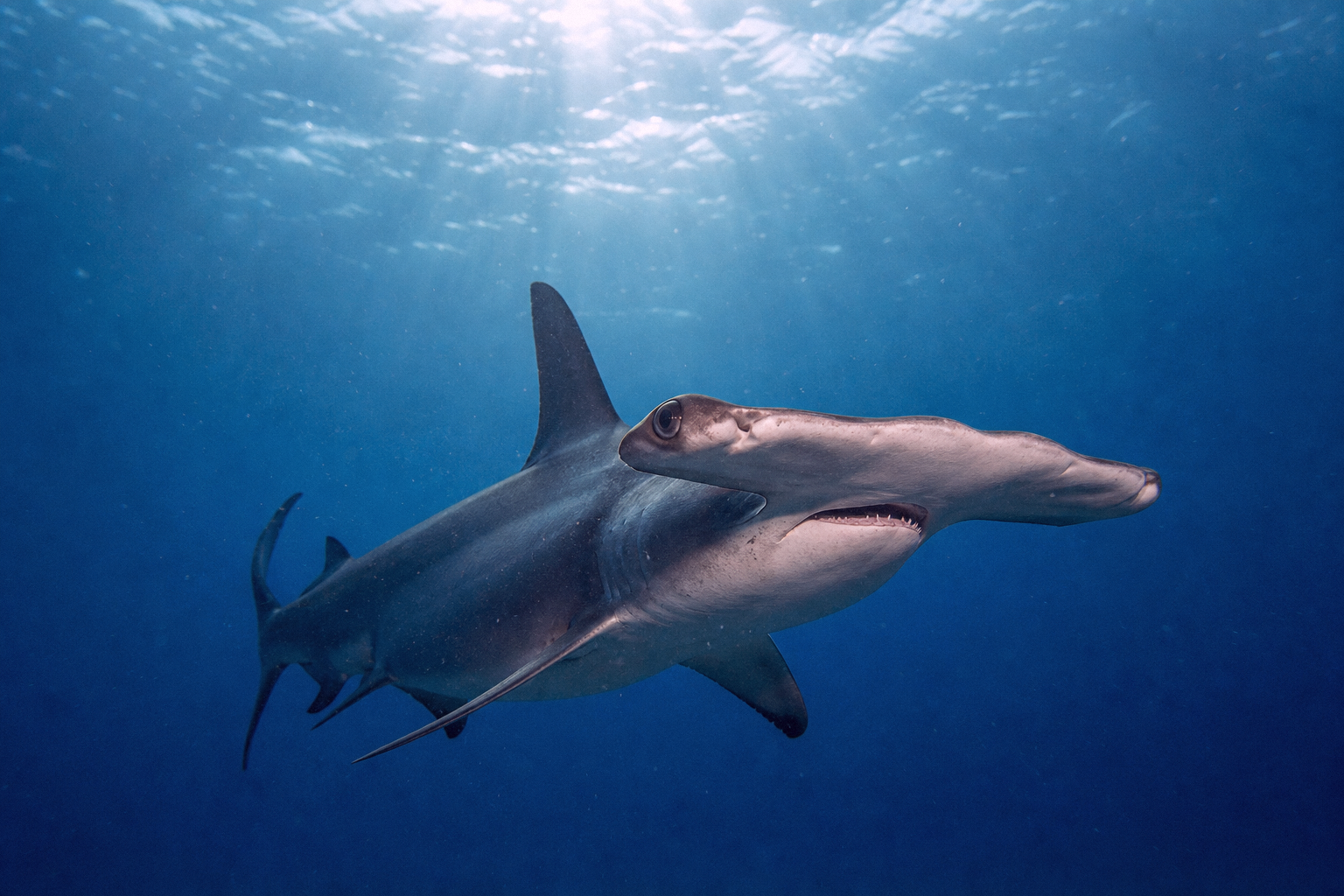
Hammerhead Shark (Great, Scalloped, Smooth)
Identification
Three hammerhead species patrol Virginia waters each summer: the great hammerhead (Sphyrna mokarran), the scalloped hammerhead (Sphyrna lewini), and the smooth hammerhead (Sphyrna zygaena). All share the unmistakable cephalofoil — that wide, flattened head with eyes positioned at the outer edges, like a swimming hammer. The great hammerhead is the giant of the group, reaching 12 to 15 feet, with a notched leading edge on the cephalofoil and an enormously tall, sickle-shaped dorsal fin that is unmistakable when it breaks the surface. Scalloped hammerheads run 8 to 10 feet and have a distinctly scalloped front edge on the head — hence the name. Smooth hammerheads, the rarest of the three in Virginia, have an unnotched cephalofoil and reach similar sizes to the scalloped. If you see a dorsal fin that looks too tall and too curved to belong to anything else, you’re looking at a great hammerhead.
Habitat and Behavior
Hammerheads are warm-water visitors, drawn to the Virginia coast from June through October by rising temperatures and abundant prey. Great hammerheads favor deeper nearshore waters and inlet areas, often shadowing schools of cownose rays, tarpon, and other large prey. They are specialist stingray hunters — the cephalofoil is packed with electroreceptors that detect buried rays in the sand. Scalloped hammerheads are more social, traveling in schools and frequently encountered in the lower Chesapeake Bay and around the CBBT. All hammerheads are most active from dusk through the night, when they move into shallower water to feed. They prey on fish, rays, squid, and other sharks.
Fishing Techniques
Targeting hammerheads from the Virginia surf demands serious gear. A 13-foot or longer surf rod paired with a large conventional reel, 50-80 pound braid, and a minimum 150-pound wire cable leader is the starting point. Kayak-delivered baits past the outer sandbar are the standard approach at Sandbridge and along the Eastern Shore beaches. Paddle the bait out 200-300 yards, drop it, and return to shore to wait. Fish at night for the best odds. Great hammerheads are particularly wary — long, quiet soaks with minimal disturbance around the rod are essential. For boat anglers, drifting large live baits in deep water near the beach or in the channels around the CBBT produces encounters. Trolling can also draw strikes from actively feeding fish.
Baits and Lures
Live bait is the top offering, especially for great hammerheads. A live bluefish is one of the most effective — the vibration and scent carry far in the water column. Live menhaden and large live mullet also produce. For cut baits, whole fresh bunker and large chunks of tuna or bonito are effective. Scalloped hammerheads are less selective and will take smaller offerings, but great hammerheads want a substantial meal. Use 10/0 to 12/0 circle hooks on heavy cable leaders. Freshness and size of the bait are the most important factors for consistent success.
Best Times and Locations
Hammerheads appear off Virginia from June through October, with peak encounters in July and August. Sandbridge is the premier surf-fishing location for all three species, particularly great hammerheads — the deep-water access and proximity to the Gulf Stream create ideal conditions. The beaches of False Cape and Back Bay also produce. Scalloped hammerheads are more frequently encountered in the lower Chesapeake Bay and around the CBBT. The Kiptopeke area on the Eastern Shore can produce hammerheads during summer nights. Fish from dusk through the night, especially during tide changes. Calm, warm water following southerly winds creates the best conditions.
Regulations
Great hammerhead and scalloped hammerhead sharks are prohibited from recreational harvest in Virginia state waters — catch and release only. Smooth hammerhead has a minimum size of 54 inches fork length. All hammerhead species must be landed with head, tail, and fins naturally intact. Hammerheads are particularly vulnerable to catch-and-release mortality — they have high metabolic demands and can die from exhaustion more readily than other shark species. Minimize fight time, keep the shark in the water at all times, and release quickly. Never lift a large hammerhead by its cephalofoil. Cut the leader close to the hook if the hook cannot be safely removed.