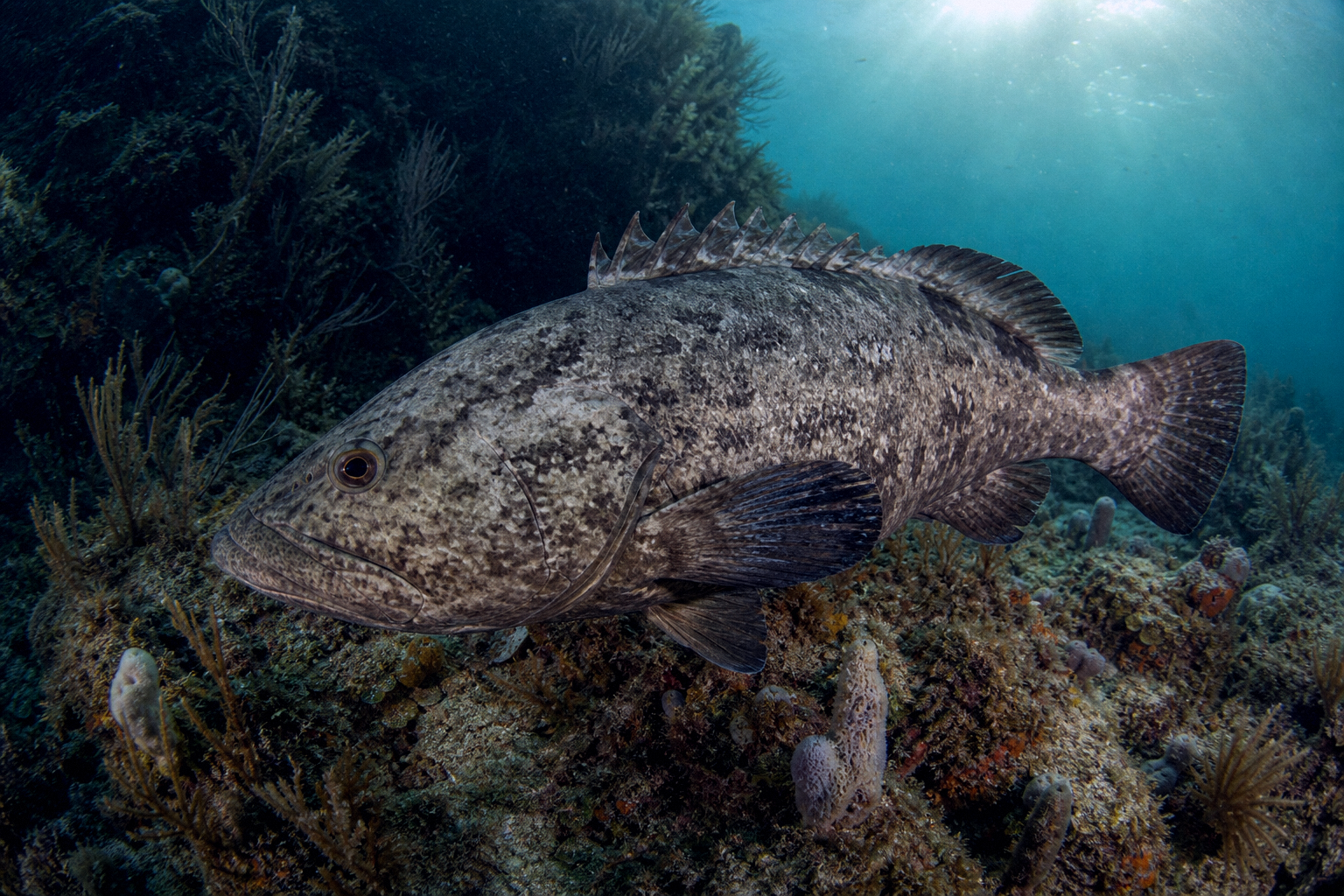
Gag Grouper
Identification
Gag grouper are the heavyweight bottom brawlers of Virginia’s offshore wreck fleet. These fish reach 50-plus pounds and carry a mottled brown-to-gray body with irregular darker blotches that shift with mood and surroundings. The body is elongated and muscular — built for power, not speed. The tail fin is slightly concave, and the lower jaw protrudes just past the upper, giving them a permanent underbite. Color phases range from nearly black (“gray grouper”) to a lighter tan with heavy mottling. The telltale sign on a big gag is a dark, mustache-like marking near the maxillary bone on the snout. If you’re pulling on something that feels like a submerged cinder block, you’re probably into a gag.
Habitat and Behavior
Gag grouper are structure fanatics. They live in and around wrecks, rock ledges, artificial reefs, and any hard bottom with enough relief to provide an ambush point. Off the Virginia coast, productive gag water starts around 60 feet and runs out past 300, with the sweet spot in 80 to 180 feet over high-relief structure. They tuck into caves, under ledges, and inside wreck cavities, waiting for prey to wander within range. Their diet is almost entirely fish — menhaden, croaker, pinfish, small grunts, and squid. Gag are protogynous hermaphrodites: every fish starts life as a female and transitions to male as it ages and grows, which is why the largest specimens are almost always males.
Fishing Techniques
The standard approach is brutally simple: drop a live bait on heavy tackle directly onto structure and hold on. A Carolina rig with 8 to 16 ounces of lead, an 80-100 pound fluorocarbon leader, and a live menhaden or pinfish is the go-to. The strike is violent — a gag inhales the bait and immediately bolts for cover. You have seconds to turn its head before the leader meets sharp wreckage. Crank hard and don’t give an inch. Bucktail jigs in the 4-8 ounce range, tipped with a strip of fresh bait and worked aggressively near the bottom, draw reaction strikes from fish that ignore live bait. Trolling deep-diving plugs like Mann’s Stretch 30+ or Rapala X-Rap Magnums over live bottom in 50-90 feet is an effective search pattern for locating new structure holding gags.
Baits and Lures
Live menhaden — big, oily, and abundant in the Chesapeake — are the premier gag bait. A lively 8-12 inch bunker dropped to the bottom over a wreck is as close to a guarantee as offshore fishing gets. Live pinfish and croaker are equally effective. Cut bait (fresh mullet, menhaden, or squid) works for smaller fish. Bucktail jigs in white, pink, and chartreuse, dressed with a strip of fresh bait, are the choice for anglers who prefer active jigging over soaking bait. Deep-diving plugs in menhaden or mullet patterns, trolled at 4-6 knots, trigger aggressive strikes from gags patrolling above structure.
Best Times and Locations
Gag grouper are available May through December off Virginia, with the season closed January through April for spawning. The offshore wrecks running from the Virginia Beach coast out to the 30-fathom curve are the primary grounds. Charter boats departing Rudee Inlet and the Lynnhaven area run regular bottom trips targeting gags alongside seabass, tilefish, and other reef species. The Triangle Wrecks, the artificial reef network off Virginia Beach, and the deeper ledges along the continental shelf edge all hold fish. The waters off the Eastern Shore, accessed from Wachapreague or Kiptopeke, offer less-pressured structure worth exploring. Full-day trips are the norm — gag fishing is a commitment, but the payoff is a cooler full of some of the finest-eating fish in the Atlantic.
Regulations
Gag grouper fall under the South Atlantic Fishery Management Council. The recreational season opens May 1 and closes December 31, with a spawning closure January 1 through April 30. Minimum size is 24 inches total length. The bag limit is 2 gag per person per day within the aggregate grouper limit. Always verify current VMRC and SAFMC regulations before your trip — grouper management measures are adjusted based on annual stock assessments.