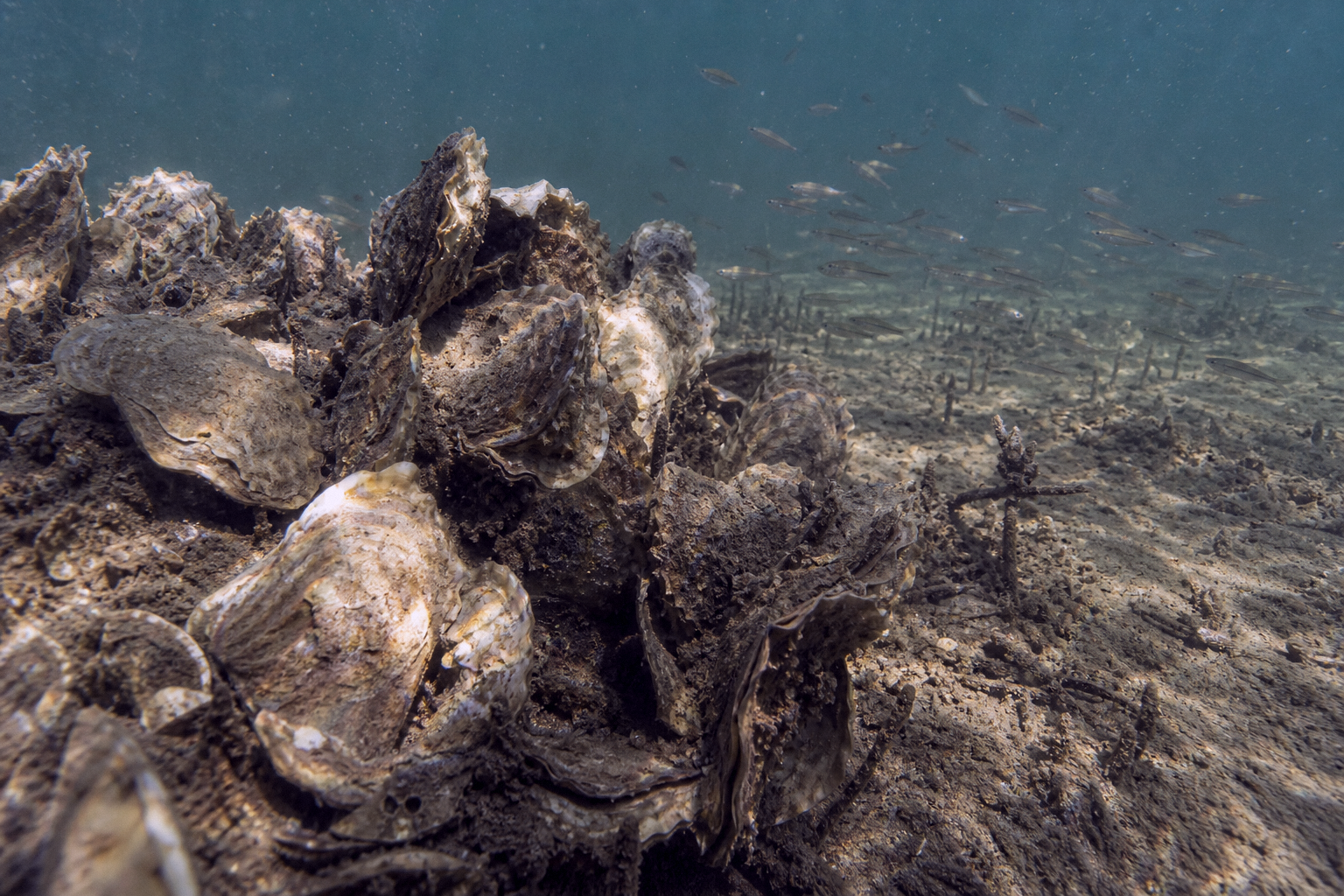
Eastern Oyster
What You’re Looking At
Picture a rough, asymmetrical shell — gray-white to deep brown, fluted and jagged, often fused to its neighbors in dense clusters. That’s Crassostrea virginica, the native bivalve that built the Chesapeake’s legendary reef systems. Individual animals span anywhere from a couple of inches to eight, though the law says keepers must measure at least three. A healthy specimen clamps its two valves shut tight; if the shells gape open, the creature inside is dead and should be discarded. Crack one open and you’ll find cream-to-pale-gray meat swimming in liquor that tastes exactly like the creek it came from — Lynnhaven oysters carry a different signature than James River oysters, and both differ from Eastern Shore seaside stock.
How They Live
Oysters spend their entire adult existence cemented in one spot. A free-swimming larva settles onto hard substrate — almost always the shell of another oyster — and never moves again. Generation after generation stacks up, creating three-dimensional reefs that function as the Bay’s biological engine rooms. Each grown oyster pumps up to 50 gallons of water through its gills daily, straining out algae and suspended particles. They thrive in brackish zones where salinity runs between 5 and 30 parts per thousand. Spawning kicks off when summer water temperatures climb past 68°F, which is precisely why the traditional harvest calendar runs through the cooler months — September to April, the old “R-month” rule. During low tide, intertidal reefs sit exposed to the air, and oysters simply seal up and wait for the water to return.
Gathering Your Own
Walking the flats at dead low tide is the simplest method. Wade out onto exposed reef in the shallows, pick legal-sized clusters by hand, and drop them in a bushel basket or mesh sack. A short-handled garden rake helps pry apart cemented clumps. For subtidal reefs that never go dry, the traditional tool is a pair of oyster tongs — long wooden handles joined at a pivot with basket-like heads at the business end. Lower them from a skiff, sweep the jaws together to grab a cluster, and haul it up. It’s honest physical work. Bring heavy gloves; the shells are razor-edged and will slice bare skin without hesitation. A culling gauge lets you check size before the oysters go in the basket. Waders or beat-up sneakers are mandatory — you’ll be standing in mud and shell.
Where and When
Virginia’s public oyster season generally opens October 1 and closes March 31. The Lynnhaven River system, from the Lesner Bridge up through the western branch, has been the focus of intensive restoration and now produces outstanding oysters. The seaside of the Eastern Shore — the waters around Oyster, Willis Wharf, and the barrier island marshes — holds extensive natural reefs. Public grounds exist in the James River near the James River Bridge and in the Nansemond River above Suffolk. The York River around Gloucester Point is traditional oystering territory. Time your trips for the bottom of the tide; consult a tide chart and be on the flats as the water drops. Pick calm, mild winter days. Skip any period right after heavy rain — runoff triggers temporary sanitation closures. Always check the Virginia Department of Health shellfish map before heading out.
Rules to Know
The VMRC sets recreational harvest at one bushel per person daily, with a two-bushel cap per vessel regardless of passenger count. Walking the flats and picking by hand requires no license. Harvesting from a boat using tongs or rakes may require a recreational license. Leased and private grounds are off-limits without the leaseholder’s permission. The three-inch minimum is enforced. Decades of restoration work — especially in the Lynnhaven — have brought Virginia’s oyster population back from the brink. Harvest responsibly so the recovery continues.