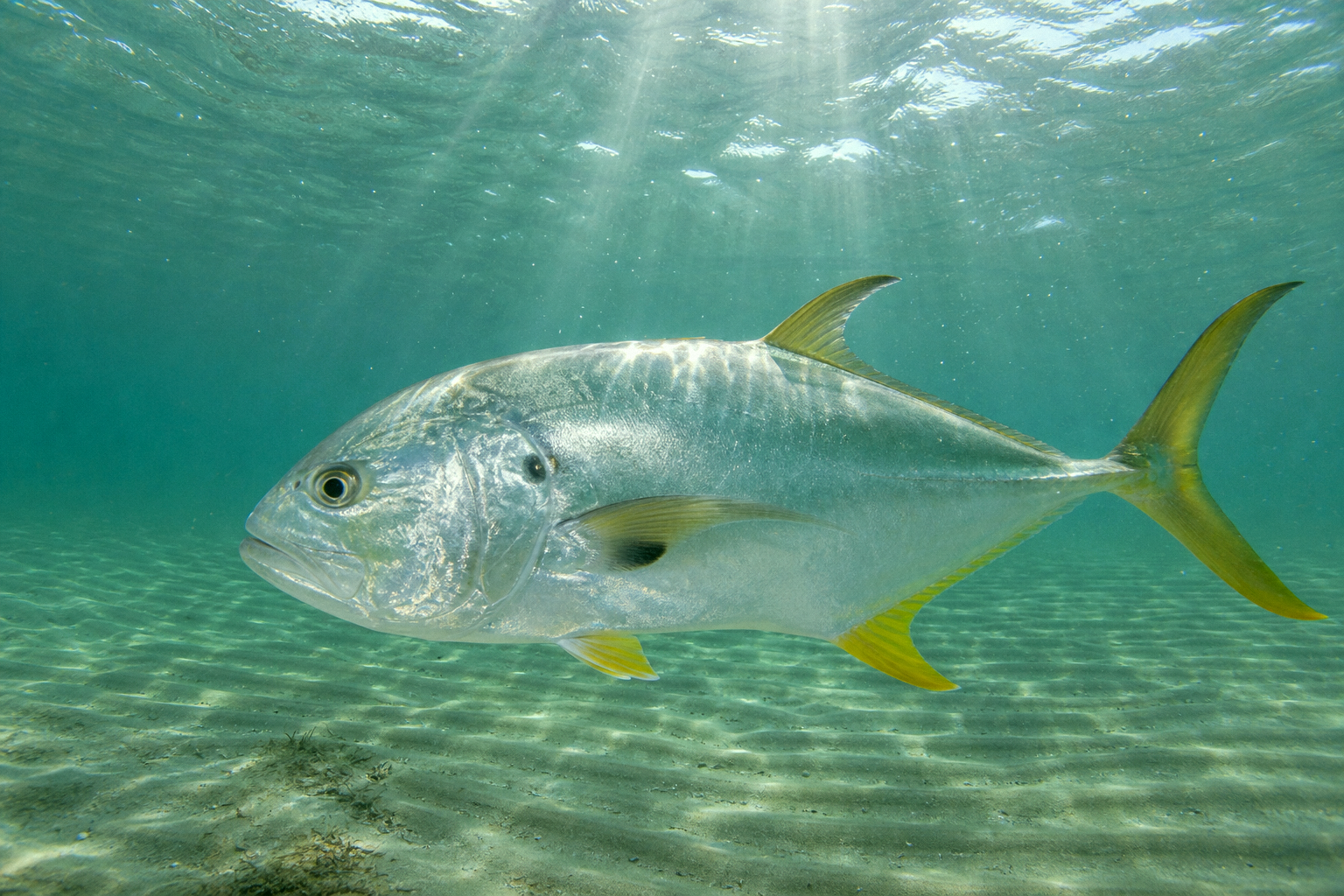
Crevalle Jack
Identification
Crevalle jacks are the brawlers of the jack family in Virginia — thick through the shoulders, deep in the chest, and possessed of a fighting spirit that borders on unreasonable. Most run 5–20 pounds, with 30–40 pound specimens possible. The body is slab-sided and tall, colored dark olive to blue-green above, silver to brassy-yellow along the flanks, with a yellowish tail. Two black blotches serve as field marks: one on the lower rear of the gill plate, another at the pectoral fin origin. The head is blunt and the profile is dramatically deeper than a blue runner. A fleshy eyelid partially sheathes the eye, a trait shared across the Caranx genus.
Habitat and Behavior
Few inshore predators match the crevalle jack’s adaptability. They show up in the ocean surf, around inlet jetties, on nearshore reefs, and deep inside the Chesapeake Bay — even pushing into the tidal James and York Rivers during summer. They hunt in wolf packs, corralling menhaden and mullet against shorelines and sandbars, then detonating through the bait in explosions of whitewater. The fight is legendary: a hooked crevalle uses its broad flank and powerful tail to make long, grinding runs that test tackle to failure. They strike lures with reckless abandon when in a feeding mood and will chase down anything that looks like escaping prey.
Fishing Techniques
Topwater fishing for crevalle jacks is pure adrenaline. When fish are blitzing bait on the surface, fire a popper or walking plug into the melee and work it with sharp, aggressive sweeps. Pencil poppers, spook-style walkers, and chuggers in silver, white, and chartreuse all draw explosive strikes. When fish are holding deeper or not showing on top, swim jigs and bucktails worked through the water column produce. Live menhaden or mullet on a fish-finder rig or suspended under a float works when fish are staged around structure. Spotting a school of jacks cruising in shallow water and casting ahead of them is one of the most electric moments in Virginia inshore fishing. Use 30–50 lb fluorocarbon leader — jacks don’t have cutting teeth, but their tail-slapping runs and sheer power abrade lighter material.
Baits and Lures
Topwater plugs lead the list — pencil poppers, spook-style walkers, and chuggers in silver/white get crushed. Swimming jigs of 1–3 oz in chartreuse and white, bucktails dressed with grub tails, and soft plastic swimbaits all produce. Live menhaden is the top natural bait — hook through the nostrils or behind the dorsal and let it swim. Live mullet, peanut bunker, and pinfish also work. Circle hooks in 5/0–7/0 are standard for live bait.
Best Times and Locations in the Chesapeake Bay
Crevalle jacks appear from May through October, with July, August, and September delivering peak action. The CBBT is a magnet — jacks stack up around the rock islands when menhaden schools push through the area. The Rudee Inlet mouth and the Virginia Beach oceanfront produce fish through summer. The lower Bay around Kiptopeke and the channels near the CBBT hold jacks that drive bait against the shoreline. The James River mouth and the waters off Ocean View produce when bait is present. Dawn and late afternoon, especially around tide changes, are the best windows for finding jacks actively feeding on top.
Regulations
Crevalle jacks carry no federal bag limit and no minimum size. Virginia state waters impose no additional restrictions. Most anglers release them — the dark, strong-flavored meat makes poor table fare. They’re valued purely as one of the hardest-fighting inshore game fish in the region.