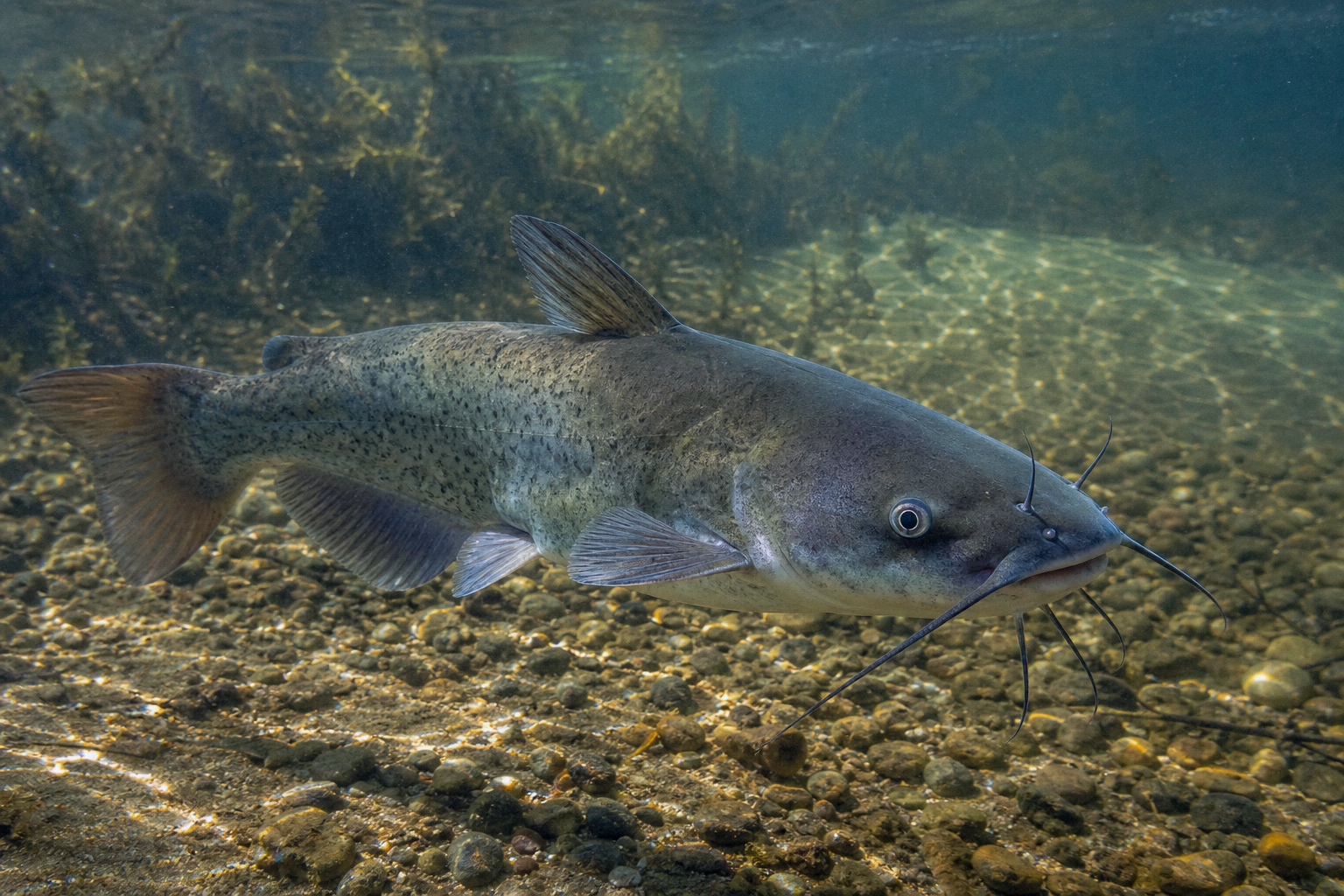
Channel Catfish
Identification
Channel catfish are the most abundant whiskered fish swimming in Virginia’s tidal rivers and freshwater creeks. The body is cylindrical and scaleless — a smooth, slimy tube of bluish-gray to olive-brown across the top, fading to silver-white along the belly. The tail is sharply forked, which instantly separates channel cats from the square-tailed bullheads and the barely notched tail of a flathead. Four sets of barbels fringe the mouth, with the upper pair extending rearward past the eye. Young fish carry scattered dark speckles across their flanks that disappear as they grow. Most Virginia channel cats run 1–5 pounds; a 10-pounder earns respect, and 20-pounders inhabit the deeper holes of the James and York River systems.
Habitat and Behavior
Channel cats thrive throughout the Chesapeake watershed, from the freshwater headwaters down into the brackish margins where rivers meet the Bay. The James, York, and Nansemond Rivers all support robust populations, as do the countless smaller creeks and drainage canals crisscrossing Hampton Roads. They favor deeper pools with moderate flow, soft mud or sand substrate, and overhead cover — fallen timber, bridge footings, undercut banks. These fish are built for low-visibility hunting: their whiskers are loaded with taste buds, and their olfactory sense is extraordinary. They feed most actively after sunset, consuming fish, crayfish, aquatic insects, and virtually any organic debris they encounter. Channel cats tolerate brackish water surprisingly well and are common in tidal creeks where salinity stays below about 10 ppt.
Fishing Techniques
A sliding-sinker bottom rig is the universal approach. Thread an egg sinker onto the main line above a barrel swivel, attach a 12–24 inch leader of 15–30 lb monofilament, and finish with a 2/0 to 4/0 circle hook. Cast into deeper holes at river bends, below bridge abutments, and where tributary creeks empty into larger rivers. A slip-bobber rig suspended 3–6 feet down works well in canals and slack-water areas. Drifting with a bottom-bouncing rig covers water efficiently in the broader river sections. For bank anglers, the bridges along Route 17 and the shoreline access points near the James River Bridge offer easy entry. Trotlines and jug lines — where regulations permit — are traditional methods in the tidal rivers that can produce impressive numbers overnight.
Baits and Lures
Cut menhaden and cut herring are the top natural baits — the oily flesh disperses a scent plume that catfish detect from impressive distances. Chicken liver is cheap, universally available, and effective, especially for smaller fish in warm water. Nightcrawlers work everywhere and are the best option in the fresher upper reaches of the rivers. Prepared dough baits and dip baits fished on sponge or tube rigs can be deadly during summer. Live shad, hooked through the back and fished on the bottom, will catch the largest channel cats, which are fully capable predators. In the Back Bay and Northwest River drainages, fresh-cut sunfish is a local standby.
Best Times and Locations in the Chesapeake Bay Region
Channel cats bite year-round but are most active from May through October when water temperatures are warm. The James River below the fall line — especially the deep bends near the Benjamin Harrison Bridge and the Chickahominy confluence — is a premier destination. The Nansemond River above Suffolk and its network of feeder creeks offer excellent fishing. The canals paralleling Shore Drive and the Lynnhaven River watershed are easily reached and consistently productive. The Northwest River and the Back Bay system hold good numbers. Summer nights are the sweet spot — fishing after dark with cut bait in the tidal rivers can produce nonstop action. Chickahominy Lake and its outflow channel are underutilized but productive.
Regulations
Channel catfish in Virginia fall under DWR inland fishing regulations. There is no minimum size in most waters, and the daily creel limit is 20 fish per person. Trotlines, jugs, and set hooks may be permitted in certain waters with specific gear restrictions. A valid Virginia freshwater fishing license is required. Always consult the current Virginia DWR Freshwater Fishing Regulations digest for waterbody-specific rules, particularly when using set gear.