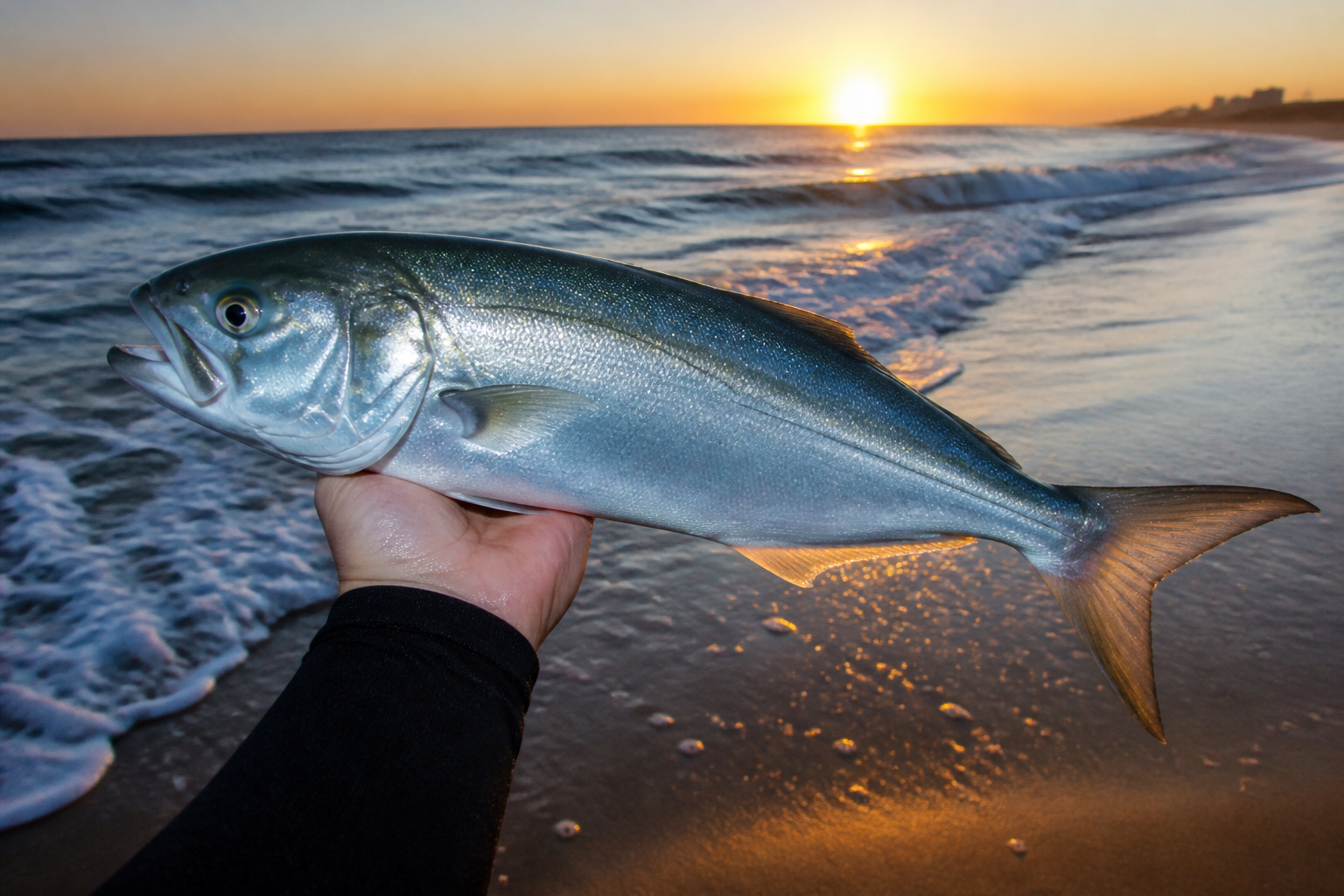
Bluefish
Bluefish are the brawlers of the Virginia Beach surf — aggressive, toothy, and relentless. They provide year-round action for shore-bound anglers, with explosive fall blitzes that rank among the most exciting fishing experiences on the East Coast. These fish hit hard, fight harder, and travel in voracious schools that slash through bait with surgical precision.
Identification
Bluefish have a robust, torpedo-shaped body with a bluish-green to teal back, bright silver sides, and a white belly. The mouth is large and packed with razor-sharp triangular teeth that interlock when closed — handle every bluefish with extreme caution, as even a small one can inflict a serious cut. The tail is deeply forked, and the first dorsal fin is short and spiny, followed by a longer soft dorsal. Virginia blues range from 1–3 pound “snappers” in the Bay to 10–15 pound “choppers” in the fall surf, with occasional fish pushing 20 pounds.
Habitat and Behavior
Bluefish are highly migratory predators that move up and down the Atlantic coast with the seasons. In the lower Chesapeake, they’re present year-round, with juveniles (snapper blues) abundant in the Bay and its tributaries through summer and large adults (chopper blues) dominating the fall surf. Bluefish hunt in coordinated packs, driving baitfish into shallow water and slashing through the school. They’re notorious for killing more than they eat — a bluefish blitz often leaves the water slick with oil and floating bait fragments. They feed primarily on menhaden, mullet, spot, and silversides.
Fishing Techniques
Surf casting with metal lures is the classic Virginia approach. Cast a 2–4 oz Hopkins spoon, Kastmaster, or diamond jig into breaking fish and retrieve at high speed. Bluefish will chase a fast-moving lure with abandon. Topwater plugs — pencil poppers and spook-style walkers — produce explosive surface strikes during blitzes. Trolling with spoons, surgical tube lures, and small umbrella rigs works well in the Bay and along the oceanfront. Live bait fishing with live menhaden or spot on a fish-finder rig produces larger fish. Chunking with cut menhaden on the bottom is effective when blues are holding deep. Always use a wire leader or heavy fluorocarbon — bluefish teeth will slice through monofilament instantly.
Baits and Lures
Metal lures are the top producers: Hopkins spoons, Kastmasters, diamond jigs, and Gotcha plugs in the 1–4 oz range. Silver, gold, and chrome finishes all work. Topwater plugs in white or chartreuse draw violent strikes. For bait, fresh menhaden (bunker) is the gold standard — cut chunks on a bottom rig or live-lined. Mullet, spot, and cut croaker also produce. Wire leaders of 12–30 lb test or 40–60 lb fluorocarbon are essential.
Best Times and Locations off Virginia Beach
Bluefish are available year-round, but the fall migration (October–November) delivers the most spectacular action. The surf from Sandbridge to Fort Story can erupt with blitzing blues when menhaden schools move south. The CBBT is a year-round bluefish magnet — the rock islands and the high-rise section hold fish in all seasons. The Rudee Inlet jetty and the Lynnhaven Inlet area produce well. The Ocean View Fishing Pier and the Virginia Beach Fishing Pier are reliable shore-based spots. In the Bay, the waters off Kiptopeke and the channels near the CBBT hold blues through summer. Dawn and dusk are prime feeding windows.
Regulations
Virginia manages bluefish through the VMRC. The minimum size is 8 inches total length with a daily bag limit of 10 fish per person. There is no closed season. Bluefish are excellent table fare when bled immediately and iced — the dark meat is rich and flavorful, best grilled, smoked, or broiled. Always check current VMRC regulations before fishing.