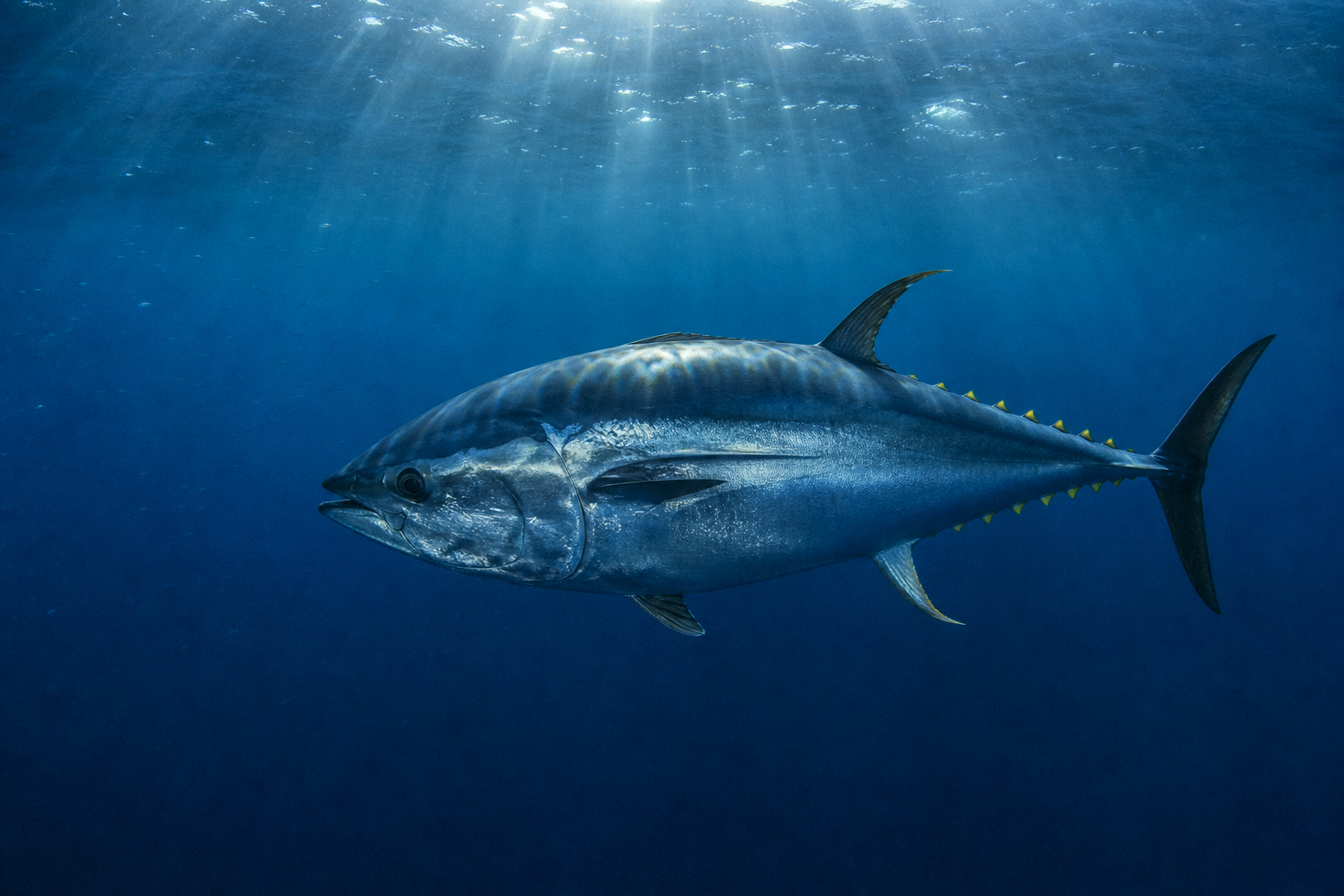
Bluefin Tuna
Appearance and Size
Among the Thunnus genus, none commands greater respect than the giant bluefin — an animal whose sheer mass and power have captivated anglers for generations. The upper body carries a deep metallic indigo that cuts sharply to a stark white underside, the classic open-water camouflage pattern. A sequence of yellow finlets bridges the gap between the second dorsal and the crescent-shaped tail. The pectorals are compact and lock into body grooves during high-speed runs. A pronounced lateral keel on each side of the caudal peduncle reduces hydrodynamic drag. Specimens exceeding a thousand pounds and ten feet in length are documented, though Virginia anglers more commonly encounter fish across the full size spectrum — from 30-pound school-class individuals to genuine giants surpassing the 73-inch curved-fork-length benchmark. The muscle tissue is deep crimson, richly marbled with intramuscular fat, which explains the astronomical prices these animals command at international seafood auctions.
Movement Patterns and Feeding
These animals undertake transoceanic journeys spanning entire ocean basins. Off the Virginia coastline, the cold-season incursion — December through March — brings them remarkably close to shore, drawn by enormous concentrations of bunker and butterfish staging near the Chesapeake’s mouth. A secondary pulse arrives during late spring as fish follow the warming trend northward. A remarkable physiological trait sets them apart: a countercurrent heat-exchange network of blood vessels maintains their core temperature significantly above ambient conditions. This endothermic capability permits effective hunting in frigid water that would render other predators sluggish. They segregate by size class, with the largest individuals traveling solo or in pairs while school-class fish form larger aggregations. When a pack corrals a bait school, the surface eruption is visible for miles — acres of churning whitewater punctuated by prey spraying skyward and seabirds diving from every direction.
Targeting Them from Virginia Ports
The cold-season fishery out of Rudee Inlet and Little Creek revolves around deploying a steady stream of butterfish pieces up-current of known holding zones. This creates an odor corridor — a scent highway — that the fish follow directly to the source. Multiple rods are set at staggered depths within the drift, each carrying a different leader length to cover the entire water column. When fish are scattered across a wider area, pulling spreader bars rigged with cedar plugs and daisy chains at 5 to 7 knots covers territory efficiently. For nearshore giants holding within sight of the Virginia Beach oceanfront, a live bunker suspended beneath a balloon is devastatingly effective. The tackle demands are serious: 130-class International reels, stand-up or bent-butt sticks, and wind-on leaders testing 200 pounds or heavier. This is not light-tackle fishing — it’s a battle of attrition against one of the ocean’s most powerful animals.
Effective Offerings
Butterfish reign supreme for the chunking game — oily, bloody, and precisely what cold-season fish are feeding on. Live menhaden is the premier offering for fish holding close to the beach. Sardines, herring, and whole squid all produce in the slick. On the troll, green-machine spreader bars, cedar-plug daisy chains, and Zuker-style skirts in dark purple and black color patterns have accounted for countless Virginia fish over the decades. For school fish feeding deep, heavy vertical jigs like the Z-Man Jag Pro in the 200- to 400-gram class dropped through marks on the sounder can trigger savage reaction strikes.
Peak Periods and Key Zones
The heart of Virginia’s season runs January through March, when fish push within a few miles of Sandbridge and the oceanfront. The waters off the Chesapeake Bay Bridge-Tunnel and the area around Rudee Inlet serve as the primary staging grounds. Spring delivers a second window from May into July as fish ride the warming trend northward. Charter operations out of the Virginia Beach Fishing Center and marinas along the Lynnhaven River run dedicated trips when conditions align. Temperature is the critical variable — the 58-to-68-degree band is the sweet spot. Watch satellite sea-surface-temperature charts for sharp thermal breaks and color changes; these fish stack along such edges with remarkable predictability.
Management Framework
These fish fall under the Atlantic Highly Migratory Species management framework administered by NOAA Fisheries. An HMS recreational permit is mandatory — even for catch-and-release fishing. The size-class system divides fish into school (27 to under 47 inches curved fork length), large school (47 to under 73 inches), and giant (73 inches and above), each carrying distinct daily retention allowances that shift by season and available quota. General category permits cover commercial harvest operations. Given the dynamic nature of quota-based management, always consult the latest NOAA Fisheries HMS compliance guide before leaving the dock. Regulations can and do change mid-season based on landings data.