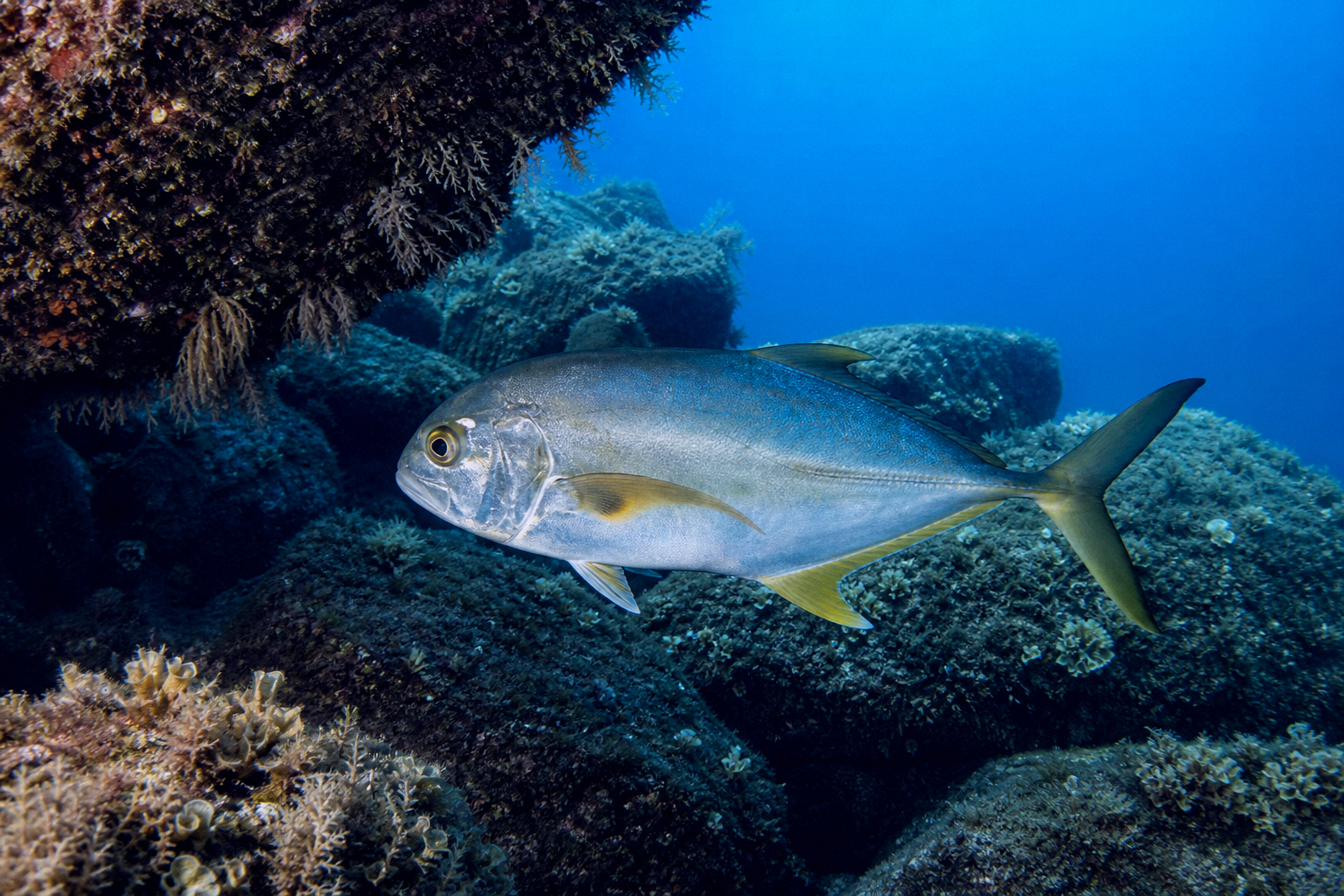
Blue Runner
Identification
Blue runners, known locally as hardtails, are streamlined jacks that patrol Virginia’s coastal waters in tight, fast-moving schools. Most run 1–3 pounds, with a 5-pounder considered large. The body is elongated and torpedo-shaped with an olive-green to bluish back, silver sides, and a white belly. A small black spot sits at the upper edge of the gill cover, and the tail is deeply forked. The lateral line is armored with enlarged scutes (bony scales) near the tail — a feature shared with other Caranx species. Blue runners have a smaller, more delicate head than crevalle jacks and lack the deep body profile of that species.
Habitat and Behavior
Blue runners are among the most adaptable jacks in the region, found from the surf zone and inlet mouths to nearshore reefs and offshore structure. They tolerate a wide salinity range and will push well into the Chesapeake Bay during summer. Blue runners are relentless predators that hunt in coordinated schools, herding baitfish into tight balls and slashing through them. They feed on small menhaden, silversides, anchovies, and squid. Their speed and endurance make them one of the hardest-fighting fish pound-for-pound in Virginia waters.
Fishing Techniques
Blue runners respond to a variety of approaches. Small metal jigs of 1/2 to 2 oz, cast into breaking schools and retrieved at high speed, produce violent strikes. They’ll also hit small bucktails, soft plastic swimbaits, and spoons. Live bait fishing with small minnows or squid strips on light spinning tackle is effective around structure. Trolling small spoons and feather lures at 4–6 knots around inlet mouths and nearshore reefs picks up blue runners alongside Spanish mackerel. Light tackle in the 8–15 lb class maximizes the sport; these fish make blistering runs and refuse to quit.
Baits and Lures
Small metal jigs in silver, gold, and chrome are the top artificials. Gotcha plugs and small spoons in the 1/2 to 1 oz range work well for casting to surface-feeding schools. Soft plastic swimbaits on 1/4 to 1/2 oz jig heads in white and pearl produce. Live glass minnows, small mullet, and squid strips on size 2 to 1/0 hooks with 15–20 lb fluorocarbon leader are effective for live bait presentations. Blue runners are aggressive and rarely selective — if you find a school, they’ll usually eat.
Best Times and Locations off Virginia Beach
Blue runners appear in May and stay through October, with peak abundance in July and August. The CBBT is a prime location — schools stack up around the rock islands and the high-rise section. The Rudee Inlet jetty and the surf zone off Virginia Beach produce when bait is present. Nearshore reefs within 5 miles of the beach hold blue runners through summer. The waters around the Chesapeake Light Tower and nearby wrecks attract large schools. Look for surface-feeding activity — diving birds and splashing baitfish signal blue runner schools.
Regulations
Blue runners have no federal bag limit and no minimum size. Virginia state waters impose no additional restrictions. They’re excellent fresh bait for larger gamefish — blue runners make outstanding live bait for cobia, king mackerel, and sharks. As table fare, the dark meat is strong-flavored and best suited for smoking or fish cakes.