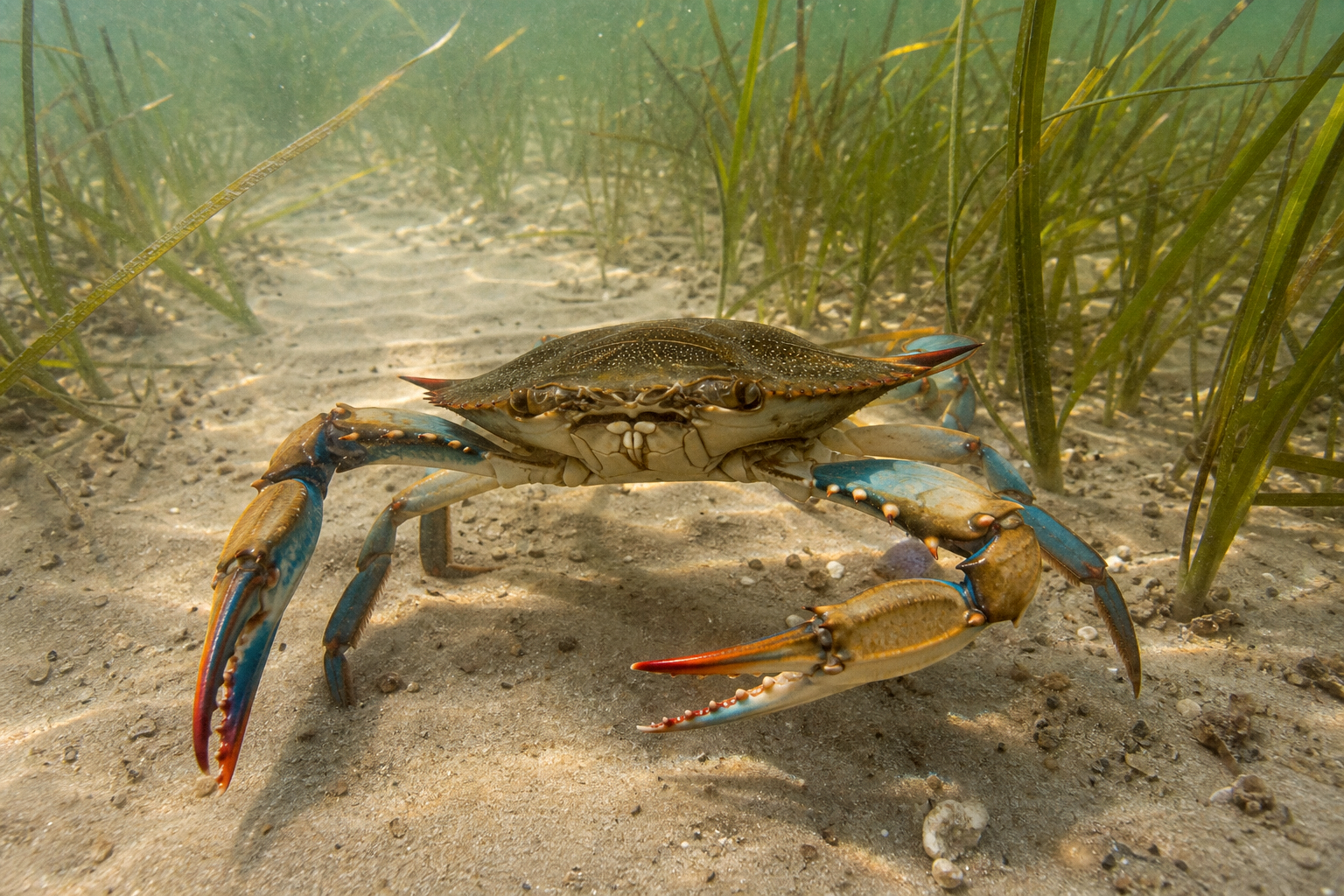
Blue Crab
Identification
The blue crab is the Chesapeake Bay’s signature crustacean — a swimming crab with a carapace that can span 9 inches point-to-point in large males. The shell color ranges from olive-green to brownish, but the claws and legs carry the vivid blue markings that give the species its name. Mature females, called “sooks,” display bright red-orange tips on their claws. The carapace has two prominent lateral spines on each side, and the fifth pair of legs is modified into paddle-shaped swimming fins. Males (“jimmies”) have a narrow, T-shaped abdominal flap; females have a broader, rounded flap. A soft-shell crab is simply a blue crab that has recently molted and whose new shell hasn’t yet hardened.
Habitat and Behavior
Blue crabs inhabit virtually every corner of the lower Chesapeake — from the eelgrass beds of the Lynnhaven River to the muddy creeks feeding Back Bay, from the shallows around Kiptopeke to the brackish reaches of the James and York Rivers. They’re opportunistic omnivores that scavenge dead fish, prey on small bivalves and worms, and even cannibalize smaller crabs. Crabs are most active in water above 60°F and burrow into mud to overwinter. They move between deeper channels and shallow grass beds with the tides, and their activity peaks during warm summer nights. The Chesapeake Bay supports one of the largest blue crab fisheries in the world, and the species is central to the region’s culture and economy.
Harvesting Techniques
Hand lines are the simplest and most traditional method. Tie a chicken neck or fish head to a length of cotton string, lower it to the bottom in 2–6 feet of water, and wait for the telltale tug. Slowly retrieve the line hand-over-hand while a partner scoops the crab with a long-handled dip net just before it breaks the surface. Crab pots — wire mesh traps with funnel entrances — are the commercial standard and work well for recreational use when soaked overnight. Trotlines — long baited lines run between anchors with floats — are a traditional Chesapeake method that can produce large numbers of crabs in a short time. Dip netting from docks and piers at night, using a spotlight to spot crabs in the shallows, is effective and requires no bait.
Baits
Chicken necks are the classic recreational bait — cheap, effective, and available at any grocery store. Menhaden (bunker) and fish racks from cleaning tables are excellent and release more oil. Razor clams are a premium bait that crabs find hard to resist. The key is fresh bait that releases scent; crabs locate food primarily by smell. Change bait regularly — once it’s washed out, it stops attracting.
Best Times and Locations in the Chesapeake Bay
Blue crab season runs from May through October, with July through September delivering peak abundance. The Lynnhaven River is one of the region’s most productive crabbing grounds — the grass beds and channels from the Lesner Bridge to the western branch hold crabs all summer. Back Bay and its marsh creeks, particularly around False Cape, are excellent. The shallows off Ocean View and along Shore Drive produce well. The creeks feeding into the James River near the James River Bridge and the Nansemond River near Suffolk are reliable. The Eastern Shore side — the waters off Kiptopeke and the seaside creeks — offers less-pressured crabbing. Warm, calm evenings with a rising tide produce the best hand-line action.
Regulations
Virginia recreational crabbing is managed by the VMRC. No license is required for hand lines or dip nets. The daily limit is 1 bushel of hard crabs per person, with a vessel limit of 2 bushels. Hard crabs must measure at least 5 inches point-to-point across the carapace. Harvesting sponge crabs (females carrying eggs) is prohibited. Soft-shell crab harvest has separate regulations. Crab pots must be marked with the owner’s identification. Always check current VMRC regulations before crabbing, as rules can change mid-season based on population assessments.