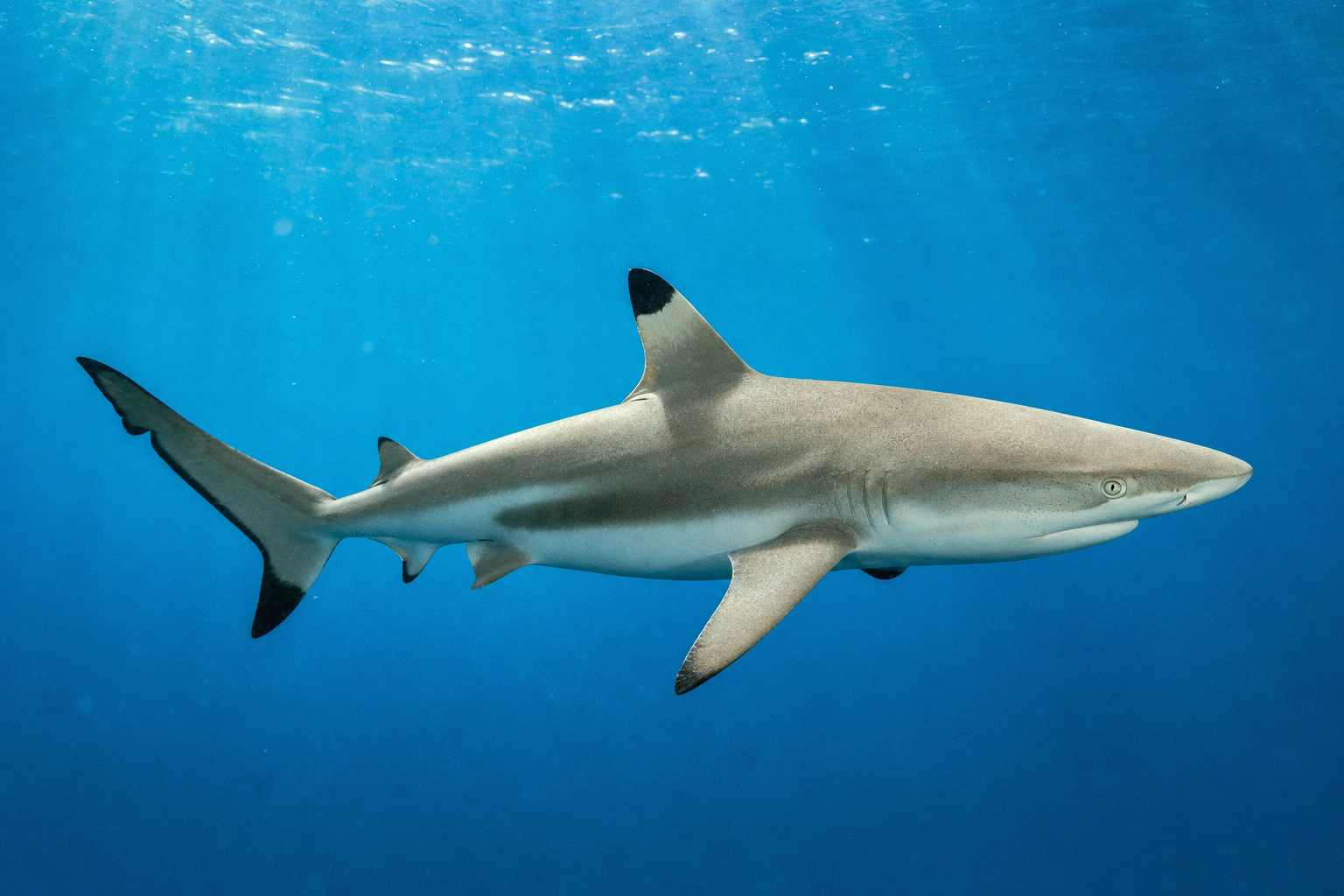
Blacktip Shark
Identification
The blacktip shark is one of the most visually striking sharks in Virginia waters, named for the crisp black markings on the tips of its dorsal, pectoral, anal, and lower caudal fins. The body is robust and streamlined, colored bronze to grayish-brown above with a white underside and a distinctive white band running along the flank. Adults in this region commonly reach 5–6 feet and 60–100 pounds. The snout is moderately long and pointed, and the first dorsal fin is tall and slightly falcate. Blacktips are frequently confused with spinner sharks, but spinners have a black-tipped anal fin (blacktips’ anal fin is unmarked) and a more slender build.
Habitat and Behavior
Blacktip sharks are warm-water coastal predators that arrive off Virginia Beach in late spring and remain through early fall. They patrol the surf zone, nearshore waters, and inlet channels, often hunting in the troughs between sandbars. Blacktips are known for their spectacular spinning leaps — they’ll launch completely clear of the water while pursuing baitfish. They feed primarily on menhaden, mullet, bluefish, and other schooling baitfish. Blacktips are more temperature-sensitive than sharpnose sharks and depart quickly when water drops below 68°F.
Fishing Techniques
Surf fishing for blacktips requires heavier gear than sharpnose sharking. A 10–12 foot heavy surf rod paired with a 6000–8000 size spinning reel loaded with 50–65 lb braid is standard. Use a fishfinder rig with 6–8 oz of lead and a 6–10 foot leader of 80–100 lb monofilament or single-strand wire. Kayak deployment of baits is highly effective at Sandbridge and along the Fort Story beaches, allowing you to place large baits in deeper water beyond the outer bar. Blacktips strike with authority — the rod will load up hard and the fish will take line immediately. Fish the hours around dawn and dusk, particularly during incoming tides.
Baits and Lures
Fresh, bloody, and large is the formula. Whole fresh mullet, half-bluefish, and large menhaden chunks are the top baits. A whole spot or croaker pinned on a circle hook also produces. The key is freshness — blacktips key in on scent trails, and fresh bait pumps out far more attractant than frozen. Use baits of 6–12 inches; these sharks have substantial mouths and will ignore offerings that are too small. Circle hooks in the 12/0–16/0 range are standard for large baits.
Best Times and Locations off Virginia Beach
Blacktips appear in late May and stay through October, with July through September delivering peak action. Sandbridge is the premier surf sharking destination in the region — the deep sloughs and proximity to Back Bay’s outflow create ideal conditions. The beaches from Dam Neck south to False Cape all produce. The Ocean View stretch and the waters around the CBBT islands hold blacktips during summer. The Eastern Shore barrier islands, accessible by boat from Kiptopeke and Oyster, offer less-pressured fishing. Fish dawn and dusk for the best action; nighttime fishing during a rising tide accounts for the largest specimens.
Regulations
Blacktip sharks are managed by the VMRC and ASMFC. Virginia state waters have no closed season. The minimum size is 54 inches fork length. The recreational bag limit is 1 shark per person per day with a vessel limit of 1 shark per vessel per day. All sharks must be landed with head, tail, and fins naturally attached. Practice catch-and-release whenever possible — use circle hooks, minimize fight time, keep the shark in the water during release, and avoid removing large fish from the water entirely.