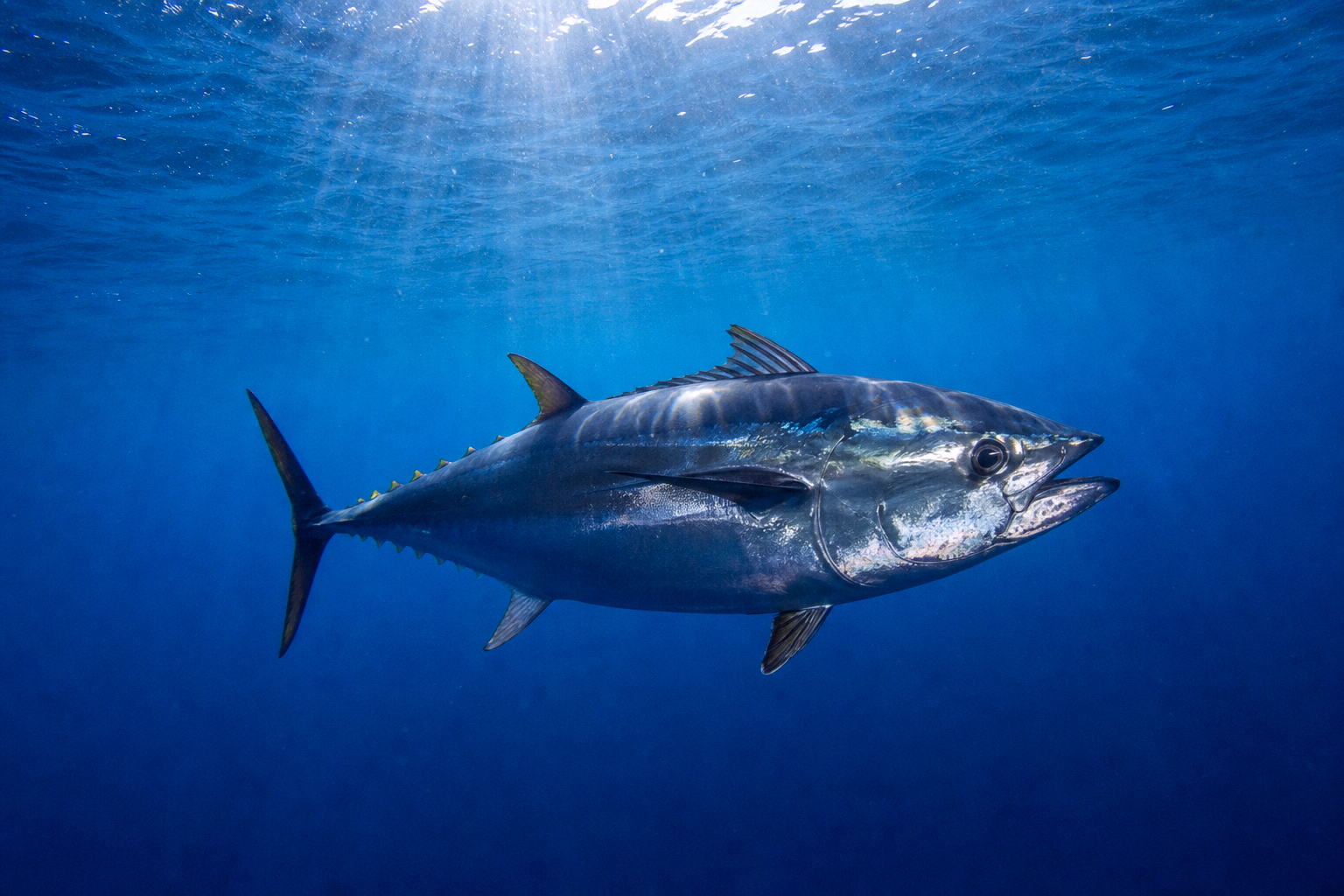
Blackfin Tuna
What You’re Looking At
Blackfin tuna are the smallest member of the Thunnus genus that regularly visits Virginia’s offshore waters, with most fish running 10 to 30 pounds and the occasional standout pushing 40. The dorsal surface is a dark metallic black to blue-black with a bronze sheen, the flanks are silver, and a golden-yellow stripe traces along the side. The diagnostic feature is the dark pigmentation on the dorsal, pectoral, and anal fins — the finlets are black, which separates them from the similar-looking Atlantic bonito. Blackfin also lack the horizontal belly stripes that mark skipjack tuna. The body is more football-shaped than the elongated bonito.
Where They Live
Blackfin tuna are pelagic fish that favor warm Gulf Stream water but regularly push inshore toward nearshore wrecks, reefs, and ledges during summer. They school tightly, often mixing with false albacore and bonito around bait concentrations. Blackfin are aggressive surface feeders that drive baitfish into tight balls and slash through them, creating visible whitewater. Their diet centers on small baitfish, squid, and pelagic crustaceans. Water temperature is the primary driver — blackfin prefer 72°F or warmer and will track temperature breaks and current edges.
How to Catch Them
Trolling is the most productive method for Virginia blackfin. Run small cedar plugs, spoons, and skirted ballyhoo at 6 to 8 knots around wrecks, reefs, and temperature breaks. Small feather lures and cedar plugs in pink, blue, and white are deadly. Chunking is highly effective once you locate a school — set up a chum slick of cut sardines or menhaden and drift live cigar minnows or chunks back into the slick. Vertical jigging with 60- to 100-gram knife jigs works well over wrecks when fish are holding deep. Blackfin also respond to butterfly jigs worked through the mid-water column.
What to Put on the Hook
Live cigar minnows are the top live bait — drifted in a chum slick, they’re nearly irresistible. Live peanut bunker and sardines also work. For trolling, rigged ballyhoo on small Ilander skirts, cedar plugs in pink and natural, Clark spoons, and small feather lures are all proven producers. Cut squid and sardine chunks are standard for chunking setups. When jigging, 60- to 80-gram knife jigs in blue/silver, pink, and zebra patterns get strikes.
When and Where off Virginia Beach
Blackfin tuna show up from late May through October, with July and August delivering peak numbers. The Gulf Stream runs 25 to 40 miles off Rudee Inlet and the CBBT, but blackfin frequently push closer — within 10 to 20 miles — around wrecks, artificial reefs, and live-bottom areas. Key areas include the waters off the Chesapeake Bay mouth (the 280, 310, and 450 lines), the CBBT reefs, and the Tower area off Virginia Beach. Watch for temperature breaks and color changes — blackfin stack up along these edges. Early morning and late afternoon troll sessions produce best.
The Rules
Blackfin tuna are managed under federal Highly Migratory Species regulations. The recreational bag limit is 3 per person per day with a minimum fork length of 14 inches. There is no closed season for recreational anglers. An Atlantic Highly Migratory Species permit is required for anglers targeting tuna in federal waters. Check NOAA Fisheries and VMRC for the most current regulations before heading out.