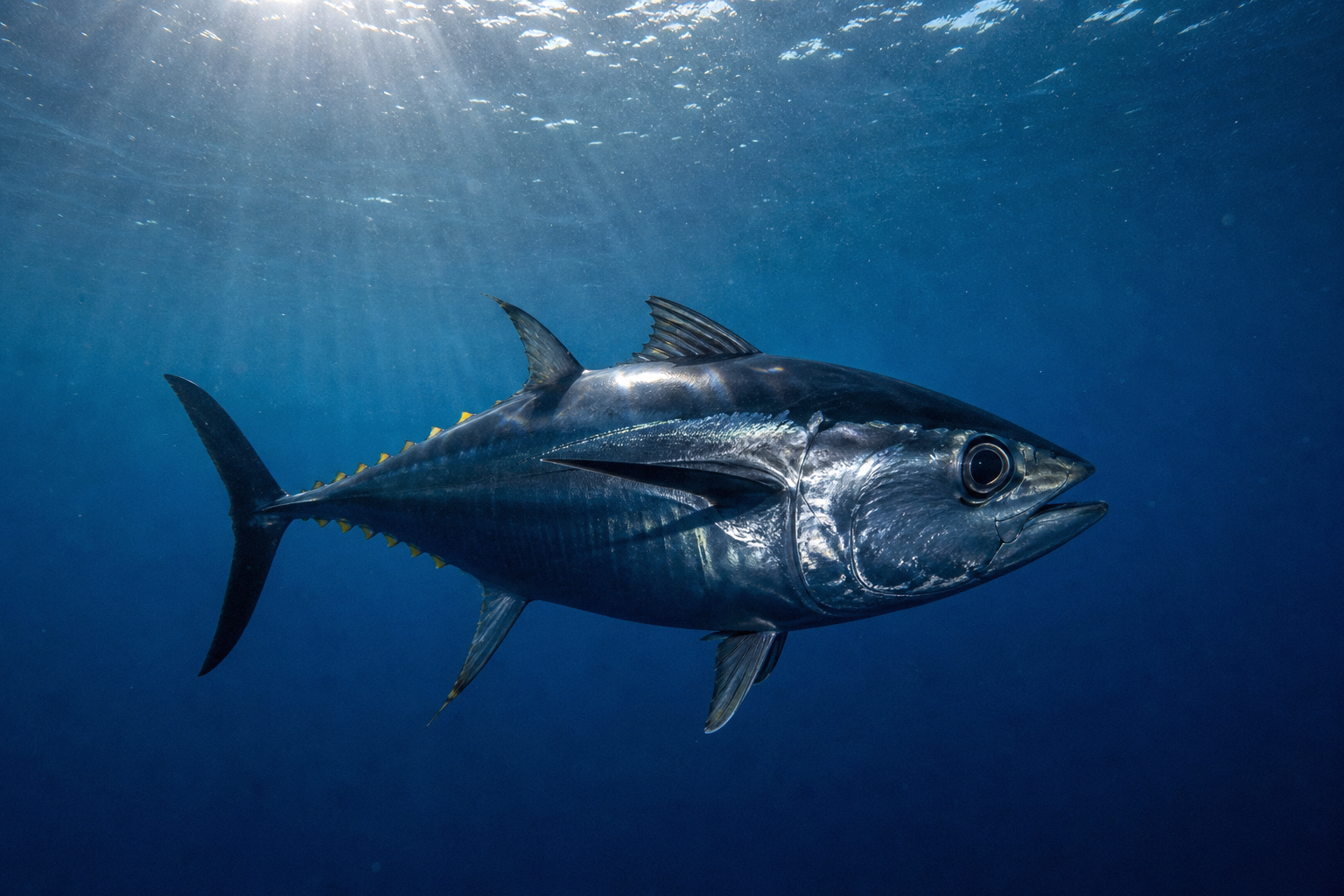
Bigeye Tuna
Identification
At first glance a bigeye can pass for a yellowfin, but the differences become obvious on close inspection. The eyes are oversized — an evolutionary concession to hunting in near-darkness at extreme depth. The torso is thicker and more robust than a yellowfin of equivalent length, and the pectoral fins sweep back well beyond the origin of the second dorsal (in yellowfin they fall short). The upper body is a deep metallic indigo, the flanks are bright silver, and a yellowish stripe runs horizontally. The finlets are yellow with dusky margins. Off Virginia, bigeye commonly run 20–100 pounds, though fish exceeding 200 come from the Norfolk Canyon and deeper waters. Their liver is proportionally enormous among tunas, providing the buoyancy control needed for daily vertical migrations of a thousand feet or more.
Habitat and Behavior
Bigeye are the abyssal hunters of the tuna world. During daylight they descend to 300–1,000 feet, shadowing the deep scattering layer — a dense band of squid, lanternfish, and crustaceans that rises and falls with the sun. After dark they ascend toward the surface to feed. Off the Virginia coast, bigeye patrol the thermal boundaries along the continental shelf drop-off and the deep indigo water of the Gulf Stream. They favor slightly cooler temperatures than yellowfin — 64–74°F — and often share the same current edges that concentrate swordfish. Their deep-dwelling nature puts them beyond the reach of standard trolling spreads most of the day, which is why specialized tactics dominate the bigeye playbook.
Fishing Techniques
Nighttime chunking is the most consistent approach for Virginia bigeye. Drift over the shelf edge in 100+ fathoms while feeding a steady trail of ground squid and butterfish into the current. Multiple rods deploy baits at staggered depths, with a deep-line rig set at 200–400 feet frequently accounting for the heaviest fish. Trolling during the brief gray-light windows at dawn and dusk can produce when bigeye briefly ascend — standard tuna spreads with ballyhoo and skirted lures work during these narrow time slots. A technique borrowed from the daytime swordfish crowd involves deep-dropping large live baits on electric reels at midday, when bigeye are at their deepest.
Baits and Lures
Squid reigns supreme — whole squid on circle hooks drifted in the chunk line are deadly. Sardines and butterfish chunks build the slick. Live herring or small mackerel deployed deep on weighted rigs account for trophy-class fish. For the troll, large skirted lures in dark patterns — black over purple, blue over silver — pulled at 6–8 knots near temperature breaks draw strikes during low-light windows.
Best Times and Locations off Virginia Beach
Bigeye are available May through October. They hold in the deep blue beyond the shelf edge, typically 30–50 miles offshore from Rudee Inlet and the CBBT. The Norfolk Canyon and the Washington Canyon to the north are key locations. Charter operations running overnight trips from Rudee Inlet and Lynnhaven target bigeye specifically. Temperature breaks in the 68–74°F range along the 100-fathom curve mark productive water. The period around the full moon often delivers the best nighttime chunking action.
Regulations
Bigeye tuna require an Atlantic HMS recreational permit. The recreational bag limit is typically 3 tuna (yellowfin, bigeye, and skipjack combined) per vessel per day, with a minimum size of 27 inches curved fork length. Commercial harvest requires a directed or incidental tuna permit. HMS regulations shift based on stock assessments and international quotas. Verify current rules at NOAA Fisheries before departing.