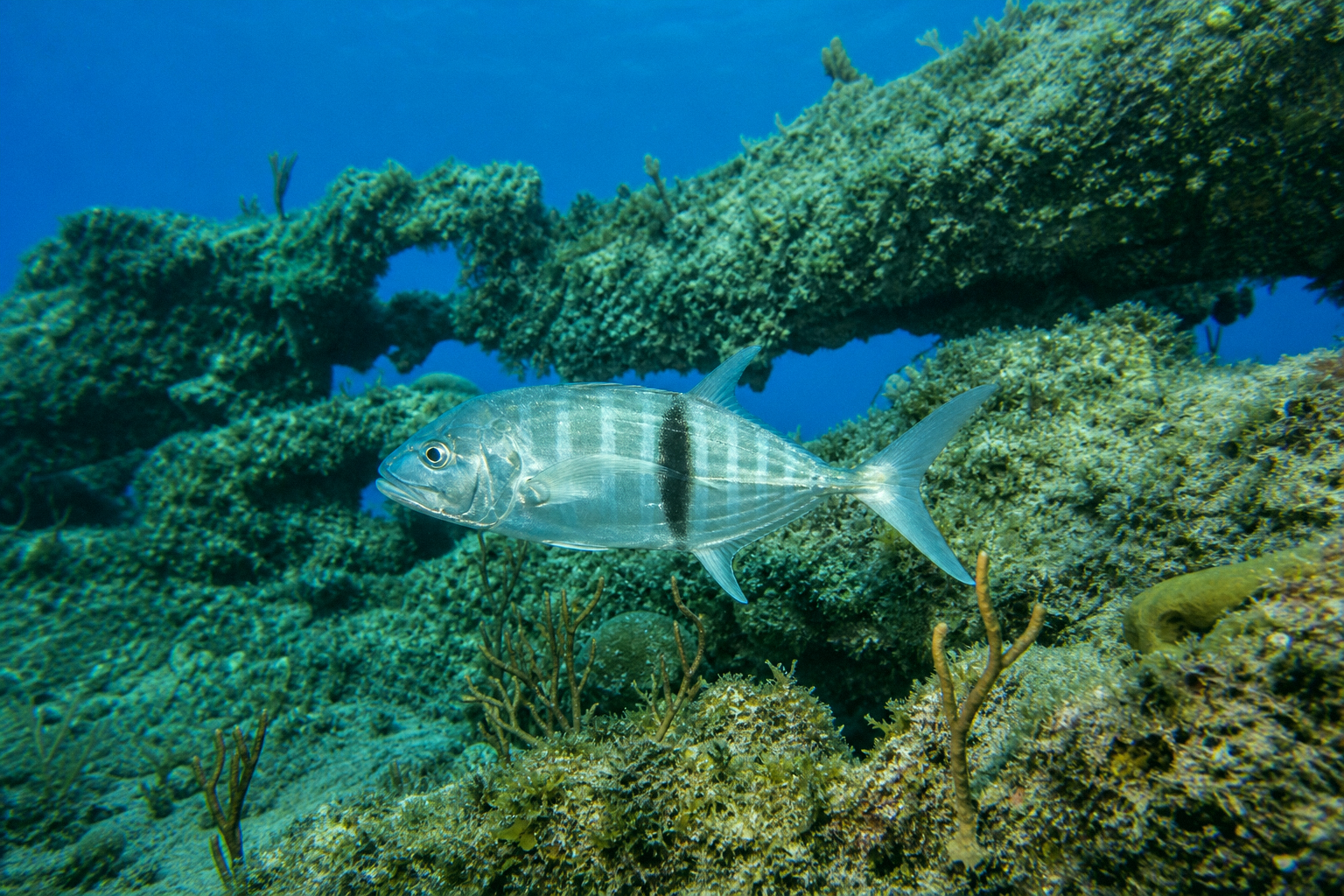
Bar Jack
Identification
Bar jacks are slender, silver torpedoes that stray into Virginia’s offshore grounds during the year’s warmest stretch. Most weigh 2–8 pounds; a double-digit fish is noteworthy. The back carries a blue-green sheen that fades to brilliant silver along the flanks. The species’ signature is a dark stripe that originates at the corner of the jaw, sweeps along the flank, and terminates at the lower fork of the deeply cleft tail. This bar shifts intensity — nearly black when the fish is agitated or feeding, barely visible when it’s relaxed. The overall shape is noticeably more streamlined than a blue runner or crevalle jack, with a smaller head and a more delicate build.
Habitat and Behavior
Bar jacks are creatures of the tropics and subtropics that ride warm eddies northward into Virginia waters during summer. They gravitate toward any object breaking the surface — Sargassum mats, drifting timber, buoy lines, and weed edges in blue water. Schools are tight and coordinated, often intermingling with blue runners and juvenile dolphin around floating debris. They’re quick, agile predators that chase small baitfish, pelagic squid, and crustaceans. Bar jacks also shadow larger fish — sharks, rays, even big mahi — snatching scraps stirred up by the bigger animal’s movement.
Fishing Techniques
Most bar jacks come aboard while anglers are working floating structure for mahi or tuna. When a school is spotted beneath a weed mat or driftwood, pitch a small jig or live bait into the group. Knife jigs of 20–60g in blue/silver and white, retrieved at a moderate clip, draw strikes. Light spinning tackle in the 10–20 lb class makes for entertaining fights — these fish run hard and change direction unpredictably. Bar jacks have sharp vision but aren’t especially leader-wary; a natural drift matters more than invisible terminal gear. Fly anglers pick them up on small white streamers and Clouser minnows when conditions allow.
Baits and Lures
Small metal jigs from 1/2 to 2 oz in silver, blue/silver, and white are effective. Epoxy jigs and soft plastic swimbaits in pearl or silver also produce. Live cigar minnows, sardines, and squid strips on 3/0–5/0 circle hooks with 20–40 lb fluorocarbon leader work well. Bar jacks are opportunistic feeders — if you locate a school around floating structure, they’ll usually strike whatever you present.
Best Times and Locations off Virginia Beach
Bar jacks appear from June through October, coinciding with the Gulf Stream’s closest approach to the Virginia coastline. They’re most commonly encountered 20–50 miles offshore from Rudee Inlet and the CBBT, around weed lines, floating debris, and offshore reefs in blue water. The waters southeast of the Bay mouth — the 280–380 line area — are the most productive, as the Stream runs closer to shore there than anywhere else in the Mid-Atlantic. Bar jacks are less common than blue runners or crevalle jacks off Virginia, but they show up reliably in warm years. Look for them around the same floating structure that holds mahi.
Regulations
Bar jacks have no specific federal bag limit and no minimum size. They are not subject to individual species management in the South Atlantic. Virginia state waters impose no additional restrictions. As always, verify with VMRC and SAFMC for any regulation updates before your trip.