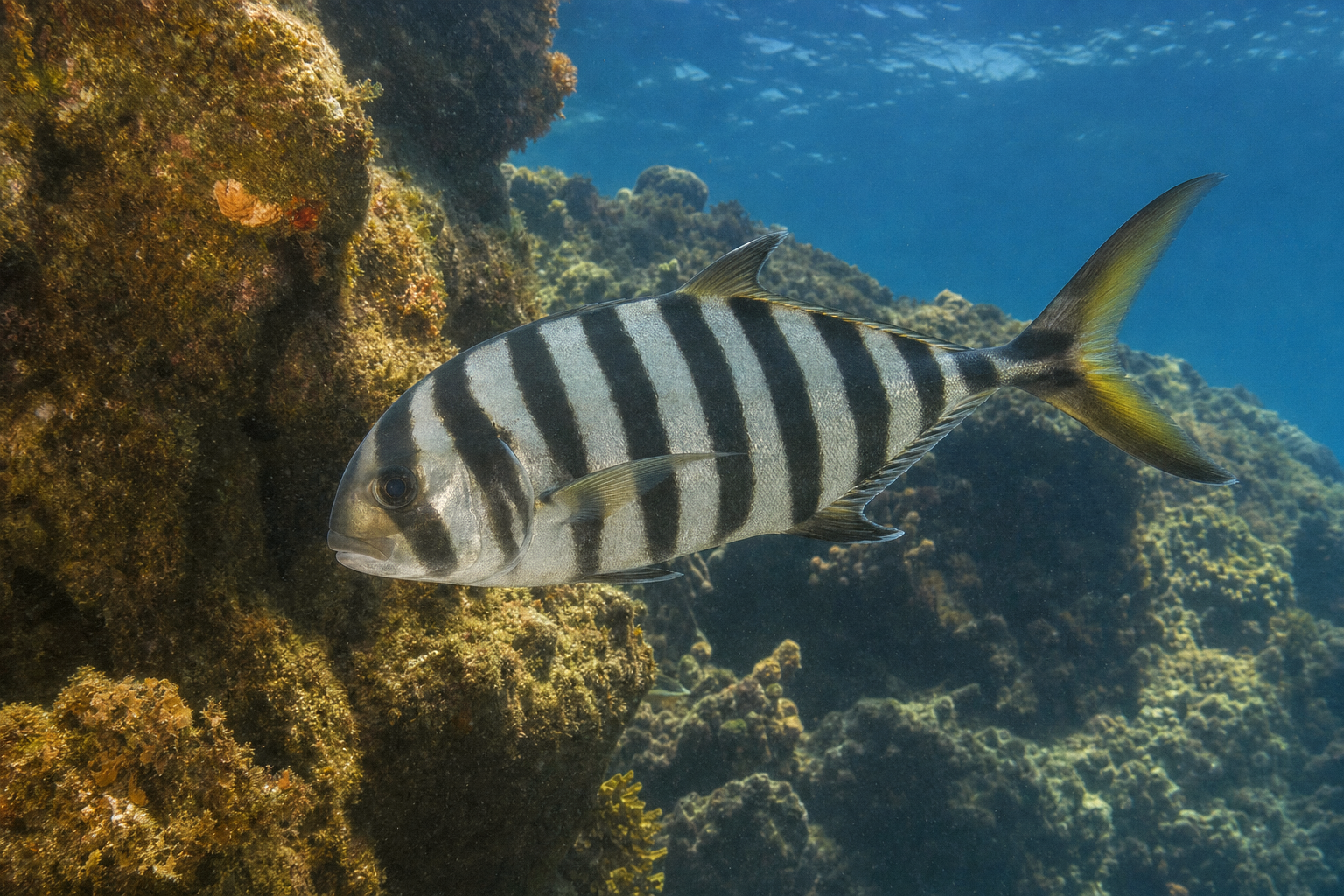
Banded Rudderfish
Identification
The banded rudderfish is the runt of the amberjack litter in Virginia waters — most weigh 1–5 pounds, with an 8-pounder being a genuine standout. The body is elongated and moderately compressed, wearing olive-green to brown across the back and bright silver below. A dark lateral stripe traces from behind the eye to the base of the caudal fin. The feature that christened the species is the set of bold vertical bars displayed by young fish — these dark bands across the flanks gradually fade as the animal matures, though ghost traces often linger in adults. The profile sits between the slender almaco jack and the blocky greater amberjack, and the second dorsal fin lacks the dramatic streamers that characterize the almaco.
Habitat and Behavior
Banded rudderfish occupy nearshore and mid-shelf structure, favoring reefs and wrecks in 30–80 feet — substantially shallower than the haunts of greater amberjack. Immature fish frequently associate with drifting objects, Sargassum weed mats, and even channel markers and buoys inside the Bay mouth. They school in loose aggregations and commonly mix with lesser amberjacks and small almaco jacks around structure. Their diet revolves around small forage fish, squid, and pelagic crustaceans. Unlike bottom-hugging groupers, banded rudderfish are active through the entire water column over a reef.
Fishing Techniques
Most banded rudderfish arrive as incidental catches while anglers bottom-fish or jig for other reef dwellers. They strike small jigs eagerly — both vertical knife jigs and cast-and-retrieve metal lures. Drop a 30–60g jig to the substrate near wrecks and work it upward with sharp, snapping lifts. Small soft plastics and bucktails tipped with squid strips also produce. For live bait, tiny minnows or squid on a dropper loop or high-low rig work well. Light tackle in the 15–30 lb class makes for sporty fights; these fish punch well above their weight class.
Baits and Lures
Knife jigs in the 30–60g range, dressed in blue/silver, pink, and glow patterns, are effective. Small bucktails of 1/2 to 1.5 oz tipped with squid strips are a classic Virginia bottom-fishing presentation. Metal jigs in silver and chrome, 1/2 to 1 oz, work for casting around nearshore structure. Live cigar minnows, small sardines, and squid strips on 3/0–5/0 hooks with 20–40 lb fluorocarbon leader are standard. Banded rudderfish are aggressive and rarely selective — present almost any small offering near structure and they’ll commit.
Best Times and Locations off Virginia Beach
Banded rudderfish appear from June through October. They’re found on nearshore reefs and wrecks in 30–80 feet — closer to shore than greater amberjack. Prime locations include the artificial reefs off Rudee Inlet, the Tower Reef, and the nearshore wrecks within 10 miles of the Virginia Beach coast. The CBBT rock islands and nearby structure also hold fish, particularly juveniles around the pilings and riprap. The reefs off Sandbridge and False Cape produce when warm water pushes close to shore. Mid-summer delivers the most consistent action.
Regulations
Banded rudderfish fall under the amberjack complex managed by SAFMC. As a Seriola species, they may be subject to the same aggregate bag limits as greater and lesser amberjack. Check current SAFMC regulations for amberjack complex rules, minimum sizes, and seasonal closures. Virginia state waters follow federal frameworks. Always verify with VMRC and SAFMC before departing, as amberjack management measures change frequently.