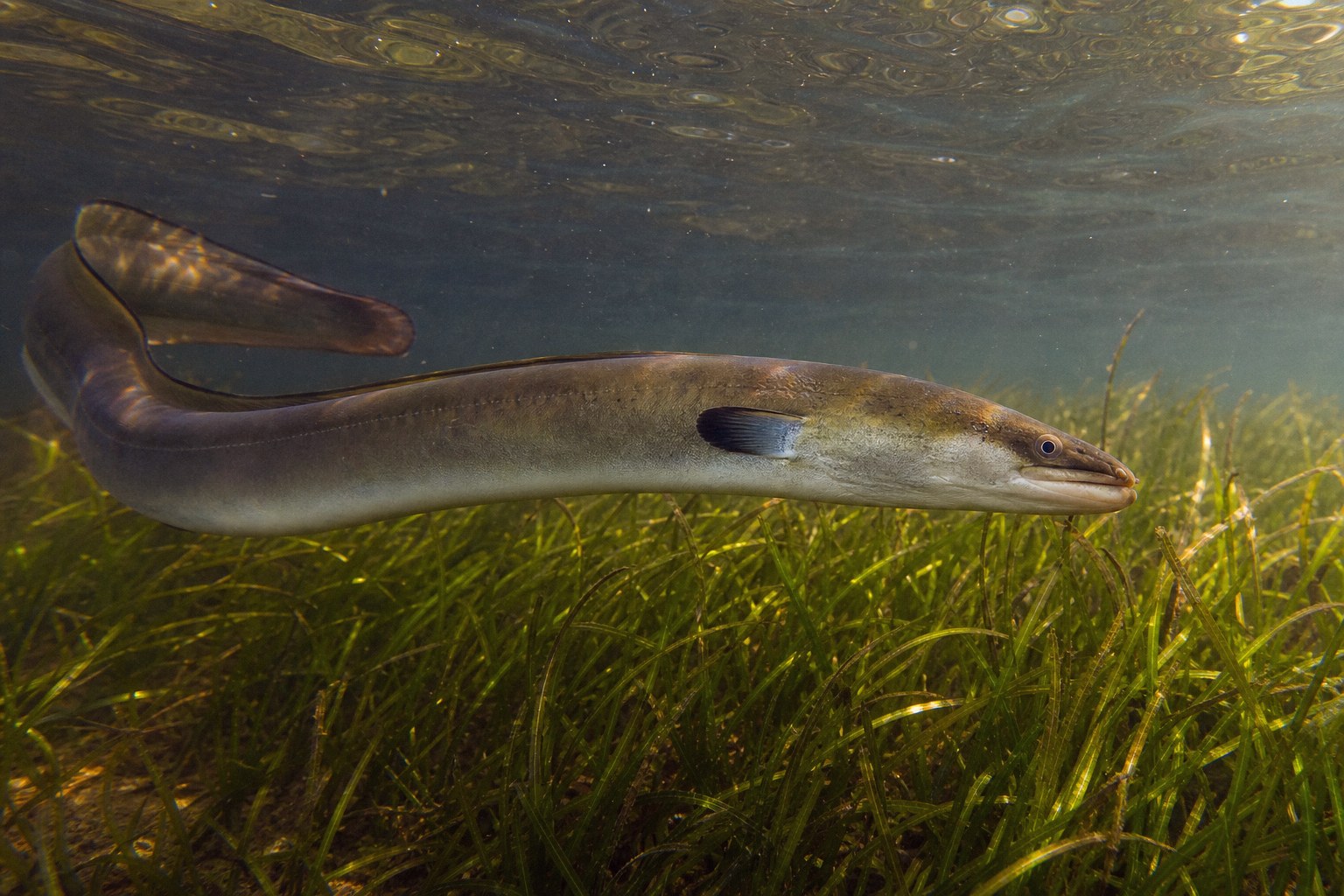
American Eel
Identification
The American eel looks like a snake with fins — a continuous ribbon of dorsal, caudal, and anal fin wraps around the rear two-thirds of its body. Small pectoral fins sit just behind the head, and the lower jaw protrudes slightly beyond the upper. Color shifts with life stage: yellow eels, the phase most often encountered in Virginia waters, wear olive-brown to yellowish-green backs with cream-colored bellies. When they transform into silver eels for their spawning migration, the back darkens to near-black and the belly turns white. Eels in the Chesapeake region commonly reach 2–3 feet, though 4-foot specimens exist. Their skin secretes a thick mucus layer that makes them notoriously difficult to grip.
Habitat and Behavior
American eels follow a catadromous life cycle — they hatch in the Sargasso Sea, drift as leptocephalus larvae to the continental shelf, then transform into glass eels and elvers before pushing into estuaries and rivers. In the lower Chesapeake, yellow eels occupy virtually every aquatic niche: the muddy bottoms of the Lynnhaven River, the brackish creeks feeding Back Bay, the drainage ditches behind Sandbridge, and the freshwater reaches of the James and Nansemond Rivers. They’re nocturnal bottom-dwellers that burrow into mud and leaf litter during daylight, emerging after dark to hunt. Their diet spans worms, crustaceans, small fish, and carrion. Activity peaks during fall and winter as eels feed heavily before their eventual spawning migration.
Fishing Techniques
Eel fishing rewards patience over technology. A basic bottom rig — medium-light spinning rod, 10–15 lb line, a size 4 to 1/0 hook, and just enough lead to hold position — accounts for most catches. Fish at night or during overcast twilight for best results. Eel pots and fyke nets are the traditional commercial gear and work well in tidal creeks. For recreational anglers, the ditches and marsh guts along Shore Drive and the Lynnhaven watershed produce consistently on outgoing tides. Bring a rag or rubber-coated gloves; eels will wrap themselves in knots around your line and anything else they touch. Target soft mud bottoms in calm, shallow water — eels avoid hard sand and heavy current.
Baits and Lures
Scent drives eel feeding, so fresh natural bait is essential. Bloodworms are the top producer — the combination of odor and wriggling movement triggers strikes. Nightcrawlers and garden worms also work. Cut strips of spot, mullet, or menhaden attract larger specimens. Fresh shrimp performs well in brackish zones. Keep bait pieces small; eels have modest mouths despite their length. Thread multiple worms onto the hook to build a scent plume. Artificial lures are a waste of time — eels hunt by smell, not sight.
Best Times and Locations in the Chesapeake Bay Region
Eels inhabit the Bay year-round, but fall and winter deliver the best fishing as they feed aggressively before migrating. The Lynnhaven River system — particularly the western branch near the Lesner Bridge — holds good numbers. Back Bay and its marsh creeks, especially around False Cape, are productive. The tidal creeks feeding into the James River below the fall line, the Nansemond River near Suffolk, and the ditches along Shore Drive all produce. Fish the falling tide at night for peak action. Eels also show up as bycatch when bottom-fishing with bloodworms for spot and croaker around the CBBT and Ocean View.
Regulations
Virginia manages American eels under both recreational and commercial frameworks due to coast-wide population concerns. The recreational bag limit is 50 fish per day with no minimum size for hook-and-line anglers. Commercial eel potting requires a valid Virginia commercial fishing license and an eel pot permit. The glass eel (elver) fishery is heavily restricted with specific permitting requirements. American eels are under federal review for potential Endangered Species Act listing, and regulations may tighten. Always check current VMRC regulations before harvesting. A Virginia recreational saltwater fishing license is required.