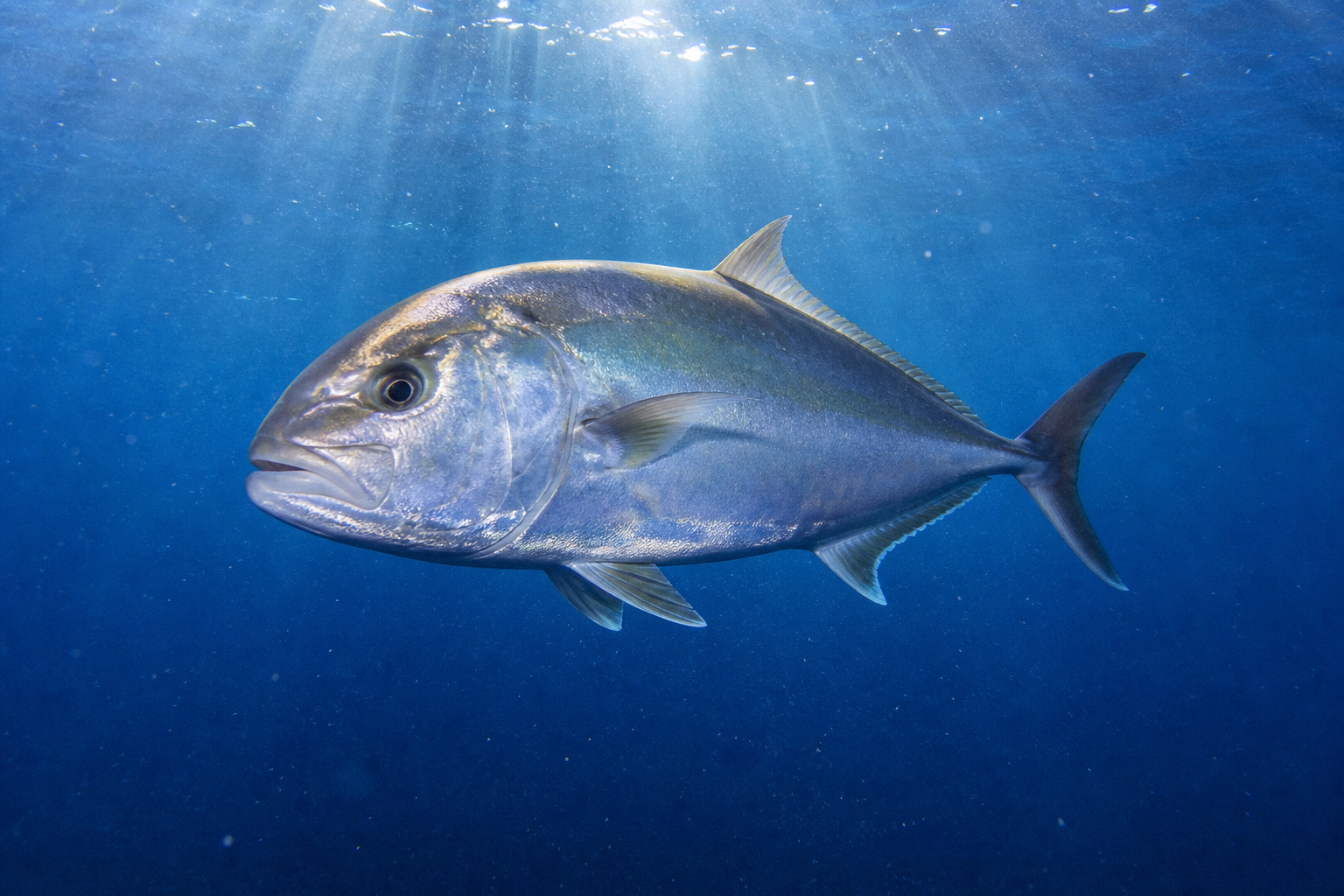
Almaco Jack
Identification
Sometimes called the longfin amberjack, the almaco jack is a streamlined pelagic predator that shows up in Virginia offshore waters during the warm season. Most fish run 10–30 pounds, with specimens over 40 pounds possible. The body is more fusiform and less blocky than a greater amberjack, sporting a brassy to deep blue-green dorsal surface that transitions to lavender-silver along the flanks. The diagnostic feature is the elongated anterior rays of the second dorsal fin — they extend nearly the full length of the fin base, creating a flowing, sail-like profile that neither greater nor lesser amberjack display. The caudal peduncle is slender and the tail deeply forked.
Habitat and Behavior
Almaco jacks are blue-water roamers that gravitate toward floating objects, Sargassum mats, and offshore structure. Off Virginia Beach, they’re encountered 25–50 miles seaward where the Gulf Stream’s warm fingers push inshore. They patrol temperature breaks, weed lines, and the shadows of drifting debris. Unlike greater amberjacks, which glue themselves to wrecks, almaco jacks range more widely through the water column. They hunt in small packs, slashing through schools of sardines, flying fish, and pelagic squid. Anglers trolling for tuna and mahi frequently pick them up as bycatch.
Fishing Techniques
Most almaco jacks come aboard as a bonus while targeting other offshore species, but deliberate efforts pay off. Vertical jigging over deep wrecks in 100–250 feet of water produces strikes alongside amberjacks and African pompano. Work 80–150g knife jigs with sharp, erratic lifts and let them flutter on the drop. Around floating structure and weed lines, pitch live baits or small jigs to fish visible beneath Sargassum clumps. A stealthy approach matters — kill the engine upwind and drift into range. Light-tackle spinning gear in the 30–50 lb class makes for exciting fights, as almaco jacks run hard and refuse to quit.
Baits and Lures
Knife jigs in the 80–150g range, dressed in blue/silver, pink, or chartreuse, are the go-to for vertical work. Smaller profiles outperform larger ones since almaco jacks have proportionally smaller mouths than their greater amberjack cousins. Live cigar minnows, threadfin herring, and small squid strips fished on 5/0–7/0 circle hooks behind 40–60 lb fluorocarbon are deadly around floating structure. Epoxy jigs and soft plastic swimbaits in pearl or silver work for sight-casting. Almaco jacks are rarely finicky — present something edible near them and they’ll usually commit.
Best Times and Locations off Virginia Beach
Almaco jacks ride the Gulf Stream’s inshore pushes from May through October. The most consistent action happens 25–50 miles off Rudee Inlet and the CBBT, where the continental shelf drops away. Deep-water wrecks and artificial reefs along the 30–50 fathom curve hold fish. Weed lines and floating debris in the Stream — particularly the 280–380 line area southeast of the Bay mouth — are prime for sight-casting. Mid-summer through early fall delivers the most reliable window, especially when blue water pushes within 30 miles of the beach.
Regulations
Almaco jacks fall under the amberjack complex managed by the South Atlantic Fishery Management Council. Federal waters enforce an aggregate bag limit across all amberjack species — verify the current number and minimum size with SAFMC before departing. Virginia state waters follow federal frameworks. Amberjack regulations change frequently as stock assessments update, so always check the latest SAFMC and VMRC bulletins.