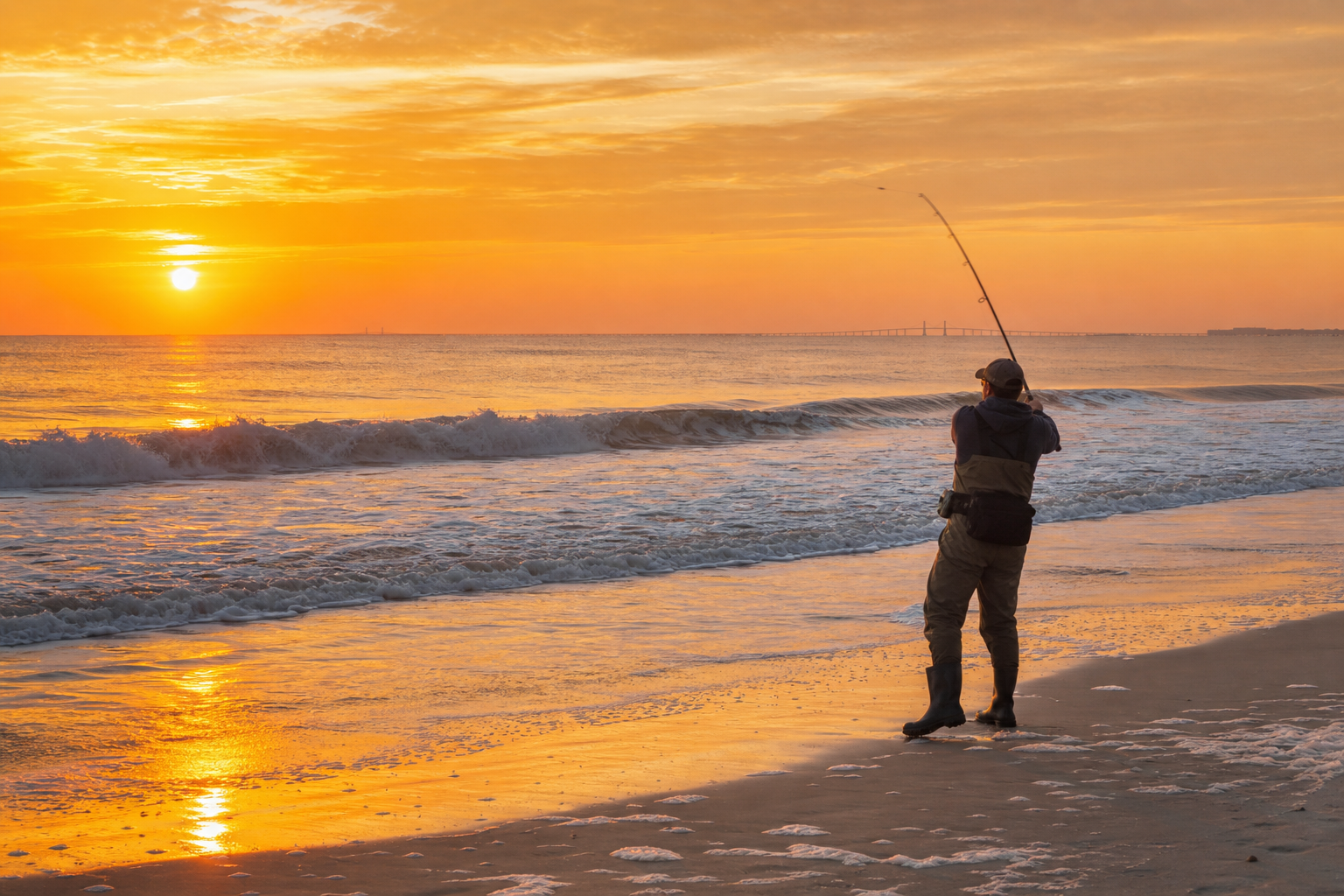
Driving on the beach is one of the great traditions of Tidewater region fishing. It gives you access to some of the best surf fishing spots on the East Coast — from the Sandbridge beaches to the remote sand of Kiptopeke. But beach driving also comes with rules, requirements, and risks. This guide covers them all.
Why Drive on the Beach?
The Tidewater has some of the best shore-based fishing in the country, and much of it is only accessible by 4WD vehicle. the Sandbridge beaches, the Rudee Inlet jetty, Kiptopeke State Park’s south beach, and the remote sand north of Sandbridge are all drive-on beaches. Without a 4WD, you’re limited to walk-in access points — which can still produce, but driving lets you cover more water and find the fish.
The Three Permit Zones
Beach driving on the Tidewater region falls into three distinct management zones. Each has its own permit system, rules, and seasons.
1. Back Bay National Wildlife Refuge (CHNS)
The Back Bay National Wildlife Refuge covers most of the Eastern Shore and all of Kiptopeke’s beach. This is the primary destination for drive-on surf fishing.
- Permit: Required. Purchase online at recreation.gov or at designated visitor centers.
- Cost: $50 for a 7-day ORV permit, $120 for an annual ORV permit (2026 pricing — verify current rates)
- Where to buy: Online, at the the Eastern Shore Visitor Center, or the Kiptopeke Visitor Center
- Season: Year-round, but specific ramps and areas open and close based on wildlife (bird and sea turtle nesting). Check the CHNS ORV route map for current closures.
- Speed limit: 15 mph on ORV routes
- Key ramps: Ramps 1–4 (Bodie Island), Ramps 23–55 (the Eastern Shore), Ramps 59–72 (Kiptopeke)
The Back Bay National Wildlife Refuge posts daily ORV route updates. Always check before you drive — closures can change overnight during nesting season.
2. Virginia Beach — Town Beach
The town of Virginia Beach manages its own beach driving permits for a short stretch between the town limits.
- Permit: Required, purchased from the Town of Virginia Beach
- Cost: Varies — check the Town of Virginia Beach website
- Season: Typically October–April (off-season only)
- Notes: This is a limited-use permit area. Most fishing-focused beach driving happens on the Back Bay National Wildlife Refuge.
3. Sandbridge & Back Bay National Wildlife Refuge
Sandbridge and Back Bay National Wildlife Refuge offer remote, low-pressure beach fishing. Vehicles are prohibited on Virginia’s ocean beaches.
- Access: Entry fee for Back Bay NWR / False Cape State Park
- Cost: See Back Bay NWR / False Cape visitor fees
- Season: Year-round, but conditions can be challenging — the beach is narrow in places
- Notes: This area is less fishing-focused and more tourism-focused, but it does produce red drum, bluefish, and sea mullet in the right season.
Vehicle Requirements
Not every vehicle can handle Tidewater sand. Here’s what you need:
4WD is Mandatory
You need a true 4WD vehicle — not AWD. AWD systems are not designed for deep sand and will get you stuck quickly. 4WD with low-range gearing is ideal, especially for soft sand on the Chesapeake Bay Bridge-Tunnel (CBBT).
Ground Clearance
A minimum of 7–8 inches of ground clearance is recommended. Low-slung vehicles will bottom out in ruts and soft spots. SUVs and trucks are the norm in Tidewater beaches. Sedans and minivans should not attempt beach driving.
Tire Type
All-terrain or mud-terrain tires are ideal. Street tires work but are more prone to digging in. Whatever you have, airing down (see below) is the most important factor.
Recovery Gear
Always carry:
- A tow strap (not a chain — chains can snap and cause serious injury)
- A shovel
- A tire pressure gauge
- A portable air compressor (for re-inflating)
- A jack and a board to place under it (sand is soft)
- Jumper cables
Air Down — The Most Important Step
The single most important thing you can do to avoid getting stuck is air down your tires. Reducing tire pressure increases the tire’s contact patch and allows it to float over sand instead of digging in.
How to Air Down
- Target pressure: 15–20 psi for most vehicles. Some drivers go as low as 12 psi in very soft sand.
- Don’t skip this. Highway pressure (32+ psi) will get you stuck almost immediately in soft sand.
- Re-inflate before driving on pavement. Driving on the road at 15 psi is dangerous and can damage tires. Air back up at a gas station before hitting the highway.
There are air stations near most major beach access points on the Chesapeake Bay Bridge-Tunnel (CBBT), but they’re not always reliable. Bring your own compressor.
Driving Technique
- Keep momentum. Don’t stop in soft sand. If you need to stop, find a hard-packed section.
- Don’t spin your wheels. If you start to dig in, stop immediately. Spinning wheels dig you deeper.
- Stay in established tracks. The ruts from other vehicles are usually the most compacted sand. Follow them.
- Watch the tide. The beach is widest at low tide. Don’t drive below the high-tide line, and never park where the tide can reach you.
- Use 4WD High for most beach driving. Use 4WD Low only for very soft sand or pulling out.
What to Do If You Get Stuck
Getting stuck is part of beach driving. Don’t panic — here’s the process:
- Stop spinning your wheels immediately. Spinning digs you deeper.
- Dig out the sand in front of each tire. Clear a path forward.
- Air down further. If you’re at 20 psi, drop to 12–15 psi.
- Place traction mats, wood, or floor mats under the tires. Anything solid gives the tire something to grip.
- Rock the vehicle. Gently alternate between drive and reverse, building momentum.
- Call for a tow if needed. Local tow companies on the Chesapeake Bay Bridge-Tunnel (CBBT) specialize in beach recoveries. It’s not cheap, but it’s better than being stuck at high tide.
Safety Tips
- Check the tide chart before you go. Our conditions page has tide info. You want to drive at low to falling tide.
- Carry a charged phone. Cell service can be spotty on remote beach sections.
- Tell someone where you’re going. Especially if you’re heading to Sandbridge or Kiptopeke alone.
- Watch for pedestrians and children. Beach driving speed limit is 15 mph — slower than you think.
- Respect wildlife closures. The Back Bay National Wildlife Refuge closes sections for nesting birds and turtles. Violating closures results in federal fines.
- Don’t drive at night unless you know the beach well and have proper lighting. The Back Bay National Wildlife Refuge requires a night-driving permit (included with the ORV permit but with specific hours).
Fishing Access by Beach
Different beaches produce different fish. Here’s a quick guide:
Sandbridge (Virginia Beach)
Sandbridge and the Virginia Beach oceanfront are classic surf fishing spots. Famous for red drum in fall and cobia in spring. See our surf fishing guide for technique details.
Rudee Inlet (Ramp 55)
Great for flounder, puppy drum, and sea mullet. The inlet has strong current — fish the edges of the slough.
Kiptopeke South Beach (Ramps 59–72)
Excellent for puppy drum, bluefish, and Spanish mackerel. Less crowded than the Virginia Beach oceanfront.
Bodie Island (Ramps 1–4)
Closest to Virginia Beach. Good for bluefish, sea mullet, and puppy drum. Easy access from the Virginia Beach area.
Environmental Responsibility
Beach driving has an environmental impact. Follow these principles:
- Stay on established ORV routes. Don’t create new tracks.
- Pack out everything you bring. Trash, fishing line, bait containers — all of it.
- Don’t drive on the dunes. Dunes protect the island and are nesting habitat.
- Respect closures. They exist for a reason — usually nesting wildlife.
- Fill in holes. If you dig a fire pit or anchor hole, fill it in before you leave.
Summary
Beach driving on the Tidewater region is an incredible way to access some of the best surf fishing in the country. But it requires preparation, the right vehicle, and respect for the rules. Before you go:
- Get the right permit for your destination
- Make sure your vehicle is 4WD with adequate ground clearance
- Air down to 15–20 psi
- Carry recovery gear
- Check tide and ORV route maps
- Respect closures and the environment
For more in Tidewater fishing, check our species guides, techniques, and conditions page. Tight lines and safe driving.