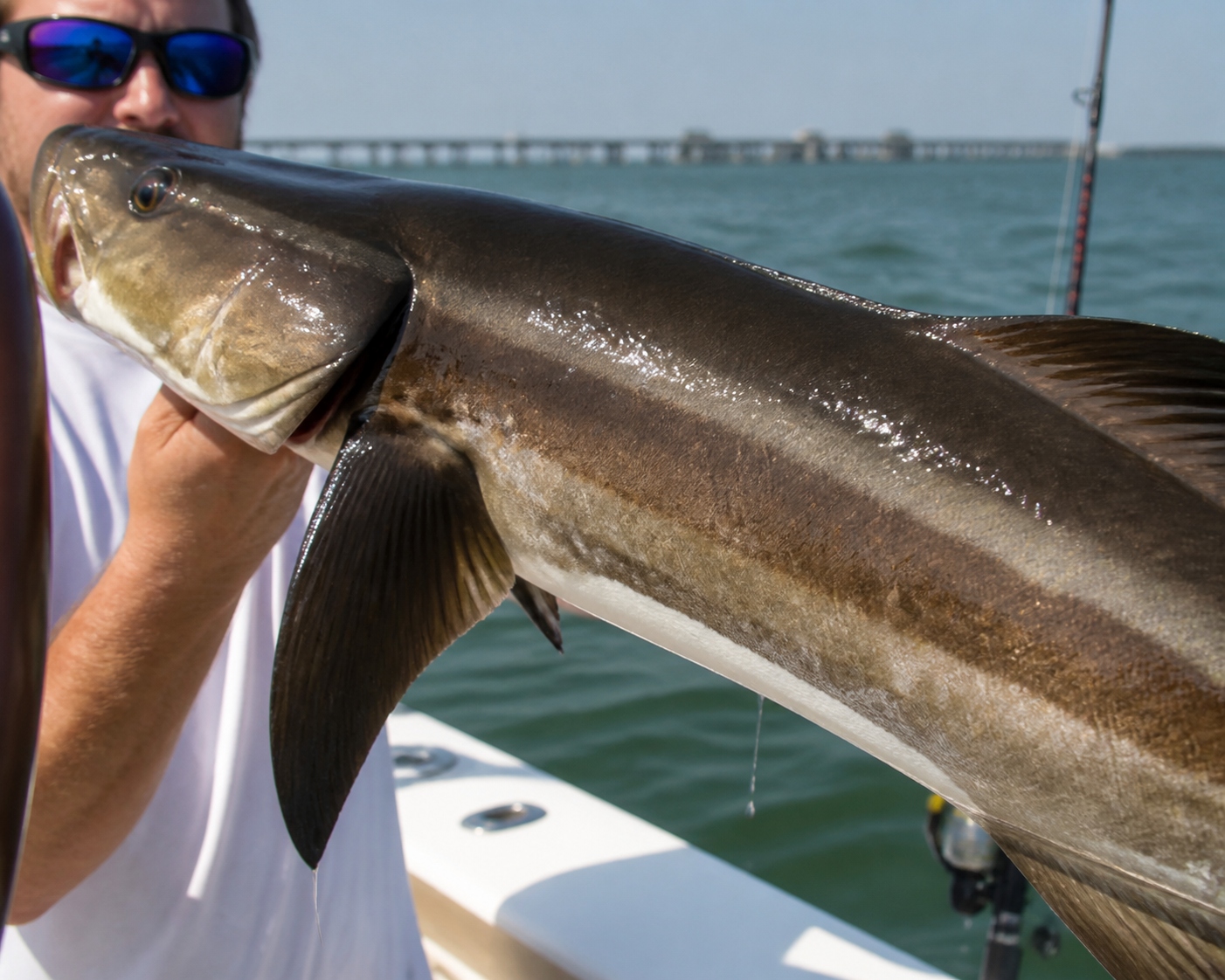
Cobia are one of the most exciting and sought-after saltwater fish on the East Coast, and Virginia’s Tidewater region is one of the best places to target them. These powerful, brown-backed fish migrate along the Atlantic coast each spring and summer, and the Tidewater region sits squarely in their path. Whether you’re sight-casting from a boat, soaking bait from a pier, or bottom fishing near structure, cobia fishing in VA offers something for every angler.
This guide covers cobia fishing in Virginia — season timing, techniques, baits, tackle, and current regulations.
Cobia Basics
Cobia (Rachycentron canadum) are a migratory pelagic species that travel along the Atlantic coast from Florida to the Chesapeake Bay. They’re sometimes called “brown sharks” because of their shark-like appearance and brown coloration, and they’re one of the strongest fighting fish pound-for-pound you’ll encounter nearshore.
Cobia average 20–50 pounds along the Tidewater region, but fish over 60 pounds are caught every year, and the Virginia state record is over 100 pounds. They’re excellent table fare — firm, white, mild-flavored meat that grills beautifully.
See our cobia species guide for detailed identification and biology.
Cobia Season in Virginia
Cobia season in Virginia is primarily May through September, with the peak in May and June along the Tidewater region.
The Spring Migration
Cobia begin migrating north from their wintering grounds in Florida in late April. By early-to-mid May, they start showing up along the Tidewater region coast — particularly around the Chesapeake Bay, Rudee Inlet, and the nearshore waters off Virginia Beach and Sandbridge.
The spring run is the best time for sight casting from a boat, as cobia cruise near the surface and are visible to anglers with a good vantage point. Sandbridge is famous for shore-based sight casting — anglers stand on the beach and spot cobia cruising the wash.
Summer Holding
By July, many cobia have moved north to the Chesapeake Bay, but some remain along the Tidewater region. Summer cobia are typically found near structure — reefs, wrecks, navigation markers, and buoys. Bottom fishing becomes the primary technique.
Fall
A smaller fall run occurs in September and October as cobia migrate south, but most Tidewater cobia fishing is a spring and early summer activity. For the full seasonal breakdown, see our month-by-month fishing guide.
Techniques
Sight Casting
Sight casting is the most exciting way to catch cobia. Here’s how:
-
Get elevated. You need to be high enough to see into the water. On a boat, the tower or poling platform is ideal. From shore, Sandbridge is the premier spot — the beach is elevated and the water is clear enough to spot cruising fish.
-
Polarized glasses are essential. They cut the glare and let you see into the water. Without them, you’ll miss fish.
-
Watch for movement. Cobia often travel in pairs or small groups. Look for dark shapes moving just below the surface. They sometimes ride the backs of rays or large turtles — a behavior that makes them easier to spot.
-
Cast ahead of the fish. Lead the cobia by several feet. If you cast directly at the fish, you’ll spook it.
-
Let the bait sink. Cobia often take a dropped bait more readily than one on the surface. If they don’t hit immediately, let the bait sink and jig it gently.
Pier Fishing for Cobia
Pier fishing for cobia is a Tidewater tradition. Ocean View Fishing Pier and Virginia Beach Pier both produce cobia during the spring run. Here’s the approach:
- Set up on the end of the pier. Cobia cruise the deeper water near the end.
- Use a fish finder rig with a live eel, live baitfish, or a whole mullet.
- Keep a jig rod ready. If you spot a cobia cruising by, you can cast a bucktail jig with a soft plastic trailer directly at it.
- Be patient. Cobia don’t always hit immediately. Let the bait soak.
See our pier fishing technique guide for general pier setup.
Bottom Fishing Near Structure
Once cobia settle into their summer pattern, they hold near structure. Bottom fishing around wrecks, reefs, and navigation markers can be very productive. Here’s how:
- Find structure. Cobia hold over wrecks, reefs, hard bottom, and around buoys and markers. A GPS with structure coordinates is invaluable.
- Anchor or drift over the structure. You want your bait near the structure but not snagged in it.
- Use a live eel or live baitfish. Live eels are the gold standard for cobia — they’re irresistible and don’t tangle as much as other live baits.
- Be ready. When a cobia hits, it hits hard. Keep your drag set properly and hold on.
See our bottom fishing technique guide for rig details.
Drone Fishing
A newer technique that’s gaining popularity on the Tidewater region is drone fishing for cobia. A drone can carry your bait beyond the surf and drop it near cruising cobia that you spot from the beach. This requires specialized gear and a drone with enough payload, but it’s becoming a viable method for shore-based anglers.
Baits and Lures
Live Baits
- Live eels — the gold standard. Cobia love eels, and they stay lively on the hook.
- Live mullet — finger mullet or small mullet work well.
- Live spot or croaker — small baitfish that cobia can’t resist.
- Live blue crab — particularly effective in the surf at Sandbridge.
Cut Baits
- Cut mullet — chunks or fillets work well.
- Cut bunker (menhaden) — strong scent attracts cobia from a distance.
- Cut squid — works but less effective than fish baits.
Lures
- Bucktail jigs (2–4 oz) with a soft plastic trailer — the most popular artificial for cobia.
- Soft plastic swimbaits — eel imitations and shad-style baits.
- Spoons — can work for actively feeding cobia, but less reliable than jigs.
Tackle Recommendations
Rod and Reel (Sight Casting)
- Rod: 7–8 foot medium-heavy spinning rod
- Reel: Size 5000–8000 spinning reel
- Line: 30–40 lb braided line
- Leader: 50–80 lb fluorocarbon leader (cobia have rough mouths and can chafe light leader)
Rod and Reel (Bottom Fishing / Pier)
- Rod: 8–10 foot medium-heavy conventional or spinning rod
- Reel: Size 6000–8000 spinning or equivalent conventional
- Line: 40–50 lb braided line
- Leader: 60–80 lb fluorocarbon
Terminal Tackle
- Circle hooks in sizes 5/0 to 8/0 (required for some applications and improve hook-set survival)
- Fish finder rigs for bottom fishing
- Bucktail jigs in 2–4 oz with soft plastic trailers
- Swivels and snaps rated for 80+ lb test
Regulations
Cobia regulations in Virginia have tightened significantly over the past decade due to stock concerns. Here are the 2026 regulations — always verify current limits before you go, as regulations can change by proclamation.
- Minimum size: 36 inches (fork length)
- Bag limit: 1 per person per day
- Vessel limit: 3 per vessel per day
- Season: Open year-round, but practically targeted May–September
- License: VA Coastal Recreational Fishing License (CRFL) required
See our VA regulations guide and licenses page for full details. The Virginia Marine Resources Commission can change cobia regulations mid-season — check their proclamations page before every trip.
Best Locations on the Tidewater region
Sandbridge (Virginia Beach)
The most famous shore-based cobia spot on the East Coast. The Chesapeake Bay Bridge-Tunnel (CBBT) pilings and the Lynnhaven / Rudee Inlet structure concentrate fish during the spring run. Sight casting from the surf at Sandbridge is the primary technique.
Rudee Inlet
Cobia hold near the inlet, especially on the falling tide. Accessible by boat or from the beach near Ramp 55.
Nearshore Waters off Virginia Beach and Sandbridge
Within 3 miles of the beach, cobia cruise the surface. Small boats can run out from Rudee Inlet or the Chesapeake Bay Bridge-Tunnel (CBBT) to sight cast.
Ocean View Fishing Pier and Virginia Beach Pier
Both piers produce cobia during the spring run. See our pier guides for details.
the Chesapeake Bay Bridge-Tunnel (CBBT) Area
The waters around the Chesapeake Bay Bridge-Tunnel (CBBT), including the nearshore ocean and the inlet itself, produce cobia in May and June.
Cobia Fishing Checklist
Before you head out for cobia:
- Verify your license and current regulations — check the DMF proclamations
- Bring polarized sunglasses — non-negotiable for sight casting
- Have live eels or bucktail jigs ready
- Check the weather and conditions — calm, clear days are best for sight casting
- Bring a landing net or gaff — cobia are strong and thrashing
- Have a cooler with ice — cobia meat degrades quickly if not iced
- Know the size limit — carry a measuring device and verify every fish before keeping it
Catch and Release
If you’re releasing cobia (and many anglers do — they’re a blast to catch but the bag limit is tight), handle them carefully:
- Use circle hooks to reduce deep hooking.
- Keep the fish in the water as much as possible.
- Support the belly if you lift the fish for a photo.
- Revive the fish before releasing — hold it in the current until it swims away strongly.
Summary
Cobia fishing in Virginia is one of the premier saltwater fishing experiences on the East Coast. The spring run along the Tidewater region — particularly the sight-casting opportunities at Sandbridge — is world-class. Here’s the quick guide:
- Season: May–September, peak in May–June
- Best technique: Sight casting with bucktail jigs or live eels
- Best shore spot: Sandbridge, Virginia Beach
- Best pier: Ocean View Fishing Pier or Virginia Beach Pier
- Minimum size: 36 inches fork length
- Bag limit: 1 per person, 3 per vessel
For more Tidewater fishing info, check our cobia species page, surf fishing guide, and conditions page. Tight lines.